

Lots of folks head to the beach for spring break, but this year,
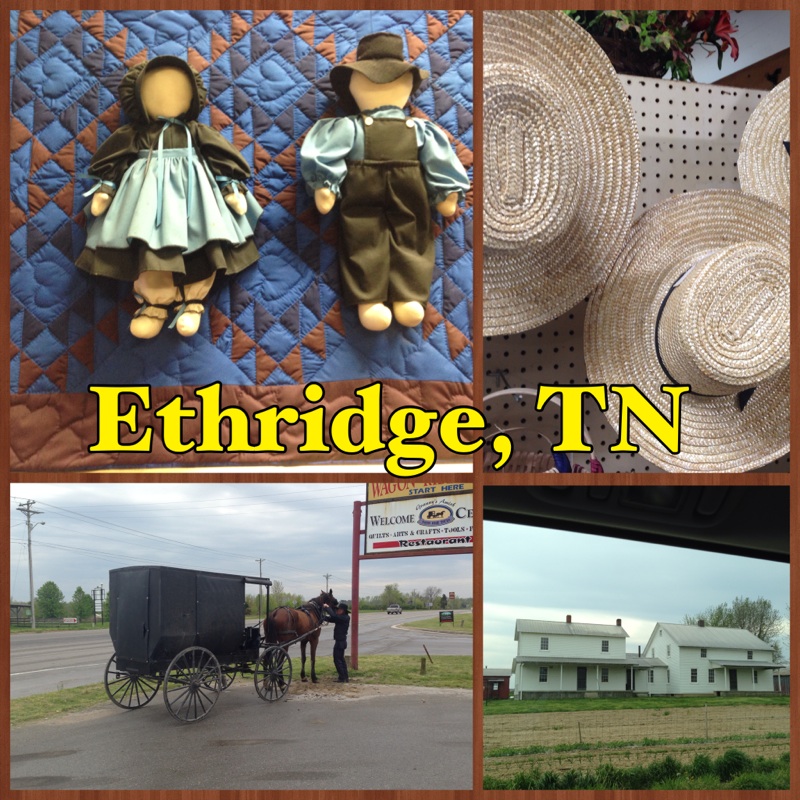
my destination was Ethridge, Tennessee. The small town, located about eighty miles southwest of Nashville, is home to the largest Old Order Amish community in the
South.


The Amish raise chickens, pigs, and cattle. The corn they grow is feed for their livestock. Tobacco is a
popular crop. They also train horses for the English and build furniture, porch swings, gazebos, cedar chests, lawn furniture and more.


A few days before Easter, I submitted a new proposal to my editor
for an Amish Suspense Trilogy. The fictional community I’ll feature in my
stories is situated in the North Georgia Mountains, and the original Amish who
settled in my made-up community came from Ethridge. While some Amish groups
have eased their stance on technology, especially when dealing with English businesses and customers, the
Swartzentruber line, of which Ethridge is a part, have remained extremely conservative. That means no indoor plumbing or any use of electricity or propane, even in their wood shops, dairies and sawmills.

My husband and I left the Atlanta area on Tuesday, April 5, and
took back roads to Cullman, Alabama, where we spent the first night. The next
morning, we traveled north on Interstate 65 to Tennessee, then turned west
onto State Highway 64 and drove to Lawrenceburg. While researching our trip, I
found information about the Richland Inn, which appeared to be the nicest
accommodations in the area, and made reservations. Our room was newly renovated
and very comfortable.
 |
| This Amish man stopped at the Welcome Center soon after we arrived. I chatted with him inside. He was young, with red hair and a sweet smile. |
In spite of my pre-planning, I couldn’t control the weather. The
day was gray and rainy, with high winds and storms predicted to hit later in
the afternoon. As we hurriedly headed on to Ethridge, we passed a number of
Amish horse and buggies trotting along the roadway.
 |
| Sue (left) and Jana (right) work at the Amish Welcome Center. |
Ethridge is a tiny town, not much more than a crossroads, and we
quickly spotted the Amish Welcome Center. Sue and Jana greeted us warmly,
and we were soon talking about books, especially Amish stories, and favorite
authors. The store was packed with souvenirs, homemade jellies and
jams, antiques and second-hand consignments, including the Amish straw hat and
black bag that Amish women use as a diaper bag, pictured below.
 |
| Amish ladies pack baby bottles and diapers in the black tote. |
We had called ahead to arrange a tour, and Jimmy Martin, our
guide, met us at the Welcome Center. Jimmy grew up in the local area, knows the
Amish people and hosts tours in an open wagon he built himself. Convinced
that the weather wasn’t going to improve, we grabbed raincoats from our car and
climbed into Jimmy’s wagon. In the spring and summer, his tour wagon is packed
to capacity with sightseers, but due to the weather, we had a private tour
and Jimmy’s undivided attention. The hour he usually allots turned into a
delightful three-hour excursion where we got to meet and talk to a number of
the local Amish folks.
 |
| Leaving the Welcome Center and heading toward the Amish farms. Notice the rain drops on the plastic windshield. |
The Ethridge Amish community is made up of 250 families. The farms—each
consisting of roughly 50 acres—spread out for miles on each side of Highway 43.
The first floor of a typical Amish home has a living area and main
bedroom where the parents sleep. The kitchen usually sits as a one-story
extension in the rear of the house. The upstairs is divided into two large
rooms, one for the boys and the other for the girls.
 |
| The kitchen appears to be on the rear left of this house. |
A wood stove in the main room, similar to the one below that we saw
in a woodworking shop, heats the first floor. Holes are drilled in the ceiling
so the warmth rises to the second story. The wood shed is a small, covered
building behind the main house, and the outhouse is usually located behind
the wood shed.
 |
| Wood burning stove found in homes and shops. |
A water pump sits outside near the kitchen. Some are hand operated, and
others use small diesel motors to help draw the water. A plastic cup was hung
over the pumps we saw, for a quick drink on a hot day. Glass jugs filled with
milk chilled nearby in buckets of well water. The cows and goats are milked
twice a day, and the cool well water keeps the milk fresh, even in the summer.
The Amish eat goats, and the goat milk is given to infants who can’t tolerate
their mother’s milk or milk from the dairy cows. Cream is placed in glass jars,
and the children’s job is to shake the jars to produce butter.
 |
| Two houses sitting side-by-side is common. One belongs to the parents and the other to the son and his family. |
 |
| Road signs direct customers to local shops. |
The woman sell peanut brittle, fudge, cookies, jams and jellies.
They also make soap, although Jimmy said they buy detergent
from Walmart to use on their own clothing. They can meat and vegetables and buy any staples they don’t produce on the farm.

According to Jimmy, eighty people can build a house in a day. The
farmer buys the wood from the local sawmill that’s owned and operated by an
Amish family. He’ll have the window and door frames ready, and the cement slab
poured before the families arrive on the house raising day. The men construct the house while the woman prepare a huge lunch that everyone enjoys.
 |
| A closeup view of the school house. Children get up at 4:30 AM to do chores before school. They bring a lunch from home, and head back to the farm for more chores at the end of the school day. |
The community has many one-room school houses situated about a
mile apart. Families go together to support the school nearest to their farms,
and an older teenage girl is chosen to be the teacher. Children speak
Pennsylvania Dutch at home and learn English when they attend school. Their
education extends through the eighth grade. We visited Ethridge at the
beginning of April, and schools were already out for the summer so the boys
could help with the plowing.
 |
| The Amish schoolhouse from a distance. |
Jimmy stressed the differences in the Amish way of life,
especially for children. There are no birthday celebrations or Christmas
presents and no toys. The children help with chores from an early age. Three
and four-year-olds care for the babies, and seven and eight-year-old boys plow
the fields. All children wear dresses and bonnets until about age two, after which boys are dressed in trousers. At one of our stops,
young children with rosy cheeks stared wide-eyed out the window at us. When I
waved, they bashfully ducked their heads.
 |
| The local sawmill owned and operated by an Amish family. |
The Amish don’t coddle their children, according to Jimmy. Parents
occasionally go to town for dinner, usually at all-you-can-eat buffets. The
infants will accompany them and perhaps one or two of the older children. The
others remain at home. Sometimes the parents will travel to visit distant
relatives for a week or so. The children stay at home and keep the house and
farm running smoothly while the adults are away.
 |
| We waved to each buggy that passed, and the Amish driver always waved back. |
Twenty-one is the age most couples marry. They court and marry in
winter before the spring planting. All “dates” are chaperoned, and their usual
outings are rides in open-top carriages. Adult children work at home or on
their parents’ farm but do not get paid until their twenty-first birthday. At
that time, they’re expected to pay rent if they continue to live at home.
 |
| I had to take a picture of this little foal. The Amish families usually own about 15 horses. |
We stopped at three farms to buy baked goods and baskets. I met
Anna, a grandmother who was on her way to the grocery in Lawrenceburg. She wore
a black bonnet and a heavy shawl she had cut from black knit fabric and pinned
together with three large safety pins.
 |
| Wash hangs on the line. See the slanted addition at the rear of the house? That's the kitchen, located away from the main living area. |
Her ten-year-old granddaughter, Emma, waited on us as we picked
out baskets to buy. Emma wore a two-piece brown, ankle-length dress. The blouse
was held together with straight pins. An apron wrapped around her slender waist
and nearly covered the calf-high rubber boots she (and the other children)
wore. The young girl stole my heart with her wide smile and twinkling eyes. Her
brother, Manuel, one year older, wore a straw hat, blue waist-length jacket and
blue trousers with the same style rubber, mud boots. He had a pensive gaze and
stood back and watched as I chatted with his sister. Eventually, he stepped
closer and joined in the conversation.
 |
| Bent hickory rockers wrapped in plastic and stacked one atop the other, waiting to be transported to Alabama. |
At our next stop, we toured a wood working shop. The saw, lathe
and drill were run by diesel. Sawdust was piled high in one section of
the shop and would be used as mulch for their gardens, as bedding in their stables and
to start the fires in their wood stoves.
 |
| An Amish woodworker's shop. |
I chatted with a young married woman at our third stop. She wore
the typical two-piece long dress with apron and a pinafore over her blouse. She
also had a triangular headscarf tied under her chin, like a Polish babushka.
She said ladies often wear scarfs, instead of a bonnet, when they’re in their
homes. We discussed the pretty color of her outfit, which we decided was
eggplant.

I also met Lydia Yoder, a widow who invited me into her house.
She showed me her wood-burning cook stove, and we talked about baking and
regulating the oven temperature. I bought a few of her baskets and have written
her, hoping she’ll write back.
 |
| Jimmy's team after we returned from our tour. Notice the sky had cleared, and the sun was shinning! |
Our visit to Ethridge was even better than I had hoped. Jimmy
provided so much information and being able to talk to the Amish and visit
their farms and homes was a special treat. As you probably know, the Amish are
opposed to having their photographs taken, which they claim are graven images. I was able to snap
some shots of their homes and workshops, but never when they were nearby.
 |
| Thanks, Jimmy, for a great tour! |
On our drive back to Atlanta, I received an email from my agent with good news. Emily Rodmell, my talented editor at Love Inspired Books, loved the three-book
Amish proposal and offered me a four-book contract. In addition, Stranded, my March 2015 release, will be reissued in a two-for-one
with Emma Miller’s Amish story, Miriam’s
Heart, in July.

Leave a comment about research trips, your Amish experiences, or
what you found interesting in today’s blog to be entered in the drawings. I'll give away copies of Plain Danger, along with an extra surprise gift to two lucky winners.
Wishing you abundant blessings,
Debby Giusti

PLAIN DANGER
By Debby Giusti
DANGEROUS
INHERITANCE
When Carrie
York arrives at the house she inherited from her father in an Amish community,
she's shocked to discover a soldier's body on the property. Her neighbor, army special
agent Tyler Zimmerman, starts investigating the murder, and Carrie fears it's
related to her father's mysterious death. Tyler doesn't trust the pretty
speechwriter or the suspicious timing of her arrival—especially since her boss
is responsible for his father's death. But when someone attacks Carrie, Tyler
insists on protecting her. With his help, will Carrie be able to hold on to her
inheritance and her life?
Order
your copy HERE!

Stranded,
by Debby Giusti, and Miriam’s
Heart, by Emma Miller.
