Showing posts with label the business of writing. Show all posts

Tuesday, August 8, 2017

10 Traits of Successful Writers


Pondering what to blog about today got me thinking about the attributes of successful writers, so I came up with a Top 10 list. Maybe you’ll find some of these descriptions as motivational (and, in some cases, as convicting) as I do.

Trait #1. Writers write. You get a story idea, but you haven’t settled on the best way to begin, so . . . you don’t. Sure, you may be uncertain where to start, but if you don’t start somewhere, the book will never get written. You can always go back and fix things during revisions. The important thing is not to get hung up on getting it right the first time, because that’s paralyzing. Just write!

Trait #2. Writers finish what they start. I know, I know. It’s way too easy to get sidetracked by glittery new ideas you’re eager to pursue, or finding yourself bogged down in the middle of the story without enough energy (or interest?) to push through to the end. Make some notes for future reference and then ignore those other ideas for the time being. Because, especially for unpublished writers, it’s next to impossible to sell an unfinished manuscript.

Trait #3. Writers don’t wait to feel inspired or until they’re “in the mood” to write. If you’re waiting for the perfect state of mind or that elusive burst of inspiration, you could be waiting a long, long time. If you want to make money as a published author, you have to approach writing in a businesslike manner. Schedule writing time, and when that time rolls around, make sure you’re in your chair with fingers on the computer keys. This is your job, so treat it that way.


Trait #4. Writers identify their target audience and focus on them. When I first started out writing for magazines, I sent off for scads and scads of sample copies and writers guidelines. This was back in the day when snail mail ruled, so I racked up some hefty postage bills. But studying those sample issues gave me insight into whom the magazines were targeting, what kinds of topics the editors looked for, average article word count, and so much more. Even the advertisements offered clues about the reading audience and their interests. Novelists should be prepared to do an equal amount of market study. Visit publishers’ websites. Pick a similar book to your own and scan Amazon’s “also bought” feature. Read reviews. Check out book blogs to see who’s commenting and what those comments say about the readers.

Trait #5. Writers master basic grammar. Okay, do I have to get Grammar Queen on your case? Because I will, you know! If you don’t trust your own skills to catch grammar errors, enlist the aid of a proofreader whose knowledge you trust. Words, sentences, punctuation—those are the tools of our trade. You don’t want glaring grammar mistakes blowing your chances of an acceptance.

Trait #6. Writers continually study their craft. If you need to brush up on topics like single point of view, characterization, story structure, etc., just check the labels over on the right. You’ll always find plenty of helpful instruction right here in Seekerville. Attend conferences and workshops. Invest in some good craft books, check them out at the library, or borrow from your writer friends. (Have you seen my office bookshelves???)


Trait #7. Writers trust the vision. Having a critique partner or two or three can be helpful, provided you respect them both as individuals and as writers. But bear in mind that everyone has an opinion, and the more opinions you solicit, the more varied those responses are going to be. Take it from someone who’s been there—too many opinions can confuse you so much that you lose your grip on your own vision and voice. Limit yourself to feedback from the people you trust the most, and even then, weigh their comments against your own best judgment.

Trait #8. Writers take the long view. Especially when you’re first starting out, it can be all too tempting to jump at the first offer of a publishing contract or agent representation. (Can you hear Sally Field’s Oscars speech in your head right now? “You like me! You really, really like me!”) But be patient. Don’t get locked in with a bad deal—an unfairly slanted contract or an agent who turns out not to be the right fit. Building a successful writing career takes time. Plan wisely.

Trait #9. Writers take responsibility for their own marketing. Whether traditionally or independently published, we can’t escape this crucial part of the business. A professionally designed website is not a frivolous investment. Make sure it showcases who you are and is easy to navigate. If you blog, make sure you’re offering useful information for the readers you want to attract. Use social media for developing relationships and not just to sell books. Get to know your local booksellers and librarians, because you want them on your side!

Trait #10. Writers don’t quit. So it’s taking a lot longer than you thought it would and the long-awaited book contract hasn’t materialized. Or you’ve published several books but the sales numbers are unimpressive if not downright dismal. It’s hard to watch your writer friends’ careers going gangbusters while yours seems to be creeping along at a snail’s pace. But quitting? When you have no idea what could be waiting just around the bend? Take it from someone who, after 25 years of collecting book rejections, was this close to walking away before I got “the call.” That was nine years ago this month, and in just a couple of weeks, my twentieth published book officially releases! If you can quit, then . . . okay. But if you’re hardwired to be a writer, then stay true to the work God called you to. Be patient, keep writing, and wait for His perfect plan to unfold.

Writers, which of these traits causes you the most struggle? Which comes easier? If you need to make some changes, what steps can you take?

Readers, are there aspects of these traits that could apply to your daily life? Please share!

Any other traits you’d add to my list?

Join the conversation in the comments and mention your interest if you’d like to be entered in a drawing for either or both of today’s two giveaways: my very first published novel, One Imperfect Christmas, or my twentieth book in print, Her Hill Country Cowboy


About Myra: Award-winning author Myra Johnson writes emotionally gripping stories about love, life, and faith. Myra is a two-time finalist for the prestigious ACFW Carol Awards, winner of Christian Retailing’s Best for historical fiction, and winner in the Inspirational category of the National Excellence in Romance Fiction Awards. Originally from Texas but now residing in the beautiful Carolinas, Myra and her husband love the climate and scenery, but they may never get used to the pulled pork Carolinians call “barbecue”! The Johnsons share their home with two very pampered doggies who don’t always understand the meaning of “Mom’s trying to write.” They have also inherited the cute little cat (complete with attitude) their daughter and family had to leave behind.
Twitter: @MyraJohnson and @TheGrammarQueen 
Sign up to receive Myra’s quarterly e-news updates here!

Wednesday, June 7, 2017

Navigating the Unpredictable Sea of Publishing

 with Guest Connie Mann


I’m delighted to be back at Seekerville and hope to offer some encouragement, no matter where you are in your writing career.  (I’m a USCG-licensed boat captain in my non-writing life, so I hope you won’t mind the nautical terms.)

Over the years, whenever I’ve asked publishing veterans about the industry, they’ve all said essentially the same thing: publishing is hard--it’s always been hard.

I don’t doubt it, but it seems today, it’s a different kind of hard.

Publishing used to be more predictable. There was the occasional unexpected squall, of course, but authors sailed down fairly predictable routes.

That seems to have changed. Radically. Now we paddle like crazy on stormy seas of uncertainty, with nary a break on the horizon. It’s enough to make a writer seasick.

With the explosion of indie publishing, authors have more avenues to get their books into the hands of readers than ever before. Which is wonderful and amazing and not to be discounted. But like most good things, there is a tradeoff, as going the indie route has its own challenges.  At the same time, there are less options for traditional publishing. Houses have merged and streamlined and too often, have closed lines entirely, as with the recent announcement from Harlequin. That kind of unexpected wave can toss a writer into icy, uncharted depths, flailing about for solid ground.

If your career and plans have been swamped by a rogue wave, know that you are not alone. Ask any writer who’s been around a while, and they’ll tell you stories. I’ve been there, too, several times. I’ve weathered two line closures and two different contracts that suddenly sank, and it’s scary, discouraging stuff. To make matters worse, while I was struggling to get back into the boat, the doubt gremlins were standing on shore, taunting me with all manner of lies--instead of throwing me a life ring, the dirty rotten scoundrels.

Here are a few of the navigation beacons I cling to when this crazy business tosses me around.


Trust the lighthouse

The Great Creator stands as solid and unmovable as a lighthouse on a rocky cliff. Even when it’s stormy, the lighthouse stands. It doesn’t move, hasn’t stopped lighting our way.

It’s a huge comfort to know that God’s love for us never changes, either, even on days we don’t feel it, or don’t feel anything at all. One of my favorite verses is this one:

“For I know the plans I have for you,” declares the Lord, “plans to prosper you and not to harm you, plans to give you hope and a future.” (Jeremiah 29:11)

Just because things feel out of our control, they are never out of His.


Set a new course if necessary

They say the definition of insanity is doing the same thing, but expecting different results.

The market is changing faster than most of us can keep up with. What sold last year isn’t selling this year. What worked in promotion six months ago, isn’t working now. It’s enough to make me want to climb into bed and pull the covers over my head.

But that won’t help. Take time to evaluate what you’re doing. If the current path isn’t getting you anything but gray hair, maybe it’s time to try something new, in big and small ways.

Take the helm

As much as I would love it if God sent me an email every day, outlining exactly what I should do, it hasn’t happened yet. So I have to make decisions and choices—and so do you. The harsh reality is that God can’t steer your ship if you’re up on dry land. You have to take action, leave the shore and take risks, try things. And above all, write. You can’t sell what you haven’t written.


Keep an Eye on the Sky

Publishing—and life itself—is all about change. If you’re in a really good place right now, enjoy every single minute to the fullest. Because inevitably, another storm will blow in. That’s life.  

But the good news is that the reverse is also true. When the storm is really bad, hold tight, because it won’t be like this forever, either. Promise.

Grab a life ring

I’m not telling any of you anything new, but sometimes, we need to be reminded of it. And we need connection. I’ve had some unexpected, deep conversations with fellow writers recently, ones that went all the way down to the hard stuff, the scary stuff. It was such a huge relief to know I wasn’t the only one going through these things. Talk to your writer friends. They can understand and encourage in ways no one else can. Feel free to contact me, too. I will be cheering you on.

Stay the course, friends. Together, we’ve got this.


What about you? I’d love to hear how you stay afloat when publishing gets stormy.

GIVEAWAY! Let us know if you'd like to be entered for a print copy of Hidden Threat from Connie. (E-book outside US)


She’ll uncover who’s poisoning her hometown—at any cost.

An environmental crisis is the last thing clean-water crusader Eve Jackson expected in her hometown. She’s used to taking on powerful DC politicians in her fight, but when a baby in Safe Harbor, Florida, shows mysterious signs of possible poisoning, the danger hits painfully close to home, stirring memories of her own mother’s death.

Eve’s search leads her to the Sutton Ranch, now run by her high school crush, Cole. Focused on keeping the family ranch afloat as a series of deformed calves are born to his herd, Cole has no time for Eve’s crusade. But as her unwelcome questioning ostracizes her from locals, Cole’s irritation turns to intrigue—not only about the source of the poisoned water but also the tenacious, loyal, and passionate woman determined to help.

As Eve digs deeper into Cole’s operation, she sees her suspicions in Sutton Ranch may be misplaced. Yet she can’t shake the feeling that his ranch, and perhaps his past, hold the answers she seeks. When the sabotage escalates, the two must work together to uncover the culprit—if they can survive the investigation.


Bio:

Connie Mann is a licensed boat captain and the author of romantic suspense novels Tangled Lies, Angel Falls and Trapped. Her latest novel, HiddenThreat, (book 2 of the Safe Harbor series) is now available from Waterfall Press. When she’s not dreaming up plotlines, you’ll find “Captain Connie” on Central Florida’s waterways, introducing boats full of schoolchildren to their first alligator. She’s also passionate about helping women and children in developing countries break the poverty cycle. She and her hubby love traveling and spending time on the water with their grown children and extended family. (Hubby says they are good at fishing, but lousy at catching.) Visit Connie online at www.conniemann.com


Tuesday, May 12, 2015

Tips for Crafting a Catchy Query Letter

Myra Johnson
A few weeks ago I came across a newspaper article about how to create an attention-getting profile for online dating services. I was not reading it for myself, I promise! But it occurred to me that crafting an effective query letter isn’t a whole lot different. Just like your online dating profile is the “doorway” by which a prospective date starts getting acquainted with you, your query letter to an agent or editor serves the same purpose. You want to present yourself in the best possible light in hopes of the best possible outcome.

So, borrowing from a few of the points made in the article, here are some things to keep in mind as you put together a query letter that will invite your dream editor or agent to (in dating terms) explore how a relationship between the two of you might develop.

  1. Be compelling. You’d make your dating profile as intriguing as possible, wouldn’t you? So open your query with a hook that sets the tone and grabs the publishing pro’s interest in the project—and in you. It might be a one- or two-sentence blurb about your book, or you could craft your opening as a provocative story question.

  2. Be confident. Not falsely overconfident, but in a professional manner that reflects your qualifications and passion for this project. You might mention your inspiration for the story or anything from your personal experience that makes you the right person to write it.

  3. Be true to yourself. If you pretend to be something you’re not in a dating profile, you can bet the truth will come out the first time you meet each other in person! So in your query, just be honest about your background and qualifications; don’t claim bragging rights you haven’t earned. It’s okay if you haven’t yet garnered previous writing credits, contest wins, etc. Every writer has to start somewhere. See #2 above and focus on what’s relevant to this particular story.

  4. Avoid too many “I” statements. We’ve all had encounters with people who couldn’t stop talking about themselves, and it can be a real dating turn-off. Likewise, too many “I” statements in a query can come across as egotistical or self-absorbed. Count how many of your sentences begin with the word “I” and see if any of them can be reworded.

  5. Use proper spelling and grammar. Consider this your “dress-up and makeover” for that personal photo you’d post on a dating site. Since writers are supposed to be wordsmiths, “glam up” your query by checking for typos, faulty grammar, or spelling mistakes. Such errors might be all it takes for an editor or agent to reply with a quick NO. And don’t rely exclusively on your word processor’s spelling and grammar checker. If you don’t trust your own skills, consider having a trusted colleague proofread your query before you send it out.

  6. Don’t make demands. In certain respects, there has been movement in the industry toward the more realistic view that a writer’s time is as valuable as an editor’s or agent’s, so (except in specifically identified situations) simultaneous submissions are almost expected these days. However, be realistic about the agent’s or editor’s response time. Don’t put a hard deadline on an answer to your query unless and until you have received clear interest from a competing house or agency. And then—as always—be courteous and respectful in asking for a decision.

  7. End with a polite request for action. For example, “If my Old West romantic suspense about alien vampires sounds like a story that would appeal to you, please let me know if I may submit the manuscript for your consideration.”
With a dating profile you can’t control what others are seeking in a relationship. In the same way, you have no control over what the editor or agent is looking for. You only have control over how you present yourself and your book proposal.

What other tips would you offer for crafting a compelling query? Share in the comments! One lucky visitor to today’s blog will win a $10 Amazon gift card!

Other great Seekerville blogs on query letters:


~~~~~~~~~~~~~ 

Though Myra Johnson’s roots go deep into Texas soil, she now enjoys living amidst the scenic beauty of the Carolinas, but she does miss real Texas beef barbecue! Empty-nesters, Myra and her husband share their home with two pampered rescue dogs. Myra's awards include the 2005 RWA Golden Heart and two ACFW Carol Award finals. When the Clouds Roll By, book 1 of the historical romance series “Till We Meet Again” (Abingdon Press), won the historical fiction category of the 2014 Christian Retailer’s Best Award. Book 2, Whisper Goodbye, and book 3, Every Tear a Memory, both received 4½-star reviews from Romantic Times. Her latest release is the novella Settled Hearts, included in Barbour’s Oregon Trail Romance Collection. Follow Myra on Twitter at @MyraJohnson and @TheGrammarQueen, and on her Facebook author page.

Monday, February 25, 2013

Are you treating your writing like a business . . . or a hobby?

Next month is Speedbo here in Seekerville, so it’s not too early to start preparing. And one way to prepare is to examine your attitudes about the writing business. Because for the serious writer, that’s what it is--a business. As with any job, if you don’t put in the time, you don’t reap the rewards.

So even though you may never earn mega-bucks as a writer or even come anywhere close to being self-supporting, it stands to reason that if you think and act like a professional, you greatly increase your chances of success.

Okay, so many of us go to work in our jammies--and that’s definitely a perk in this business! But we still try to exhibit professionalism in our written communication, presentation materials, telephone manners, and responsiveness to editorial requests, right?

Even more important is our day-to-day approach to writing, and that says a lot about where we fall on the continuum between “hobbyist” and “professional.” 


The following self-test is an updated version of the quiz that appeared in my April 2010 post. If you took the test back then, how are you doing three years later?

1. Do you set “office hours,” certain days of the week and/or specific times of the day that you devote to writing? (score 5 points for yes, 3 points if your writing time is random but you set a daily or weekly word count quota, 0 points for no set writing time or goals)

2. Do you log the number of writing hours you put in as well as how you spend your writing time (writing, revision, marketing, etc.)? (5 points for all of the above; 3 points for just logging your hours or word count; 0 points for none of the above)

3. Do you have a writing office or study, or at least one corner of a room designated as your workspace? (5 points for a separate writing office; 3 points for a corner of a room; 1 point if your only available writing spot is the local Starbucks or library; 0 points if you don’t have a clue where you’ll be writing next)

4. Are your computer, reference books, and supplies readily accessible? (5 points if everything is easily reachable in your writing workspace; 3 points if you have a designated shelf or crate somewhere nearby; 0 points if you have to go searching)

5. Do you have a system for tracking manuscript submissions and results, including those to editors, agents, and contests? (5 points if you use a spreadsheet or other electronic system; 3 points if you keep a handwritten log; 1 point for notes stuffed into file folders; 0 points if you don’t remember what you sent where)

6. Do you belong to one or more professional writers organizations, such as ACFW or RWA? (3 points for every national writers organization you belong to; 2 points for every local chapter or writers group; 0 points for none)

7. Do you subscribe to writers publications and study them for writing instruction, marketing news, etc.? (3 points for every major publication you subscribe to and actually READ; 1 point for every writers group newsletter you read; 0 points for none)

8. Do you have a critique partner and/or do you regularly submit your work to contests for feedback? (5 points if you have a regular critique partner or have entered at least 3 manuscript contests in the past year; 3 points for at least 1 manuscript critique or contest submission in the past year; 0 points if you don’t generally seek out critique feedback of any kind)

9. Do you attend writers group meetings and conferences regularly? Take classes or read instructional books to improve your craft? (5 points for every major conference you attend annually; 3 points for regular writers group attendance; 1 point for every online or local class you have taken or craft book you have read in the past year)

10. Do you keep track of your writing income and expenses? (5 points for yes; 0 points for no) Expenses (keep all receipts and consult your tax professional) may include:
  • Postage
  • Writers group membership dues
  • Mileage to and from writing-related events
  • Lunch with your critique partner
  • Writers magazine subscriptions
  • Office supplies and equipment
  • Reference books
  • Education expense

Well, how did you do?
  • 55 points or higher--you’re a regular writing CEO!
  • 41-54 points--Vice President
  • 31-40 points--Middle Management
  • 21-30 points--Administrative Assistant
  • 11-20 points--Prospective Employee
  • 10 points or less--Hobbyist
If you scored 35 points or less, what are two things you could change right now to improve?
In searching through the Seekerville archives for other helpful posts on this subject, I came across this one by our beloved Ruthy. Definitely worth a second look, because if Ruthy can’t motivate you, no one can!

Here’s another kick-in-the-pants post by Glynna. Glynna works full-time at a demanding “day job” and fits in writing in the early mornings, evenings, and weekends. She knows how to treat her writing like a business.

And, for some no-nonsense advice about using the time we have to its best advantage, don’t miss this post by Tina.

~~~~~~~~~~

Myra Johnson is a Texan through and through, but (except for the scarcity of real Texas barbecue) she has no regrets about her move two years ago to the scenic Carolinas. She and her husband of over 40 years proudly claim two beautiful daughters and two fine sons-in-law with huge hearts for ministry. Six precious grandchildren take up another big chunk of Myra’s heart. The Johnsons also enjoy bird-watching from the back porch and pampering their very spoiled over-sized lapdogs. Myra's latest release is A Horseman's Hope (Heartsong Presents, January 2013).

Thursday, November 15, 2012

Guest blogger Dora Hiers on "Romancing the Library"

Good morning, Seekerville! Myra here, and I'm so happy to welcome my friend Dora Hiers. I first met Dora last year at a Carolina Christian Writers meeting (our area ACFW chapter). As we started getting to know each other,  she graciously invited me to join her and Jennifer Hudson Taylor as panelists in an upcoming library program. Since then, we've done several programs and author events together, and I can tell you Dora really knows her stuff when it comes to "romancing the library"! Please give her a hearty Seekerville welcome.

“So, honey. I could use your help. I need a way to crash a plane,” I said. Hubby and I were eating lunch at Buffalo Wild Wings. I needed his thirty-plus years of experience and contacts in the fire service for plotting my current book.

His eyebrows practically arched off his head. His gaze darted around the room. A couple local police officers sat a few tables away. Hubby nodded at them then leaned back and inhaled, deep and shaky. “Crashing a plane. Hmm.”

“Yeah. Or maybe a poison.” That swirled around in my head for about thirty seconds. “Yeah, poison might actually work better. Just enough of a drug to make the pilot a little woozy, but not enough to kill him.”

Hubby scrunched his face, gave another quick glance around the dining room, and hunched his generous body lower in the bench. In the smallest voice he’s capable of, which would still be booming, he said, “Poison. OK. Give me this afternoon. I’ll make some phone calls and find you something to work with.”

A head from a nearby booth jerked and swiveled in our direction. Frowning, the man leaned toward his lunch partner and whispered, began frantically punching numbers into a cell phone.

Hubby bolted to his feet and held out a hand. “You ready to go?”

Flinging a desperate glance over his shoulder, he offered an apologetic wave to the police officers and hustled me out the door.

I’m thankful for my real-life hero. And that we live in a small town.

Hubby is an integral part of my writing journey, from character development to plotting to marketing.

When our local library contacted me about speaking, I balked. What would I say? Who would listen? Hubby encouraged me, even offered some basic topics to tackle. Thankfully, the library manager allotted me a few months to hammer out a presentation and bolster my confidence. When I stepped to the podium, my knees buckled and my voice trembled. My nerves finally settled, and I actually found that I enjoyed the interaction with readers.

Over breakfast a few weeks later, I mentioned visiting a friend who lived a couple hours away.

“Why don’t you visit the library and donate a copy of Journey’s End?” Hubby asked. “The library gets a new book, and for a minimal investment, you’re getting your book in the hands of readers who may buy future books. The way I see it, it’s a win-win.”

Did I mention how supportive and encouraging my hubby is? His suggestion opened up the door for many library invitations.

Here are some tips on Romancing the Library:

Plan your trips and vacations. Map out your route and check library systems in advance to make sure they don’t already stock your book. I have a better success rate with smaller-to-mid-sized branch libraries, so I target them as much as possible. If you’ll be vacationing, email the local librarians to let them know the dates you’ll be visiting. A librarian in Virginia invited me to speak while we stayed in the area for a fire conference.

Dora speaks at the York County Library

Bring your smile and your one sheet. Your enthusiasm breeds excitement. Smile and introduce yourself, trailing your finger along the book covers on your one sheet as you talk.

Inquire if they are receptive to author events and procure the manager’s email address/contact info. Many library managers complain that their readers aren’t interested in straight book signings, but their eyes light up when you offer information their patrons can use. A skeletal presentation can be expanded to cover many topics, depending on the library’s needs. My presentations include: A Glimpse into Publishing, Social Media for the Beginning Writer, and Heart-to-Heart.

Dora speaks at Steele Creek Library

Request a tax donation form. This will ensure that you receive credit for your investment at income tax time.

Follow up. Email a few days after your visit, reminding the library manager of your donation and your presentations offering. Specify a target time frame, i.e. fall or early 2013. Attach your one sheet so they can remember you.

Recognize that library opportunities take time. You may not hear from a library for months. Don’t get discouraged. Writers know all about waiting, don’t we?

Don’t discount the contacts you’ll make in a library.
A newspaper reporter wrote about a library’s summer reading program and mentioned my program. Another presentation prompted an invitation for a radio interview. In another, a patron invited me to speak elsewhere.

Romancing the Library is a win-win. Hubby was right. Poor guy. He never knows what awaits him on a lunch date. 

If you’re interested in Romancing the Library, make sure you check out Myra Johnson’s great article on What Works and What Doesn’t at Libraries.

What about you?

Does your loved one support and encourage your writing journey?

Have you considered romancing the library?


Thank you so much for allowing me to visit. Join the conversation today for a chance to win a print copy of Journey’s Edge.

About Journey’s Edge:

A Routine Audit? Hardly.

Red flags—including some goon who's following her—raise McKinley Frasier's suspicions that numbers don't add up at the insurance firm. When someone tries to snatch McKinley's daughter from school, she turns to police officer and ex-fiancé, Renner Crossman—the cop who walked out on her a month before their wedding. But Renner's not the same guy who broke her heart ten years ago. He calls himself a "new man." She trusts the new Renner with her daughter's safety...but what about her heart?

Purchase Link for Journey’s Edge

About Dora Hiers:

After a successful auditing career, Dora left the corporate world to be a stay-at-home mom to her two sons. When her youngest son didn’t want her hanging out at school with him anymore, Dora started writing Heart Racing, God-Gracing books. Dora belongs to the American Christian Fiction Writers (ACFW) and the Carolina Christian Writers.   

When Dora isn’t writing, she enjoys reading, family gatherings, and mountain cabin getaways. She despises traffic, bad coffee, technological meltdowns, and a sad ending to a book. Her books always end with a happily-ever-after!

Readers can connect with Dora:

Website ~ Facebook ~ Twitter ~ Pinterest

Blog: Seriously Write and Heart Racing, God-Gracing Romance

Tuesday, November 13, 2012

Confessions of a crazed writer

Myra here. Today I am going to confess a grievous crime from the early days of my writing career.

Yes, you will be shocked. You will be horrified.

You will probably die laughing to think mild-mannered Myra could stoop so low.

See, it all began back in the days post-graduation from the Institute of Children’s Literature, when I wrote for kids and teens. I had several magazine story sales under my belt, plus a really cool middle-grade novel manuscript that I was oh-so-proud of. The characters were based very loosely on my daughters and their experiences as competitive swimmers, and as a U.S. Swimming-certified stroke and turn judge back then, I knew whereof I wrote.

Did I mention this was the late ‘80s, when I was much younger and much stupider (at least about the publishing industry)?

But I digress. In those days I was a member of the Society of Children’s Book Writers and Illustrators, which was not stupid at all. This was and is a fine organization. Our area chapter hosted a conference every summer, and we brought in some really big names in children’s publishing.

At one such conference, a popular multi-published author in our chapter gave me an introduction to an editor from a major publishing house that I really, really wanted to write for. The very charming editor kindly invited me to send her my manuscript, which I promptly did.

And boy, did I have high hopes! An “in” from a popular children’s author, a manuscript that had already garnered a sizable amount of positive feedback--this was a sure thing, right?

Okay, so a few weeks went by. Then a few months. This was back in the dark ages before everybody used email, so I snail-mailed a status request letter, complete with self-addressed post card. And another, and another over the course of about a year. Always the responses were vague. “Your manuscript is still under consideration, blah, blah, blah.”

One year became two years, and with every day that passed, I convinced myself that no news was good news. I mean, if she really didn’t want the book, how hard was it to just say no?

I asked my multi-published author acquaintance for advice, and she said I should just telephone the editor and ask for an update. Not counting the fact that the very idea of calling a big-name editor gave me heart palpitations, do you have any idea how hard it is to actually catch these people when they’re taking calls?

Thus began a very un-fun game of repeatedly leaving messages until finally . . . one sunny afternoon . . . she returned my call.

After all these years I don’t remember the specific details of our conversation. What I do remember is that it started out civilly, me asking for clarification about the status of my manuscript, her hemming and hawing about how she was so swamped, etc., would I remind her who I was, which book this was, etc., etc. Eventually it got to the part where she flatly said no, she didn’t want to publish my book.

And that is when I lost it. Utterly, humiliatingly lost it. Few times in my life have I been that angry--and just ask anyone in my family about how angry I can get when things don’t go my way!


It wasn’t just that she said no. It was that it took her two years to say no! Two long years of my life spent hoping, waiting, wondering. And then she had the nerve to make flimsy excuses and act like it was no big deal!

To my credit, I had kept writing during those two years, but that didn’t lessen my outrage that she took so long to reject this book. I may have given her a piece of my mind before hanging up, or I may have politely thanked her and said goodbye. I honestly don’t remember now.

The next thing I do remember is screaming at the top of my lungs and slamming around the kitchen with a big butcher knife (I was about to start supper when she called). I scared my middle-schooler daughters so badly that they phoned their dad at work and begged him to hurry home immediately because Mom had gone berserk. Heaven knows what they thought I was going to do with that knife!

I did calm down . . . eventually . . . and neither the cops nor the men in white coats arrived to haul me away to a padded cell. (In addition, no children, husbands, editors, or live animals were harmed during the making of this tantrum.)

There’s a lesson in all this, believe it or not:  

Never, under any circumstances, pin all your writing hopes on one submission, much less one manuscript.

To paraphrase an old infomercial, “Send it, and forget it!” Go on to the next project. Keep writing, keep coming up with new ideas, keep getting your material out there to increase the odds of eventually getting that long-awaited yes.

So what is the proper protocol for following up with an editor or agent who just never seems to get back to you? First of all, check their submission guidelines for estimated response times. Allow an extra couple of weeks, and if you still haven’t received a reply, a polite email requesting a status update is perfectly reasonable.

If interest has been expressed but you know the person is extra-busy, exercise patience and allow another few weeks. If so much time passes that you start to think you’re getting the runaround and the editor or agent is never going to get to your manuscript, it may be time to move on--most particularly if this was understood to be an exclusive submission.

At this point you can send a politely worded letter or e-mail respectfully stating that X amount of time has passed and if a decision cannot be reached by Y date, you must withdraw the manuscript from consideration so that you may submit it elsewhere. When that date passes, if you still haven’t received an answer, feel free to do exactly that! (But keep copies of your correspondence as backup.)

In all correspondence, no matter how impatient you become, be polite and professional! As we’ve said before on this blog, the publishing world is a tight-knit community. Burn a bridge with one editor or agent, and you may find doors slamming shut in other offices as well. (Pardon the mixed metaphor.)

I wish I could say I learned my lesson and never lost my cool again with a publishing professional. The truth is I’m not always a very patient person, and I’ve had to work hard at accepting that the only thing I have control over is myself. The only way to survive the frustration is to keep the focus on improving my craft, writing good books, and staying abreast of industry changes and marketing trends as best I can.

Remember, if you hope to gain the respect of other industry professionals, a businesslike approach is essential. The Golden Rule works, too. Treat others as you would like to be treated.

Even if they take two years to say no.

What “writer crimes” have you committed in the course of your career? What lessons have you learned?

Share your story and you could win a copy of Seven Spiritual Gifts of Waiting, by Holly W. Whitcomb.

In America, waiting presents an enormous challenge. We are impatient, "fix-it" kinds of 
people — and not all situations can be fixed. This book presents seven spiritual gifts that waiting can teach us: Patience, Loss of Control, Live in the Present, Compassion, Gratitude, Humility, and Trust in God. An excellent resource during times of waiting within the church year including Advent and Lent, the book includes spiritual exercises and reflection questions for personal or group use as well as a retreat design.

Tuesday, July 10, 2012

Author e-Newsletters for Dummies

... (or, "Where's a book by that title when I need one???")

Myra here. Nearly five years after the publication of my first novel, I finally felt ready to attempt an author newsletter. I decided a quarterly publication schedule would work best for me and sent the first issue out in March. The summer issue went out last weekend.

Since I’m still fairly new and inexperienced when it comes to author newsletters, today let’s talk about what works, what doesn’t, and why anyone would subscribe to an author newsletter in the first place!

As I recently discovered, there are tons of online resources for e-newsletters in general and a few specifically for authors. (Maybe I should have done this research several months ago before launching my own!) Here’s what I’ve learned so far.

Basically there are four primary aspects for creating and delivering an effective e-newsletter:
  1. A subscriber base (friends, family, fans).
  2. Interesting content.
  3. Attractive, easy-to-read layout.
  4. Dependable e-newsletter mailing service that suits both your skills and your budget.
Subscribers. With the intention of eventually launching an e-newsletter someday, I started collecting names and e-mail addresses a few years ago using sign-up sheets at book signings. So when I was ready to publish my first issue, I already had 40 or 50 victims . . . er, subscribers. (Close family members were added by default. That’s the price they pay for being related to me.)

In addition, I created a subscription page on my website and posted links on both my Facebook profile and author page. I also announced the upcoming newsletter launch on Twitter and Facebook and gained several new subscribers prior to the newsletter release date.

Content. The number-one piece of advice you’ll find anywhere is to offer subscribers something of value. One source recommends tailoring content so that at least 75% focuses on benefiting the subscriber, leaving only 25% dedicated to promoting yourself or your product.

Obviously, faithful readers want to know about your life as an author, and of course they’re interested in your latest book releases. If you’re speaking or signing at a special event, that’s important news. Anything unique or especially interesting about research for your latest novel is also a great topic.

Readers enjoy more personal glimpses into the lives their favorite authors, but be cautious about what and how much you share about your family or private life. Newsletters can get forwarded who-knows-where, so, as with the Internet in general, use common sense.

Favorite recipes are fun, as are contests, Q&A sections, interesting statistics, and expert advice about something your readers care about.

Layout. Think white space and bullet points! Don’t overwhelm your readers with dense blocks of text. Choose an easy-to-read font, no smaller than 10- or 12-point. Anything sans serif, like Helvetica, Arial, or Trebuchet, works great.

If you choose to use multiple text columns, consider how much scrolling up and down you’ll be asking your reader to do. For a two-column newsletter, I prefer one wider column for the longer articles, with the second, narrower column reserved for short items like table of contents, calendar of events, news tidbits, social networking links, etc.

Photos and graphics add visual interest. Again, though it’s nice to give readers a glimpse into your family life, vacations, leisure time, etc., use discretion.

Newsletter mailing service. A good service will assist you in almost all the areas mentioned above, including maintaining a subscriber database, creating subscription forms you can use on your website or blog, and providing a variety of layout templates to choose from along with other design aids. (Sorry, you have to provide your own content.)

These services usually offer tracking so that you know how many recipients actually opened your newsletter, which addresses bounced, and how many readers clicked on links. The services can also help you avoid breaking any spam rules by making it easy for subscribers to opt in or opt out.

The most popular e-newsletter services include Vertical Response, Constant Contact, Mail Chimp, and Mad Mimi. Pricing plans vary, so do your research and decide which one best meets your needs.


And now, a few words of advice from Seekers with e-newsletters.

Julie Lessman usually publishes her newsletter two or three times a year and uses the services of AROD Web Design.

Julie says, “I think a newsletter needs to be fun and bold and give a reader more insight and secrets to both you and your books than they can get anywhere else. It should almost be like a personal letter giving favorite friends a glimpse into who you are and connecting with them on a personal level. I always include pix of my reader friends, a new contest, excerpts, pictures of movie stars I envision for my characters, final book covers and sometimes the evolution of a cover from first draft to final.”

Subscribe to Julie’s newsletter here.

Mary Connealy doesn’t have a set schedule but sends out a newsletter with the release of each new novel. Her subscription service is actually a Yahoo Group.

Mary says, “A newsletter should reflect your voice and writing style. I try to make mine fast paced and funny. I have as my goal to be able to do it myself. I've tried a few paid newsletters because they are so much prettier and classier than a Yahoo group but I haven't been able to figure out how to lay them out and I've quit every time I've tried in frustration. I KNOW I could do it, but I just keep QUITTING.”

Subscribe to Mary’s newsletter here.

Cara Lynn James issues her newsletter twice a year. Her newsletters are composed using a template from a Mac program called Pages (part of iWork).

Cara says, “I include a lot of pictures, especially ones that relate to the setting of my newest book. Since I write historicals I like to write something about the setting or era I'm writing about.”

Cara doesn’t use a newsletter hosting service, but you can subscribe at her website here.

Missy Tippens sends out quarterly newsletters with the occasional “special news” edition. She uses Vertical Response as her newsletter service and adds, “I love it!”

Missy says, “Be personal (I love how funny Mary's newsletters are!). Include links to your website, blogs, and your books. Make it short and sweet. Include photos of events or book covers.”

Missy’s subscription info is on her homepage.

As I mentioned, I’ve opted for quarterly issues but would likely send out brief special editions for late-breaking important news. I also use Vertical Response, and you can subscribe to my newsletters here.  Archived versions are also available on this page.

Your turn. How many author newsletters do you subscribe to? What type of content do you most look forward to reading? What turns you off? How often do you prefer to receive mailings from your favorite authors? Any standout newsletters you’d recommend?

If you’re an author with an e-newsletter, what additional advice would you offer? Feel free to include  subscription info in your comment!

Join the conversation today to be entered in a drawing for a copy of my latest release, A Horseman’s Gift, the second novel in my Horsemen of Cross Roads Farm series.

Filipa Beltran is tired . . . sick and tired of living out her parents’ dreams. After years of guitar lessons and the seemingly endless string of part-time jobs to pay for them, Filipa makes a drastic decision to leave New York and the hope of becoming a professional musician behind and return to her hometown, to move forward with her life--on her terms.
 The past year has been nothing short of crazy for Nathan Cross. Once set on becoming a big business mogul, Nathan’s plans derail following his father’s untimely death and his mother’s whirlwind remarriage. Now he’s headed back home to carry on his father’s legacy running an equine therapy program . . . and trusting God to sort out his future.
 When Nathan discovers childhood friend Filipa is also back in town--to stay--he finds it hard to swallow. Maybe she wasn’t the girl he thought, or else she wouldn’t sacrifice everything her parents dreamed of for her. Can Nathan and Filipa find contentment in their God-given gifts?

Friday, May 25, 2012

Guest Blogger Carla Stewart: FIVE KEYS TO A FUN AND SUCCESSFUL BOOK RELEASE PARTY

Myra here. I'm delighted to welcome back my good friend, award-winning author, and all-around wonderful person, Carla Stewart! When I first met Carla, we were both published-novelist wannabes, and we've critiqued, conferenced, commiserated, and celebrated together through the challenges of this crazy writing business. I love her like a sister!

Today, Carla joins us to share insights, ideas, and advice gleaned from her personal experience with highly successful book launches. So sharpen your pencils, turn to a clean page in your notebooks, and get ready to learn from someone who knows whereof she speaks (er, blogs)!

Award-winning author Carla Stewart

If the release of your new book is anything like mine, it’s been at least two years (or much longer) from the time your book was a glint in your eye until you’ve held your baby in your hands. It’s like being “with child” for twenty-four months! Having given birth to four human babies, I was more that ready for a celebration after just nine months. So double that and then some, and that’s what it feels like when you book baby is born. Why not celebrate your new release with abandon? Show it off to the world and let others join in!
First, a word about terminology. A book release party can be called a launch. It can be a traditional book signing. It can be a virtual book launch. For our purposes here today, though, I’m going with the theory that it’s a PHYSICAL, in-person release party. In other words, this is a VERY BIG DEAL, and you might have to get dressed up for this. But, you know, you deserve it, right?
I’ve come up with five keys to making sure your release party is a smash hit.
PLANNING – The five W’s and How Much?
·      Who to invite – Everyone. It always surprises me who turns up at my release parties. So be sure and include neighbors, friends, work colleagues (yours and your spouse’s), church members, hairdressers, people you’ve met casually who know you’re an author. Make a list and add to it as you think of others you want to include.
·      Who will provide books – you or a bookstore? Order well in advance of the event if you will be providing your own books.
·      What type of party – Theme-related parties are fun using elements from your book. Begin jotting down ideas for decorations and if you will have a reading, a skit, music (live or background music). What unique angle does your book have? Play that up. For my debut book, Chasing Lilacs, we had a fifties-themed party that I documented here
·      When – Set a date that is close to your release date and get it on the calendar as early as possible.
·      Where – A church, bookstore, restaurant party room, museum, art gallery, or any place that is unique to your book and would lend atmosphere are all good choices. Bookstores may restrict you on decorating and entertainment, but they offer ease in having books available. Securing a location and coordinating the date go hand in hand and should be one of your first moves. Courtney Walsh held her launch in an art gallery. Read about it here:  And here
·      Why have a release party? – See first paragraph. Chances are you are not the only one invested in your writing venture. This should be a time of celebration for your cheering squad.
·      How Much? Make a budget that’s within your means. Jot down the major costs (food, decorations, publicity, rental of facility if applicable, giveaways). It adds up fast, and chances are you will spend more than you budget, but this gives you a starting place. Save your receipts for tax purposes later!
PUBLICITY - Ways to invite people.
·      Personal invitations (postcards with your book cover work great) – I’ve found these to be most effective since people have a physical reminder they can tape to the fridge or tuck in a purse. There’s just something about a personal invitation that makes people feel welcome.
·      Create events on FB or GoodReads.
·      Newspaper ads and/or press releases. This works especially well in small to mid-sized towns.
·      Newsletters: Your author newsletter or those of your church and writing groups
·      Local radio station. TV if you’re really lucky!
·      E-vites
·      Flyers and posters

ENLIST HELPERS – Friends. Relatives. Your church’s social committee. Children. I always give my grandchildren jobs at my release parties – passing out slips of paper for the drawings, collecting cups and plates from guests, even taking pictures. They love it! Don’t be shy about asking for help. People become invested in your career when asked to help. Some jobs you can delegate:
·      Greeters to welcome guests.
·      Refreshments – Baking cookies, making sandwiches, set up and serving. Catering is great, but not always in the budget. You’ll have a lot more fun if you’re not preparing the food.
·      Set-up and Clean-up – A great job for teens and kiddos. Cash is a nice motivator.
·      Decorating – Do ahead of time if possible. Provide materials and props and let creative friends help. Ask permission if you are in a bookstore.
·      Photography – Have more than one person take pics if possible. Take a lot of random photos and pose with readers.
·      Sales – If you are in charge of selling your own books, enlist help to take money and fill out receipts (important for tax records). If your event is in a book store, they will handle sales.
·      Drawings for giveaways – I have a small form to capture addresses and emails for future mailings and my data base, but letting someone else pass these out and collect them is a huge help! The slips of paper can then used to draw for prizes.
LOGISTICS: Party Time
·      Guiding Principle: It’s all about the readers and guests. Provide a festive atmosphere that invites people to mingle. Make sure guests feel welcome from the minute they walk in the door.

·      Have a schedule. Will you sign books the whole time or chat with guests before moving to the author table? When will you hold drawings for the door prizes (People LOVE door prizes!)? Let guests know so they can plan how long they will stay. 

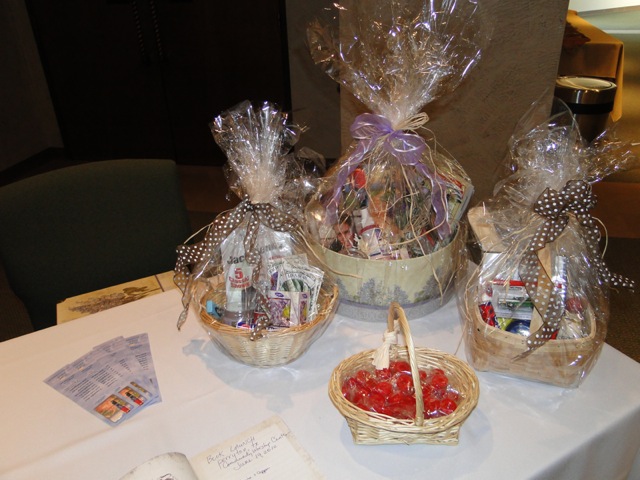
Door Prize Baskets
·      Will you be doing a reading? Will there be entertainment (special music or a skit perhaps)? Decide ahead of time when these will occur and try to honor that.
·      Round tables or groups of chairs will invite guests to stay and visit while having refreshments either before or after you’ve signed a book for them.
·      Author table: Don’t position too close to the entry. You want people to have a chance to enter the room and feel the warm reception.  Bookmarks and a bowl of candy are nice additions on the signing table.
·      Talk to each guest either while circulating or when you sign their book. Ask for proper spelling of their names and how they want book signed.
GRATITUDE
·      At the end of the day, you’ll want to thank those who’ve helped you. Send notes or provide small “hostess” gifts to your helpers. Inexpensive candles, note cards, sticky notes, bath gel, etc. make nice gifts.
·      Send a thank-you card to the facility that hosted your event. If a bookstore, leave a plate of refreshments for their break room and/or give a small gift to the coordinator.
·      Make a donation to the church if they’ve hosted your event.
·      Pam Meyers made a YouTube video of pictures of the event and sent the link to those who came. She also has a great tip if you have a book trailer.  

HAVE FUN! Releasing a new book is a day to rejoice. Enjoy it. Visit with your guests. Pose for pictures. Laugh. This is a day for you . . . and your readers. Treat them to a wonderful day, and they will be counting the days until your next book releases! 

Carla Stewart’s writing reflects her passion for times gone by. A child of the fifties and sixties, she recalls it as a glorious time when the summers were lazy, colors were brighter, and music filled her heart. Carla’s desire is to take readers back to the times when they knew they were loved, to that warm, familiar place in their hearts called “home.”
Her award-winning novels include Chasing Lilacs and Broken Wings. Stardust is her newest release. She loves readers and participating in book club discussions. You can learn more about Carla and ways to connect with her at www.carlastewart.com.
About STARDUST: 
In the bayou country of East Texas, the neon sign of the STARDUST stands silent, no longer beckoning visitors to its cozy cottages. But two days after Georgia Peyton buries her unfaithful husband, a curious thing happens: the STARDUST sign sputters to life and winks at her. Sustained by a memory from the past and determined to build a new life, Georgia acquires the STARDUST with hopes of breathing new life into it too. 

But the guests who arrive aren't what Georgia expects: her gin-loving mother-in-law; her dead husband's mistress; an attractive drifter who's tired of the endless road; and an aging Vaudeville entertainer with a disturbing link to Georgia's past. Dreams of a new life are crippled amid the havoc. Georgia's only hope is that she can find the courage to forgive those who've betrayed her, the grace to shelter those who need her, and the moxie to face the future. One thing is certain: under the flickering neon of the STARDUST, none of their lives will ever be the same.

Leave a comment to be entered in a drawing for Carla's book along with two authentic Southern pecan pralines from East Texas.

You can find Carla here:
Follow me on Twitter: www.twitter.com/#!/ChasingLilacs
Amazon link to Stardust: