Showing posts with label Winnie Griggs. Show all posts

Tuesday, September 6, 2016

Not So Common Senses

Winnie Griggs


Hello!  Winnie Griggs here and I’m really excited to be back here at Seekerville. This is always such a fun place to visit!

Today I thought I’d discuss adding depth to your stories by using the senses. I’m sure you’ve all heard, time and again, that one of the best ways to infuse your scenes with life and energy is through deft use of the five senses. In fact, if you type senses into the blog search box at the top of this page, it will display for you a number of very well written pieces on just that subject among the Seekerville archives.

So I’m going to give just a quick nod to those basic five senses and then move on to something else.

Quick, before I list them here, how many of you can name all five of the basic senses from memory? They are, of course, Sight, hearing, smell, touch and taste (I always forget touch).

The key to using them effectively in your work is to make certain you don’t just add them in as a laundry list or afterthought. To be really effective you need to show how they color the emotions of your character, mood or setting. You need to see how they touch your character in order for them to touch your reader.  Honing in on one or two really key elements in this way is much more effective than providing multiple sensory elements that just lay there.

For instance: As she walked through the park she could smell fresh cut grass, a cigar reminiscent of the ones her grandfather had smoked, and the loamy scent of newly-turned earth. You’ve included the sense of smell here, which can be one of the most evocative of the senses, but you haven’t really given the reader anything to care about or latch on to.

Instead, focus in on the detail(s) that’s going to elicit an emotional response and weave it in with the emphasis it deserves – Wafting over the everyday scents of the park that morning, the unexpected whiff of a cigar caressed her with memories of her beloved grandfather, ensconced in his recliner, puffing away, as she and her brother played at his feet. Oh, how she could use his wise counsel today.


That was just off the cuff, but hopefully you get the idea.

Let me give you a more extended example from one of my books, using one of the times when I included the five senses and think I actually got it right.

This excerpt comes from my book Handpicked Husband. The set-up here is that the hero and heroine have entered into a marriage of convenience. The day before the wedding, the hero learns something the heroine did that he feels is unforgivable but it is too late to call off the wedding. This is the evening after their wedding ceremony.


“I won’t lie,” Adam began.  “I don’t think I’ll ever be able to forget what you did.” 
Click to buy on Amazon
Reggie thought she’d braced herself for censure, but his words still had the power to lash at her.
He leaned back.  “However, I realize I’ve acted churlishly and for that I apologize.”
She held herself still, her hands clasped in her lap.  He’d apologized - that was something. 
“As you said,” Adam continued, “what happened in the past can’t be changed.  It’s the present and future we need to concentrate on, and how to make them livable for the both of us.”
She knew those words hadn’t come easily to him and that she should be grateful.  He’d offered an olive branch of sorts, a sign of compromise from a man who thought compromise was a weakness.  Expecting more from him would be unrealistic.  The least she could do was meet him half way.  “How do you suggest we do that?”
“We made vows to each other in front of God and your neighbors,” he said.  “It’s important that we be true to those.”
“I never planned to do otherwise.”
He gave a tight smile.  “Then we’re agreed.  It might take some effort, but in time it will likely become second nature for us to get along amenably.”
Amenably. Now didn’t that just sound like the most romantic way to start off a new marriage? 
Reggie, stood, needing some activity, some distance from Adam.  “You haven’t eaten anything tonight.  Let me at least get you some cheese and bread.”
Adam stood as well.  “I could use a bite of something.”
She unwrapped the block of cheese and reached for a knife while Adam took a clean cup from the drain board and uncorked the jug of cider.
He stood beside her, so close their shoulders nearly touched.  It rattled her for some reason, made her breath uneven. 
Did he feel anything at all?
Reggie sliced into the cheese with more vigor than care, then jerked her finger up to her lips, wincing at the metallic tang of blood.
Click to buy on Amazon
Adam immediately set his cup down, concern furrowing his brow.  “Let me see that.”
She pulled her finger out of her mouth and shook her head.  “It’s nothing.  The knife slipped.  I--”
“Don’t argue.”  He took her hand, examining the cut with a concerned frown.
Reggie stared down at her hand in his.  A tiny rivulet of blood seeped from the shallow cut, curling around her finger and onto his, like a narrow ribbon binding them together.
Amazing that such large, work-callused hands could feel so warm and gentle without losing their sense of strength. 
“I’m sure it’s nothing serious,” she said.  “It doesn’t even hurt.”  Not a lie since all she could feel at this moment was his touch, his nearness.
“Let’s clean it and get a better look, just in case.”  Still holding her hand, he dipped a clean rag in the nearby bucket of water, then slowly squeezed it over her finger.  Head bent, he gently dabbed at the remaining blood.
Reggie stared down at his head, so close she could smell the scent of soap and cigar smoke and night air.  So close her breath stirred his hair.  So close she could press her lips to his temple without moving much at all.
She pulled slightly back at that very inappropriate thought.
His head came up, his gaze seeking hers.  “Did I hurt you?” 
Not in any way I can explain.  She shook her head, not trusting herself to speak. 
“Well then, I think you’re right.  It’s not serious.  The bleeding’s already stopped.”  He let go of her hand.  “You’re obviously tired.  Go on to bed.  I can fix my own meal.”
“But--”
“Don’t worry.  I’ll clean up when I’m done.”
Reggie nodded and turned away, realizing nothing much had changed.  He was talking to her again, but he didn’t care to spend any more time in her company than he had to.

What do you think – did I pull you in? Did I give you an emotional connection to my heroine with those added touches of sight, sound, taste, touch and hearing?

So that’s the five senses we normally think of, and I’m sorry I wasn’t quite as brief as I’d planned to be J

What I really wanted to talk about today was the fact that there are other senses we can tap into and take advantage of when we write. Yes, there are more than five. In fact, some neurologists claim there are as many as twenty-one! I don’t plan to explore all of those today, you can google them if, like me, you find that kind of discussion fascinating. Instead I’m going to explore just the three additional senses that I think we writers can make the most use of.

Sense of Time
How we experience the passing of time, be it seconds or days, is a true sense. Writers use this all the time when we write phrases such as the days passed in a blur, time seemed to stand still, she fell down the slope in slow motion. In doing this we are attempting to pull the reader into our character’s head, have them experience the sense of time distortion with our character.

Here’s an example, from my book Handpicked Husband
The scene unfolded with tortuous slowness.  Each detail etched itself in her mind with gruesome vividness - the grim determination on Adam’s face, the bulging muscles in his arm as he strained to turn the tiller, the bone-jarring jolts his body absorbed as the runaway motor carriage careened out of control.

Then the motor carriage slammed into the photography wagon and time stampeded forward again.

Only when Ira’s hand released her did Reggie realize she’d been struggling to race forward.  Now she picked up her skirts and dashed toward the splintered mess.

Please God, let him be all right.

Sense of Equilibrium
This is what allows us to keep our balance. It also helps us to perceive gravity and the acceleration and directional changes of our bodies.  When this sense isn’t working properly we get dizzy, disoriented and/or unusually clumsy. Often, when in the throes of some strong emotion – grief, exultation, passion – we’ll experience a temporary impairment of this sense. As a writer you’ll want to tap into this.

Here’s an example, again from my book Handpicked Husband
Something inside him, some weight that had been there so long he’d ceased to feel it, began to crumble, then evaporate entirely.  His world shifted from one heartbeat to the next, leaving him with a lost, dizzy feeling and he reached for the table to steady himself.

Sense of Space
It’s how we perceive distances. And while this might, on the surface, seem to be fixed, we all have our own unique sense of space. A small vehicle might seem cramped to one person might feel comfortingly cocooning to another. We all have a different sense of our personal space so that when I (being southern) greet you with a hug, you may feel I’ve overstepped a boundary of sorts. And a stressful situation may make you feel like the walls are closing in or like we’re caught in a vacuum.  Again, you want to use this sense to create an emotional experience your reader can relate to.

This example, taken from Second Chance Hero, weaves in both the senses of time and space.
For an agonizing heartbeat, as the wagon bore down on her daughter, time stopped.  Verity felt every irregularity in the pebble that bit into her palm, could taste the tang of blood from where she’d bit the inside of her cheek when she fell, could see the dust motes hanging in the air before her.
Please Jesus. Please Jesus. Please Jesus.
She wasn’t sure whether she was uttering the frantic prayer aloud or if it was just shrieking through her thoughts.
From somewhere a woman screamed, but all sounds, save for the wagon’s relentless rumbling progress, seemed to come from a great distance as her world shrunk to only the space between herself and Joy. How could mere feet comprise such a life-or-death distance? 
And still Joy didn’t move.
Then, from out of nowhere, Mr. Cooper shot past her, and time sped up with a whoosh.  He dove toward Joy, reaching her a heart-stopping split-second before the horse’s hooves would have trampled the child, and pushing her out of the way.
Without remembering having moved, Verity was suddenly kneeling in the road with her weeping daughter clutched tightly against her.  Her heart thudded painfully against her chest and her breath came in near-gasps.  She’d come so close to losing her precious baby.  She could still feel the stab of keening desolation that pierced her the moment she’d realized she couldn’t get to Joy in time, couldn’t cross those few feet that might as well have been a chasm. 
This time the prayer she sent up was one of thanksgiving.

So there you have it, three additional senses you can think about and weave into your work when you’re trying to layer in those emotional nuances that are so important.

What do you think? Do you consider Time, Equilibrium and Space true senses, and should they be added to your writing toolbox? What other senses do you play around with when you are adding layers to your work? And as a reader, do these kinds of details draw you in?

Leave a comment to get your name in a drawing for Texas Cinderella.
Texas Cinderella


In Search of a Groom 
After a life of drudgery on her family's farm, Cassie Lynn Vickers relishes her freedom working in town as a paid companion for feisty Mrs. Flanagan. When her father suddenly demands she come home, she has no choice. Unless she can find a husband. If only she could convince handsome town newcomer Riley Walker to marry her… 
Riley is on the run. He's desperate to keep his niece and nephew safe from his crooked half brother. But a delay in Turnabout, Texas, shows him everything he didn't know he was missing: home, family—and Cassie Lynn. Can he find a way to become her Prince Charming…and build a real family with the children and Cassie Lynn?

~~~~

Born and raised in the bayou country of southeast Louisiana, Winnie Griggs moved to the opposite corner of the state when she married her college sweetheart over 25 years ago. She and her husband, along with their four teenage children, reside in Plain Dealing, a small community nestled in the piney hill country of northwest Louisiana.
With a BS degree in mathematics and a minor in Computer Science, Winnie has held an 8:00-5:00 job in the Computer Programming/Information Technology field since she graduated from college. But her first love has always been reading and writing romances. During the years preceding her sale she submitted to numerous writing contests and won or placed in many of these. Her biggest thrill, however, came in May of 2000 when she received that dream-come-true call heralding her first sale.

Winnie belongs to numerous writing organizations, including Romance Writers' of America and several of its local and special interest chapters. She is active in these groups as well as in her church - after all, she's a firm believer in the adage that you reap in proportion to what you sow.


Wednesday, March 30, 2016

The 7C’s Method Of Plotting

Winnie Griggs

Hi! Winnie Griggs here. I’m so excited to be back here at Seekerville – this is such a fun group.
In honor of this being SPEEDBO month here, I thought I’d focus this post on plotting
When it comes to plotting, writers fall somewhere on a continuum from the uber-planner who plots everything down to the nth degree, to the writer who takes a hint of an idea and dives right in, trusting that the plot will come to her as she goes along.
I personally fall somewhere in the middle.  I usually know who my characters are and what drives them.  I also know how they’ll change by the end of the story, and I also know some of the bigger turning points that happen along the way.  The rest of it I figure out as I go along. 
Over time, I’ve come up with a plotting process that helps me create a road map of sorts and today I’ll share that with you.  But first, let’s discuss what a plot is and isn’t.   Plot is not story.  Story is the end product, the combination of theme, premise, character, action and emotion, presented in an engaging manner to produce a cohesive whole. 
Plot is one part of what goes into crafting a story.  It’s the ‘what happens’, the sequence of events that occur as the characters attempt to achieve their goals and solve problems.  And to be effective, this sequence of events must be structured such that, no matter how the situation or characters change by the end, the plot has led us there in a smooth and inevitable manner.  Unlike real life where things happen randomly or with little impact on everyday life, in fiction, each event must have consequences that impact what happens next and lead inexorably to the story’s conclusion.
Cinderella
To illustrate this difference between plot and story, I’ll use a simple example - Cinderella.  At a high level we have these events:
  * A quick glimpse of Cinderella in her everyday world
  * A ball is announced and Cinderella decides that she wants to go
  * Her stepmother and step-sisters conspire to keep her from attending
  * Her fairy godmother appears and assists Cinderella in her dream to go to the ball, but she warns Cinderella that she must leave by midnight
  * Cinderella meets Prince Charming at the ball and the two fall in love
*   Cinderella almost overshoots her deadline and flees, losing her shoe in the process
 * Prince Charming finds the shoe and uses it to search for Cinderella
 * The stepmother locks Cinderella away, blocking the Prince’s attempts to find her
 * Cinderella escapes and she and Prince Charming achieve their happily ever after

As I said, high level, but these are the story events - the plot points if you will.  As you can see, it’s not the story.  It’s much too dry and lackluster to engage readers in any meaningful way.  The story itself is much richer and more lyrical, with layers and emotion that are missing here.
So, since plot is the ‘what happens’ in your story, it stands to reason that, to plot, one merely need come up with a list of events that lead us from the opening of our story to the conclusion.    Sounds easy, but I think you’ll agree that the tricky part comes in figuring out which particular chain of events are needed to make your story the page turner you want it to be.
After analyzing my own process (always a scary proposition!) I came up with what I call the 7Cs method.   These stand for:
1.      Character
2.      Circumstance
3.      Conflict
4.      Consequences
5.      Crisis
6.      Conclusion
7.      Change & Coherence

You can attack these in whatever order you like, but I usually start with Character and Circumstances. 
I explore my characters - their goals, values and especially their backstory - before I begin writing my story.  While character does not overtly play into your plot points, it does inform them.  Going back to Cinderella, our plot points don’t state what kind of history Cinderella has with her stepmother and stepsisters, or that she lost her father at a young age, or that she’s a dreamer.  But because I know this, I know what actions she is likely to take under specific circumstances.  
At this time, I also think about what my character’s initial circumstances are.  Once I really understand my character and their initial circumstances, the next ‘C’ I work on is the Conclusion.  This may sound counter-intuitive, but I need to know where I want my character to end up before I start planning how to get them there.  In the case of Cinderella, I want Cinderella to go from being unloved to finding true love. 
Once I have these three pieces - character, current circumstances and conclusion, I start trying to figure out the events that will get me there.
To do this, I play ‘what if’, brainstorming events and outcomes, looking for the ones that best fit my story and characters, the ones that will provide story energy and keep readers turning pages.  I build from the current circumstance, throw in Conflict, figure out the Consequences, then identify the new circumstance and so move forward, repeating the steps, taking the story as far as I can. 
You can see this cause / effect chain in the Cinderella example:
*  circumstance - Cinderella decides to go to the ball
conflict - her relatives erect roadblocks
consequence - she is temporarily stymied

*  new circumstance - Fairy Godmother appears, helps Cinderella go to the ball where she meets the prince
Conflict - she must leave before midnight when her finery will disappear
Consequence - she is nearly caught and must race away
and so forth.
The fifth ‘C’, Crisis, is the major event that occurs in the closing act of your story which causes the reader to wonder how your hero will ever reach his reward.  In our Cinderella example, it’s when Cinderella is locked away from the prince and it seems they are doomed to be separated forever.
The sixth “C”, Conclusion,  I’ve already mentioned.  It’s who I want my character to be when the story ends.  If I’ve done my job properly, set up the proper chain of events, I will have believably demonstrated her growth and the sacrifice she endured to prove herself worthy of her reward.
The last ‘C’, Change and Coherence, are filters I use to keep me on track.  I do this by asking the following questions:
·         Did this particular plot point change the situation and/or characters?  If it didn’t, then it doesn’t have a place in my story. 
·         Next, does it have coherence?  Does this event flow logically from the prior one, while remaining true to my character, or did I throw it in because it sounded like a fun scene to write or because I wanted to force the story in a particular direction?  Note, when I say flow logically, I don’t mean predictable.  Surprises are good, so long as you motivate the action in a believable manner.
There you have it, my 7Cs method of plotting.    
So, let me know, did you find it helpful? Do you have a different method you prefer?
Speak up, because I’m giving one of the commenters on this post the choice of any book on my backlist, which can be found at http://www.winniegriggs.com/books.php .
~~~~~~~~~~~~~~~~~~~~~~~~~~~~~~~~~~~~~~
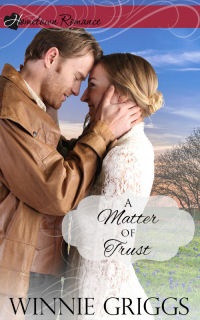
This month I have a new release out that I’m very excited about. It’s the revised version of the very first book I ever had published. This book has been out of print for the last 12+ years and was never digitized in it’s original release. But I’ve revised it and Serenade Books has given it new life in both print and digital form.  See below for more information on A Matter Of Trust.
~~~~~~~~~~~~~~~~~~~~~~~~~~~~~~~~~~~~~~
Texas, 1892—When Lucy Ames rescues a stranger from being beaten and robbed, she can’t just leave the man to die. But with her reputation in town already in tatters, how can she take this wounded man into her home? All she can do is what’s right…and hope for the best. Unlike Lucy, her young charge, Toby, is delighted to have a man in the house. As much as Lucy wants the man gone, she can’t begrudge Toby the kind of father figure he’s never had before. 

On a self-assigned mission to locate his nephew, Reed Wilder can’t believe his luck when he realizes his beautiful rescuer is the strumpet who beguiled his arrow-straight brother. But she’s not at all what he expected. She’s independent and feisty and…captivating. 

Before either of them realize it, Lucy and Reed fall in love. But how can their relationship survive the secrets that plague them both?


Wednesday, December 2, 2015

Seven Ways to Weave in Backstory Without Slowing the Pace


Winnie Griggs

Hi! Winnie Griggs here.  I’m so excited to be back at Seekerville.  I hope everyone had a lovely and blessed Thanksgiving. Today I’m going to discuss backstory.

What is Backstory?  Quite simply, it is everything that happened to your characters from their birth up until the point your story opens.  So, by definition, all backstory is important, because, for fully realized characters, everything that came before shaped them into who they are today. 

However, while it is important for you, the writer, to know all of the minutiae of your characters’ history, you want to avoid the ‘info dump’ syndrome when revealing backstory to your reader.  In other words, don’t serve up the details in a dense chunk, or in a contrived, author-intrusive manner. 

So how do you give the reader the information she needs without making her eyes glaze over?  By paying attention to the what, when and how of your backstory revelations.

WHAT:  Include only the bits and pieces necessary to keep the reader with you.  You want to trickle the information in rather than deluge the reader. 

Like learning to properly season a favorite dish, once you get past the basics, weaving in backstory is more of an art than a science.  

Add too much or the wrong mix of seasonings and you risk making the meal unpalatable. 

Add too little and it becomes bland and uninteresting, lacking in that certain zest we all strive for.


Click to Buy on Amazon
Let’s take a for instance. 

Suppose the protagonist in your current WIP was traumatized as a young child by witnessing his older brother drown while he stood by unable to help.  And to make matters even worse, let’s say his father blamed him for letting it happen.  In preparation for this story you’ve done extensive research on not only the probable effects this will have on his mental health and world view during his growing up years, but on the kinds of services and treatments that would and would not have been available to help him during whatever years this encompassed. 

In fact you have a file bursting with all sorts of fascinating, little known facts on the subject. 


Now, having discovered all of these intriguing bits and pieces of information is a good thing.  It allows you to have a much clearer picture in your own mind of who he is and what sort of coping mechanisms he would have developed, mechanisms that will likely have followed him into the present day of your story.  And, if at some point you have him or another character remembering or ‘flashing back’ to the early period of his life, you will have some authentic details to sprinkle in. 


The key here is the phrase ‘sprinkle in’.  Because, unless the information you have so diligently and painstakingly collected serves a real purpose in your story, furthering the plot, providing necessary characterization, solidifying your world building, etc., LEAVE IT OUT.

What you must consider, and consider ruthlessly, is whether the information is essential for the reader to know in order to make sense of your character motivations and move your plot forward. 

In other words, don’t toss in information for its own sake - it must serve a purpose (i.e.: foreshadow, show motivation, escalate tension/conflict, etc.). 


WHEN:  Provide background information only when it is absolutely necessary to further the action and development of your story’s current situation. If you attempt to front load your story with buckets of backstory, you will eliminate much of the suspense, the page-turning quality that drives your reader further into the story, that makes them eager to follow along as the layers are peeled back a little at a time.

In other words, it should answer a crying need for the reader to know this information at this point in time.  Revealing information too soon can deflate tension and steal the opportunity to have a ‘WOW, I didn’t see that coming!’ moment later in the book.

And to give your really big, JUICY stuff more punch, you’ll want to wait until it can serve either one of two functions:

1.    To answer a story question you’ve been building up to in earlier pages.
EXAMPLE: Perhaps your heroine shows very subtle signs of discomfort or nervousness, whenever the subject turns to boats or water sports. When you reveal in chapter seven that she is afraid of the water or perhaps it’s that she gets seasick whenever she boards a boat, then the reader will feel some satisfaction in having deduced all or part of the picture.

2.    To introduce an unexpected twist that will send your story in a whole new direction, or that will shed a startling light on prior events.
EXAMPLE: Think of the Darth Vader’s classic Star Wars line “Luke, I’m your father.”
or of the revelation in Pirates Of The Caribbean  that Will Turner’s father was a pirate.  Revealing either of these bits of backstory earlier in the story would have robbed them of much of their impact.

HOW:  There are a number of different methods you can use.  First, keep in mind that revelation of Backstory is most effective when it both unveils the past and adds to the present situation.

There are several ways to do this.   Today I’ll talk about seven of them.

Keep in mind that none of these methods are inherently good or bad.  The key is to know which method best fills the need of this particular part of your story.

For all of these methods, no matter which you use, keep in mind two directives:

·         Pare your information down to the bare essentials of what needs to be revealed.

·         Always provide some relevance to the current situation


So we’ll start with:

1. Omniscient Narrative
This is revealing backstory by out-and-out telling about a historical incident from a source other than one of the on stage story characters. There are a couple of different approaches to this

·    The News Flash approach – this method involves using a passage from an outside source, such as a letter, email, reference text, news report, etc. to drop backstory information onto the page.
EXAMPLE: think of the opening of the original Star Wars movie where “A long, long time ago, in a galaxy far, far, away...” scrolls across the screen

·    The Omniscient Narrator approach – this is where some outside entity simply states what has happened prior to the “here and now” of your story.
EXAMPLE: Think of the first Lord Of The Rings movie that opens with a narrator telling the audience the history of the rings. An author who is a master of this is Susan Elizabeth Phillips. For a great example, read the opening of her book It Had To Be You (This link will take you to the book on Amazon and you can use the Look Inside feature to read the opening: http://amzn.to/1TksuyL). She opens in Omniscient Narrator and about halfway through the third page seamlessly slips into third person POV.

2. Flashbacks

These are sections of backstory, told in present tense as if they are happening now.  They can be quite effective if used properly, but use them sparingly and keep them tight.  Flashbacks tend to take the reader away from the current action of the story.  If you run them on for too long you risk causing the reader to temporarily lose the thread of your story.  When using a flashback, always provide some relevance to the current situation. 

EXAMPLE: The Fugitive The movie opens with the police arriving at the murder scene, then we have a series of scenes where we juxtapose backstory events - scenes of Dr. Kimble and his wife at the party  and immediately after - with ‘here and now’ scenes of  Dr. Kimble’s arrest and trial.

A subset of the Flashback is the Frame Story. This is a that starts after the main story action is complete, and then proceeds to tell the rest of the story as one long flashback, with perhaps a short wrap-up at the end. 

Why would you want to employ a frame story?  There are several reasons.  A couple are:

4  To show dual perspectives - the protagonist as he’s experiencing the story events and also as he's reflecting on them afterwards

4  To pose a story question through some dramatic event that you then explain throughout the rest of the book.
EXAMPLE: Think of the movies Titanic, Ever After and Mrs. Winterbourne


3. Prologues

This can be a hot button topic among writers.  Some love them, some hate them.  So, how do you decide if you should use a prologue?  A prologue must provide essential information for the reader to know before the here and now of your actual story.  It should recount a significant event which is important for the reader to experience in real time with the character.  But make certain the information is essential to have up front.   If you use a prologue, your story will in effect have two starting points and you will need to develop two very strong opening hooks to draw your reader in.

Where a flashback often serves to answer a question raised earlier in the story, a prologue must raise questions that pulls the reader forward to search for answers. To make it work, it should be vivid and involving – a mini-story of sorts. And you should construct it in such a way that it raises story questions for the reader that propels her farther into the story to find the answer.

EXAMPLE: Pirates Of The Caribbean – the movie opens with the scene of Elizabeth and Will as children meeting for the first time. This scene accomplished several things, but in my estimation there was one very important point it made that most viewers probably weren’t consciously  aware of.  It grounded them in the fact that this was Elizabeth and Will’s story, not the more flamboyant Jack Sparrow’s.

4. Introspection
This is probably the most commonly used form of weaving in backstory.  It involves having a character think about some past event that parallels or contrasts the current situation.   

There are two ways to employ introspection

  • Reminiscing-- Where a character thinks about past events he himself is familiar with
  • Deduction-- Where a character puts together various bit and pieces of things he has observed to reach some sort of conclusion about another character’s past 
EXAMPLE – In the movie What Women Want the Mel Gibson character has acquired the ability to “hear” what women are thinking. You get some sometimes hilarious, sometimes poignant snippets of various characters’ backstory by having him eavesdrop on their thoughts.

5. Dialogue

There are several ways to use dialogue to reveal backstory

·           Third party Revelation - This is probably the most commonly employed method.  One character reminisces about something in another character’s past to a third party

·           The Side Kick - The protagonist himself confides bits of backstory, either directly or through implication, to someone else

·           Situation Update - A rookie or other person ‘outside the loop’ comes into a situation and is briefed by those in the know.  EXAMPLE: The Closer often opened with someone updating Deputy Chief Brenda Lee Johnson on what they know about the crime

Make certain the backstory-revealing-dialogue flows naturally from the characters and the current situation.  Take care to avoid the infamous  “As you know, Jane” scenario where one character is relating something to another character that they obviously both already know and have no logical reason to discuss other than to inform the reader.  Backstory through dialogue is most effective when it both reveals the past and adds to the present situation.


6. Implication
There are 2 ways you can use implication to weave in hints about backstory.

·         Self Implication - You can hint at backstory from the way a character reacts to a particular stimulus. 
For instance, if a woman flinches whenever a particular character enters the same room, your reader immediately suspects there is some dark, perhaps abusive history between the two.

·         Third Party Implication - This is actually the flip side of Self-Implication.  It’s where you hint at a particular character’s backstory based on the way other characters react to him/her

Using implication requires a deft touch - too subtle and your reader may miss the cues, too heavy-handed and you risk making the reader feel spoon-fed.  However, when done well, it allows the reader to deduce information about the character’s backstory. And it provides an impetus for the reader to keep reading to see if she has guessed correctly 


7.  Description

Personal Description - You can subtly weave in backstory through a character’s physical description.  Calluses or the lack thereof might indicate a certain kind of lifestyle.  Scars, limps, nervous habits can all hint at events in his past. 

Environment Description - The things they surround themselves with can also be telling.

·         If you want to show that your character is an avid traveler - surround him with exotic souvenirs or maps and charts

·         Is she well educated - scatter books and such around her lodgings

·         Has she recently experienced a financial downturn - have her wear expensive but outdated or faded clothing .


When using description to convey backstory, avoid resorting to stereotypes if possible, try to come up with fresh ways to illustrate your point.  But again, this is a more subtle way of imparting backstory and it allows the reader the fun of drawing their own conclusions rather than spoon feeding all the information.

So there you have it, seven methods to weave in your backstory.

Remember

·         Provide background information only when it is absolutely necessary to further the action and development of your story’s current situation.  In other words, it should answer a crying need for the reader to know this information at this point in time.

·         Include only the bits and pieces necessary to keep the reader with you.  You want to trickle the information in rather than deluge the reader. 

Keeping these two points in mind will help you maintain the fast pace and page turning quality in your story that keeps your readers coming back for more.
Let's talk about the challenges of using backstory wisely and yet, how much is too much, how little is too little, when and where to use it.
Leave a comment to get your name in a drawing for a copy of The Holiday Courtship.

Winnie Griggs 
Small Towns, Big Hearts, Amazing Grace
~.~.~.~.~.~.~.~.~.~.~.~.~.~.~.~.~.~.~.~.~.~.
Her Holiday Family
, Nov 2014

Second Chance Hero, May 2015

Journeys Of The Heart, July 2015

The Holiday Courtship, Dec 2015
http://www.winniegriggs.com/

He Wanted A Wife by Christmas... 

As Christmas approaches, Hank Chandler is determined to find a wife to mother his sister's orphaned children. When schoolteacher Janell Whitman offers to help him with his niece and nephew, she seems to be the perfect match—but she won't accept his proposal. Instead, she insists she'll find him another bride before the holidays. 

Janell moved to Turnabout, Texas, to put her past behind her and focus on her future—one that doesn't include marriage. But while she plays matchmaker and cares for Hank's children, she loses her heart to the two youngsters…and their adoptive father. If Janell reveals her secrets to Hank, will he still want her to be his Christmas bride? The Holiday Courtship by Winnie Griggs