Showing posts with label secrets. Show all posts

Friday, January 22, 2016

Best of the Archives: I've Got a Secret

Best of the Archives. First posted in 2009. Comments are closed today.

Janet here. Keeping secrets is part of being human. Until we trust someone, we tend to keep things to ourselves. Especially those things that'll make us look bad or bring others pain. Readers of our books, being human, too, will understand a character’s need to keep a secret and sympathize. Or so we hope.

The main purposes for adding secrets to our stories:

· To increase the twists and turns.
· To raise the stakes.
· To keep readers turning pages.

Bottom line: secrets cause conflict and conflict is story—which is why we should consider including them in our books. The Substitute Bride is the most secret laden book I’ve written. Elizabeth isn’t the bride Ted ordered yet manages to marry him without revealing that truth. Ted is hiding his old life as a gambler, which is the addiction that destroyed Elizabeth’s family. Elizabeth hides the existence of a younger brother. You can imagine the conflict as these secrets emerge.   

How do we create these secrets?
Secrets should carry a wallop

Develop secrets using the characters’ back story and goals and the plot:

Secrets based on the past. Secrets or secret feelings based on a character’s back story create conflict that divides characters. In Julie’s
A Passion Denied, John Brady keeps a secret about something that occurred in his past that prevents him from loving Lizzie. In my debut Courting Miss Adelaide, Charles’s secret damages his relationship with Adelaide, with others and with God. Secrets keep characters from emotional intimacy. Love cannot bloom in the soil of distrust and self-reproach when the hero and heroine keep secrets or are unable to face and overcome issues from the past.

Secrets based on the present. In
Courting the Doctor’s Daughter, Luke Jacobs hides his true relationship with Mary’s foster son. Mary suspects Luke’s hiding something, but over time she begins to trust him. Luke’s guilt and worry about Mary’s reaction if she learns the truth are a huge external conflict that force him to keep emotional distance from Mary and impacts everyone in the book. When Luke’s secret comes out, Mary feels betrayed and wants nothing to do with him.  

Secrets based on the future. In The Substitute Bride, mail-order bride Elizabeth doesn’t tell Ted of her plans to bring her younger brother to live with them. When the truth comes out, Ted is stunned. The boy’s arrival adds to their troubles. When a character hides future plans that involve another, that’s sure to add to the conflict.

Ways to use secrets in our books:

Let the reader in on the secret. Most of us are disturbed if a friend whispers to another friend in front of us. We want to know what they’re talking about and keeping from us. Or worse, we wonder if our friends are talking about us. When we let readers in on the secret while keeping the main character/s in the dark, we’re putting readers in our inner circle. Hopefully they’ll keep turning pages, wondering what will happen when the heroine or hero learns the truth.

Secrets cause conflict between the characters
Keeping a character in the dark can be a useful plot device. An example of this is a scene from Gone with the Wind when one evening the women sit stitching in Melanie’s parlor trying to act as if all is normal when they know their men are risking their lives to take revenge for an attack on Scarlet. To add to the tension in what is a marvelous, suspenseful scene, Margaret Mitchell leaves Scarlet in the dark, fuming about her husband’s indifference to her safety, as readers hold their breath and yearn to give Scarlet a slap.

Keep the reader in the dark. Keeping the reader in the dark will increase the tension. This strategy is used all the time by suspense writers. But when the reader is in the dark, secrets add suspense to any story. The author can tease readers by hinting that a character is carrying a secret but doesn’t reveal what it is until the black moment. Waiting for the fireworks is part of the fun, but the secret should carry a wallop or readers might toss the book across the room.

The secrets can come as a huge surprise to readers. Though they should be able to look back and see the clues were there and feel the secret explains a lot.


Keep the characters and the reader in the dark. In Charlotte Bronte’s Jane Eyre, Mr. Rochester keeps a humdinger of a secret. Readers know something is going on in the house, even as Jane and Mr. Rochester fall in love. During the wedding ceremony the horrible truth comes out that the groom already has a wife.

Ways to up the stakes with secrets:

Tie the secret to the book’s premise or theme.

In
Courting Miss Adelaide, Charles’ secret is closely tied to Biblical command to forgive, the theme for the book. He believes what he’s done is unforgivable, and the truth will tear his relationship with Adelaide apart. So he clings to his bitterness…and his secret. Until he’s able to face his past, forgive and reveal his secret, he can’t reach the point of forgiving himself and those who have hurt him. Only then can he move on with his life.

Tie the secret to universal concerns everyone relates to:

Secret baby, betrayal, sacrifice, bad decision stories tug at our heart strings, especially for the characters who are deceived, but also for those keeping the secret. The stakes have to be high enough that readers will put themselves in the character’s shoes and understand why s/he is afraid to reveal his secret.

Tie the secret to something most people CANNOT relate to:

Most of us are appalled by certain behaviors. Those behaviors might range from cannibalism or incest to abuse or neglect. For inspirational stories, it’s probably better if the shocking secret belongs to the villain or if the hero or heroine was the victim of the behavior, not the perpetrator.
The hero and heroine should earn their happy ending


Tie the secret to whether the hero and heroine get their happy ending.

After the wedding scene in Jane Eyre, I doubted Jane and Mr. Rochester would get their happy ending. They did. It was a long time coming, but worth the wait.

I don’t want to leave the impression that all stories should have characters hiding something. Many wonderful books don’t contain a single secret. But when appropriate, it’s a tool we can use to add spark to our stories.

Carly and Nate in The Bounty Hunter's Redemption, Love Inspired Historical, January 2016, struggled to find their happily ever after, but  of course, as romance authors, we make sure the hero and heroines of our stories do.  


Wednesday, May 16, 2012

Shhhhh! It's a Secret!

Debby Giusti here, ready to talk about secrets. Intrigued? Want to learn more?

Secrets are an easy and effective tool to hook readers and keep them turning the page. I often use secrets in my suspense stories, yet they are equally effective in sweet romances or women’s fiction or historical romance or any of the other genres we love to read and write.

Michael Hauge, in WRITING SCREENPLAYS THAT SELL, says, “When a character, event, or situation is not explained fully at the outset or when the hero must find the answer to some questions or mystery in the course of the story, the reader will ‘stick around’ to learn the solution and satisfy his own curiosity.”

Debby, Missy and Janet with Michael Hauge at ACFW.
Like the proverbial carrot on a stick, secrets pull readers into the story and keep them guessing until the secret is revealed. Conversely, if the reader knows the secret while the hero or heroine is kept in the dark, that superior position builds reader anticipation and heightens their interest in the story.

Hauge cautions, “The longer you withhold a secret from the audience, the more important it becomes, and the more satisfying it must be when it’s revealed.”

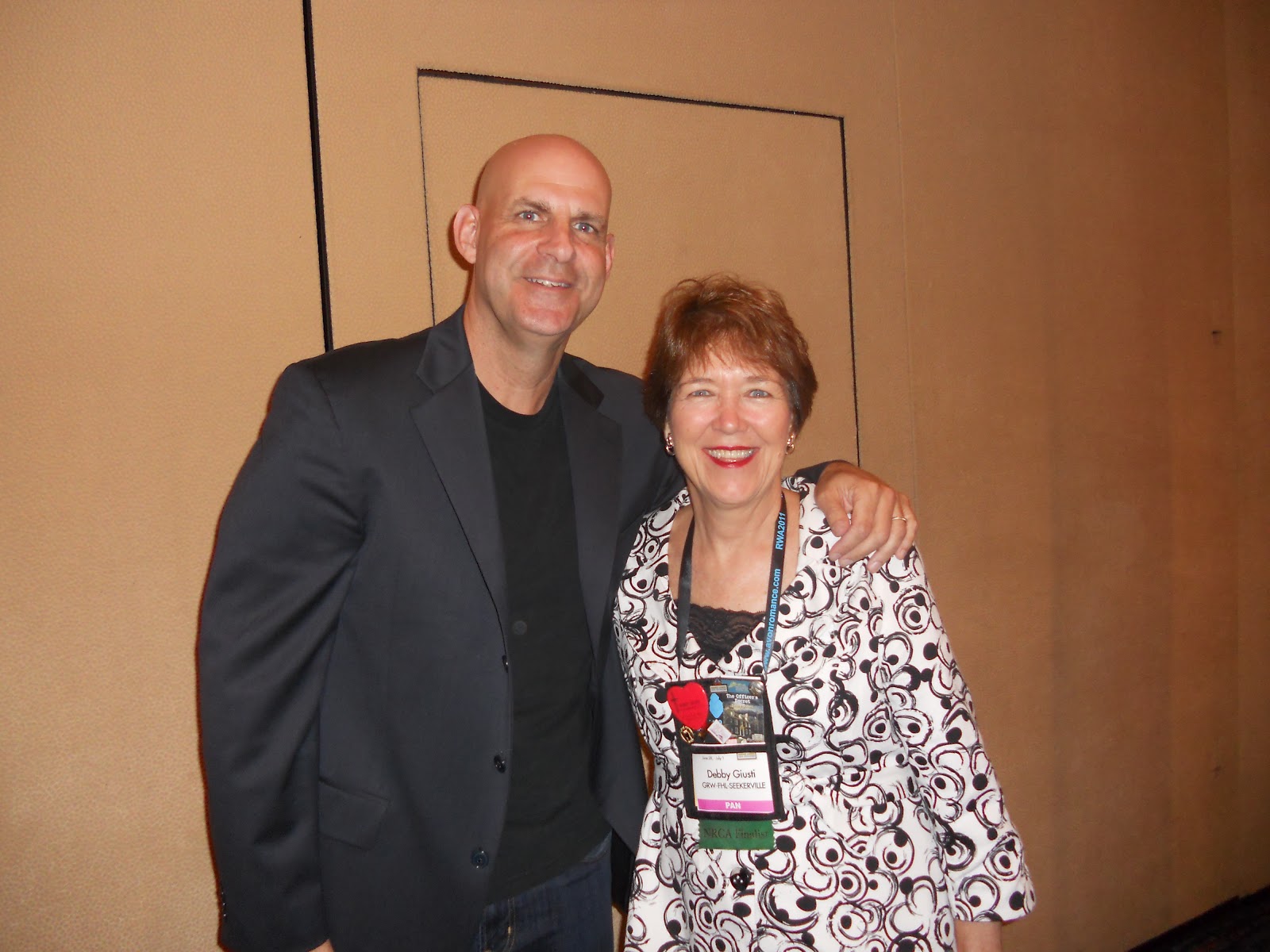
Which one is Harlan Coben? Shhh! It's a secret.
Harlan Coben dangled a very large carrot in front of me in his breakout novel, TELL NO ONE. The hero had a secret he needed to share with his wife, but she was kidnapped at the beginning of the story and thought to have been murdered. Coben made me wait until the end of the book before he disclosed the important secret that was the missing piece in the story puzzle.

Remember playing Gossip when you were a kid? Someone would whisper a sentence or phrase in a friend’s ear. The “secret” would be passed from person to person until the last child revealed the relayed message that always varied from the initial “secret.” Using the universally accepted truths about rumors and the damaging effects of sharing someone else’s secret can up the conflict in any story.

In THE GENERAL’S SECRETARY, the fourth book in my Military Investigations series to be released in January 2013, the hero comes from a small town where local gossips reveal secrets about his mother’s past. Their snide remarks and pointing fingers steel his resolve to join the military and make something of himself. In that same story, a secret from the heroine’s childhood adversely impacts the way she approaches life as an adult. In both cases, the secrets from the past have bearing on the hero and heroine’s internal conflict and the external goals they are trying to achieve.

When revealed or shared, secrets can surprise the characters as well as the reader and serve as dramatic turning points in the story.

Evan Marshall, in THE MARSHALL PLAN FOR NOVEL WRITING, says, “A surprise is a major, shocking story development that throws a whole new light on the lead’s situation and makes matters worse in terms of her reaching her goal.” Marshall goes on to say the surprise can be, among other things, “a discovery your lead makes” or a “revelation of new information that is truly bad news for your lead,” or “an event that has a negative impact on your lead’s situation.” In each case, a secret can be the unexpected catalyst that brings change.

Maass writes, “Stories, like life, are about change. Delineating the changes scene by scene gives a novel a sense of unfolding drama, and gives its characters a feeling of progress over time.”

In COUNTDOWN TO DEATH, the first story in my Magnolia Medical series, each character--the hero and heroine, the hero’s aunt, the villain, and a number of the red herrings--has an important secret that must be revealed. For me, intertwining the web of secrets was a fun exercise and, I believe, upped the tension and suspense.

Revealed secrets can lead to acts of forgiveness, which Maass says are “powerfully redemptive” and “create high moments because they elevate the characters who forgive.”

In PROTECTING HER CHILD, wealthy heiress Eve Townsend must find the daughter she gave up for adoption long ago and reveal a secret about the life-threatening disease Meredith Lassiter may have inherited. Widowed, pregnant and on the run, Meredith initially rejects her birth mother and the hero, medical researcher Pete Worth. When he learns the truth about his father, Pete must reconcile his own past and encourage Meredith to do the same.

Michael Hauge talks about a character’s wound being “the unhealed source of constant pain.” The wound usually happens in adolescent but affects a character through adulthood, especially if the character creates a false identity to protect himself.

The heroine in THE OFFICER’S SECRET has been wounded in her youth, but the only way Maggie Bennett can prove her sister was murdered is to reveal the secret that kept the two women estranged for years. Some things are too painful to disclose, and Maggie will do almost anything rather than divulge the truth about what happened long ago.

I asked the Seekers to share how they have used secrets in their stories.

Janet Dean writes: I love adding secrets to my stories and often do. In Courting the Doctor’s Daughter I used a secret to provide external conflict between my hero and heroine. Luke Jacobs hides his true relationship with Mary’s adopted son. Mary suspects Luke’s hiding something from her, but over time, she begins to trust and care for him. Luke’s guilt and worry about Mary’s reaction if she learns the truth forces him to keep emotional distance from Mary and impacts everyone in the book. The reader is in on the secret and anticipates or worries what will happen when the truth comes out. Of course, it does, but love triumphs in the end.

Ruth Logan Herne says: In Winter's End, the nurse heroine realizes she knew the hero's bi-polar mother before she died. His mother actually gave the heroine a distinctive blue-stoned ring, a ring the heroine sees and recognizes in a two-decade old family picture. She's in a quandary. This woman's faith inspired Kayla's quest for faith, but now... Now she realizes that the woman's past affected three lives, three lives Kayla is coming to love. How does she keep this secret? Should she? Should she remove herself from the case, knowing that the hero and his dying father's lives were rent by the mother's desertion? Torn between ethics, morals and common sense, Kayla is forced to consult her boss and then confront her dying patient in a poignantly honest scene, a scene that keeps her in the gridlock of emotions and further invests her in this family.

Tina Radcliffe offers two examples: The secret that both the hero Will Sullivan and secondary character Rose O'Shea know throughout The Rancher's Reunion is that Will's father died from complications of Huntington's, a hereditary disease. This is the huge secret that the heroine Annie Harris doesn't learn until the very end of the book.

Oklahoma Reunion is a secret baby book. This baby is eight years old and the story deals with not only the hero Ryan Jones' reaction to discovering he has a child but how the hero and the heroine Kait Field work to regain trust in order to create a future as a family for their daughter Jenna.

Julie Lessman’s shares her inspired secret: Even though I write family-saga romance instead of suspense, I try really hard to incorporate a big surprise at the end of each of my books. BUT ... when I got to my latest release, A Heart Revealed, where the heroine is married to an abuser who is still alive back in Ireland and cannot get a divorce or an annulment, I knew I was dead in the water because the only resolution I could see was killing the husband off. Since I didn't want to resort to the obvious, I prayed one day while sitting on my lower deck during the fall season, telling God that since He is the God of creativity, could He please provide me with a surprise ending for this book? Not ten seconds passed before an idea slowly drifted into my brain like the autumn leaves drifting from the trees overhead. I remember being so shocked by it, that I sat straight up and started laughing out loud. To this day, no one has guessed the ending ahead of time, which is a total tribute to God, not to me, giving the story that extra mystery quality that I feel so enhances a book.

Pam Hillman writes: I can't think of a single story line of mine that doesn't have at least one secret. But the secret has to be something pivotal, and it's not something that the person is willing to divulge easily. Otherwise, having and keeping the secret wouldn't be that big of a deal, would it? But, on the other hand, when the secret is revealed, it does double duty if the results are just as bad as the person worried about, but another twist turns everything around.

For instance, in Stealing Jake, Livy is a former pickpocket, and she doesn't want Jake or the townspeople to know about her past. When she's recognized and her past is revealed, all her hopes and dreams for a fresh start seem lost. But the townspeople rally around her, and vouch for her integrity and what she's done for the town. In this case, the reader knows about the secret, but Jake and the townspeople don't, so the reader knows it's got to come out sometime.

In Vengeance Rider (aka Marrying Mariah), there's a secret that is not revealed until the end of the book, but I've planted hints about the major players involved in the secret so that (hopefully) the reader will say, "Aha, why didn't I see that coming."


Sandra Lee Smith says: In Price of Victory, Sterling kept the fact that he was one of the owners of the Company that sponsored his racing team from the team members. He did that so the team wouldn't feel like they had to give him preferential treatment. The fact he was an owner was an important factor in his ability to help the heroine.

Mary Connealy writes: In my Kincaid Bride's series, all three of the heroes are badly scarred, emotionally and sometimes physically from a terrible childhood accident in a cave. None of them talk about it with each other or the women who come into their lives. Keeping this inside prevents them from healing and moving past the guilt they all carry for the damage done that long ago fateful day. In each book, the moment comes when the man talks to the woman he loves about what exactly happened in that cave. This is the moment they allow themselves to fall in love.

In Calico Canyon, Grace didn't admit that she'd hidden in Daniel's wagon to keep him from possibly handing her over from her adoptive father. Her distrust of people ... and his awareness that she was hiding something ... deepened the conflict between them.

In Gingham Mountain, Hannah kept it secret that she knew Libby, the little girl Grant adopted off the orphan train. She did this because she wanted Libby to be taken in and cared for by the lady who was running the train because they didn't have enough money to buy a train ticket. Hannah's love for Libby, as her sister of the heart, drove Hannah's need to protect all of Grant's children.

Now it's your turn. Grab a cup of coffee, and let’s discuss secrets. How have you used secrets in your own stories? Share ways you plan to increase reader curiosity or anticipation by adding a secret to your current WIP. What secrets in books or movies have had a lasting impact on your life? Two drawings today.  Winners' choice for one of my books.

Wishing you abundant blessings,
Debby Giusti
www.DebbyGiusti.com
www.craftieladiesofsuspense.blogspot.com
www.crossmyheartprayerteam.blogspot.com 

THE COLONEL’S DAUGHTER, the third book in Debby’s Military Investigations Series, will be out in August 2012. 
Pre-Order here: Amazon.com  

THE COLONEL'S DAUGHTER
UNDER SIEGE 
A ruthless killer is targeting the families of soldiers in a U.S. Army colonel’s brigade. Special agent Jamison Steele, of the Criminal Investigation Division, vows to stop him—because this time, Jamison’s heart is involved. The colonel’s daughter, the woman who loved and left Jamison without a word, came face-to-face with the murderer. Protecting Michele Logan means constant surveillance. And solving the mystery of the serial killer’s motive requires asking Michele the questions she least wants to answer. Questions that may lead them both into a deadly trap.

Sunday, July 12, 2009

I'VE GOT A SECRET


Don’t we all love a secret?

That was the basis of a TV show of the same name, an offshoot of What’s My Line? A panel—Bill Cullen, Henry Morgan, Bess Myerson and Betsy Palmer—tried to ferret out the secret a guest whispered to host Garry Moore , later Steve Allen, later still Bill Cullen. The secret was revealed on the screen for viewers at home.

From the long run of the show, I’d say people love to be in on a secret. And were hooked to see how the panel will get to the truth.

Keeping secrets is part of being human. Until we trust someone, we tend to keep things to ourselves. Especially those things that'll make us look bad or bring pain to others. Readers of our books, being human, too, will understand a character’s need to keep a secret and sympathize. Or so we hope. I’ve used secrets in all three of my sold books. In The Substitute Bride, February 2010, the hero and heroine are both hiding something that carries a wallop.

The main purposes for adding secrets to our stories:

· To increase the twists and turns.
· To raise the stakes.
· To keep readers turning pages.

Bottom line: secrets cause trouble—exactly why I include them in my books.

TWO TYPES OF SECRETS

Secrets based on the past. Secrets or secret feelings based on a character’s back story create internal conflict between characters. In Julie’s A Passion Denied, John Brady keeps a secret of something that occurred in his past that prevents him from loving Lizzie. In Courting Miss Adelaide, Charles’s secret damages his relationship with Adelaide, with others and with God. Secrets keep characters from emotional intimacy. Love cannot bloom in the soil of distrust and self-reproach. There are ramifications when the hero and heroine keep secrets or are unable to face them that create trouble.

Secrets based on the present. These secrets provide external conflict for characters. In Courting the Doctor’s Daughter, Luke Jacobs hides his true relationship with Mary’s son. Mary suspects Luke’s hiding something, but over time, she begins to trust him. Luke’s guilt and worry about Mary’s reaction if she learns the truth are a huge external conflict that force him to keep emotional distance from Mary and impacts everyone in the book.

TWO WAYS TO USE SECRETS

Let the reader in on the secret. Most of us are disturbed when we see a friend whispers to another friend in front of us. We want to know what’s they’re talking about. What we’re missing out on. Or worse, are our friends talking about us? It’s fun in our books to let the reader in on the secret while keeping the main character/s in the dark. Hopefully the reader holds her breath, wondering what will happen when the heroine learns the truth. Keeping a character in the dark can be a useful plot device. An example of this is a scene from Gone With the Wind when the women sit stitching in Melanie’s parlor one evening aware their men are risking their lives to take revenge for the attack on Scarlet, yet trying to look as if all is normal. To add to the tension in what is a marvelous, suspenseful scene, Margaret Mitchell leaves Scarlet in the dark and fuming about her husband’s indifference to her safety.

Keep the reader in the dark. Keeping the reader in the dark will increase the suspense. This ploy is used all the time by suspense writers. The author can tease the reader. In Courting Miss Adelaide, I hint that Charles carries a secret, but don’t reveal what it is until the black moment.

Or the secret can come as a huge surprise. Though the reader should be able to look back and see that the secret explains a lot. In Charlotte Bronte’s Jane Eyre, Mr. Rochester keeps a humdinger of a secret. Just as Jane and Mr. Rochester are about to marry, Jane learns the horrible truth that her groom has a wife.

When a character keeps other characters in the dark, they’re upping the conflict.

Waiting for the fireworks is part of the fun, but make sure the secret carries a wallop—is life altering—or the reader might toss the book across the room.


WAYS TO UP THE STAKES WITH SECRETS.

Tie the secret to the book’s premise or theme.

In Courting Miss Adelaide, Charles’ secret is closely tied to Biblical command to forgive. He believes what he’s done is unforgivable, and if the truth comes out, it will tear his relationship with Adelaide apart. So he clings to his bitterness…and his secret. Until he’s able to face his past, forgive and reveal his secret, he can’t reach the point of forgiving himself and those who have hurt him. Only then can he move on with his life.

In Courting the Doctor’s Daughter, Luke’s secret keeps him from accepting God’s purpose for his life. But to reveal his secret, he must trust others. In the past, people have let him down so he can’t trust. Lying by omission backs him into a corner that destroys the very trust he needs.

Tie the secret to universal concerns everyone can relate to:

Secret baby, betrayal, sacrifice, bad decision stories tug at our heart strings, especially for the characters who are deceived, but also for those keeping the secret. The stakes have to be high enough that readers will put themselves in the character’s shoes and understand why the character is afraid to reveal his secret.

Tie the secret to something most people CANNOT relate to:

Most of us are appalled by certain behaviors. Those behaviors might range from cannibalism or incest to abuse or neglect. It might be better if the shocking secret belongs to the villain. Or the hero or heroine was the victim of the behavior.

The secret must make the happy ending look in doubt.

After the wedding scene in Jane Eyre, I doubted Jane and Mr. Rochester would get their happy ending. It was a long time coming, but well worth the wait.

I don’t want to leave the impression that all stories should have characters hiding something. The book I’m working on now doesn’t contain a single secret. At least, so far.

Do you use secrets when you're writing your books? If so, would you care to share how you use them and the impact they have?

I brought coffee, tea and apple fritters this morning. Nothing homemade. All my recipes are secret recipes. ;-)