Showing posts with label Myra Johnson. Show all posts

Tuesday, November 14, 2017

Survival Tips for Introverted Writers (and Readers)


Today’s post is for the introverts in our midst, and according to my unofficial assessment (also supported by several internet sources I consulted), most writers are introverts. (Sources also suggests a high percentage of avid readers are introverts, so we’re all in good company!)

Yes, I know several extroverted writers and also a few ambiverts—people who are very comfortable being extroverts when they need to be but pulling back into introversion when it’s time to recharge. Introvert, extrovert, or ambivert, we each have our own ways of relating to others and the world around us.

So, even though I’m primarily addressing introverts today, I hope all you extrovert Villagers won’t flip over to Facebook or Twitter too soon, because even though we introverts might be an enigma to you, if you’ll take a little time to understand us, we’ll all get along better in the long run.

Okay, borrowing from various Twelve-Step programs, here are my suggested tips for surviving—and thriving!—as introverted writers and readers in an extrovert’s world.


  1. As introverts, we admit we cannot change ourselves into extroverts by force of will—and we don’t have to. It’s who we are, the way God created us. Yes, it’s hard at times. A lot of the time, in fact, since according to some surveys, in the world population as a whole, we’re in the minority.
  2. As introverts, we rely on God to help us find ways to live comfortably with the extroverts in our lives. Because maybe there are a few things we can learn from them, like how to make small talk when necessary in social settings or how to speak with confidence to agents, editors, book clubs, etc.
  3. As introverts, we turn our will and our lives over to the care of God and accept that He made us this way for a reason. I mean, can you imagine if the whole world were extroverts? Think of all the books that wouldn’t get written, the works of art we’d be missing out on, the heavy thinking that might never get thought.
  4. We make a searching and fearless inventory of ourselves—our strengths and weaknesses, likes and dislikes, what drains our physical, mental, and emotional batteries and what recharges them. Feeling too overwhelmed at a writers conference? We give ourselves permission to skip a workshop and retreat to our room for an hour or two. Nervous about our agent or editor appointment? We have our one-sheet ready plus some responses printed out in advance to help us answer any questions we might be asked about our book.
  5. We are honest with God, ourselves, and the extroverts in our lives about our introversion. We do so neither in apology nor as superior beings, but because we accept that extroverts, introverts, and everyone in between are created differently and are equally usable by God for His purposes.
  6. We cease once and for all to let our introversion cast suspicion on our “mental health” or to judge ourselves as less somehow because it’s draining to be social and we need our alone time. We are not weird because we enjoy spending hours and hours alone with our laptops or curled up with a good book. We are not crazy because we hear characters’ voices in our heads or talk to ourselves while rehearsing the scene we’re working on.

  7. We humbly acknowledge our introversion and cease asking God to turn us into extroverts. We look instead to our strengths and use them productively, whether by claiming the quiet time we need to write and read or by finding and claiming appropriate opportunities to share our thoughts and insights with the extroverts in our lives.
  8. We interact with others in “safe” ways that preserve our energy. We use social media to our advantage, because being “extroverted” online takes only a few minutes, and afterward we can log off and recharge for as long as necessary. At large gatherings, we can befriend other introverts who might be feeling stressed or overwhelmed. (We recognize them by their deer-in-the-headlights expression and the fact that they’re lingering near an exit . . . pretty much the same area we’ve migrated to.)
  9. We identify extroverts we feel comfortable with, those dear friends who understand us and willingly run interference. We make every effort to hang out with these extroverts at conferences and other gatherings because they always make a point of introducing us to editors, agents, and other writer friends, and they subtly try to include us without making us feel like conversation-school dropouts. 
  10. As far as it is possible, we make amends to anyone who may have felt slighted because of our introversion. When phone calls or face-to-face encounters are too intimidating, we express our care and concern with heartfelt handwritten notes or by sending meaningful gifts. Or we can gather our courage for an hour and invite our friends (only one or two at a time!) to meet us for lunch or coffee. 
  11. If we have an extroverted spouse or other family member who thrives on social activity, we promise not to always say no to outings and social gatherings. In turn, we expect their consideration and understanding, and together we plan ahead for when “enough is enough.”  This could be an agreed-upon signal for when it’s time to go. Or we could arrive in separate cars and politely take our leave while the other person stays to enjoy the party.
  12. Having fully embraced our introversion, we carry this message of acceptance and hope to other introverts who may still be struggling to find their place in a world full of extroverts.

Finally, here are a few resources you may find helpful in your journey as an introvert (or to share with your extroverted friends and family members who might need to be enlightened):

Online:
(also find them on Facebook)
The Introverted Writer (Steve Laube Agency Blog)

16 Personalities (where you can take a personality test)

Books:


The Highly Sensitive Person, by Elaine N. Aron, PhD

So, did you see yourself (or an introverted friend) in any of the twelve steps? Introverts, what are your greatest struggles? Do you have other coping tips you could share? Extroverts, please share your experiences with introverted friends or family members.

Join the conversation today and let me know if you’d like to be entered in a drawing for your choice of Susan Cain’s book Quiet OR Joanna Penn’s book Public Speaking for Authors, Creatives, and Other Introverts.

~~~~~~~  ~~~~~~~  ~~~~~~~

About Myra: Award-winning author Myra Johnson writes emotionally gripping stories about love, life, and faith. Myra is a two-time finalist for the prestigious ACFW Carol Awards, a two-time Maggie Award finalist, winner of Christian Retailing’s Best for historical fiction, and winner in the Inspirational category of the National Excellence in Romance Fiction Awards. Originally from Texas but now residing in the beautiful Carolinas, Myra and her husband love the climate and scenery, but they miss Texas bluebonnets in the spring and may never get used to the pulled pork Carolinians call “barbecue”! The Johnsons share their home with two very pampered doggies who don’t always understand the meaning of “Mom’s trying to write.” They have also inherited the “cat with a ’tude” their daughter and family had to leave behind when they recently moved overseas.


Sign up to receive Myra’s quarterly e-news updates here!

Tuesday, September 12, 2017

Tips & Tricks for Tracking Series Details


I love writing connected stories. Not that I always plan them that way, but once I get attached to a set of characters, I’m reluctant to let them go. Besides, certain supporting characters often beg to have their stories told. Even unplanned walk-ons develop their own personalities, so much so that they keep . . . walking back on!

Consistency within and between books can become a challenge. Who exactly is this character related to? How did I describe him or her the first time? Where did I say this business or that house was located? What were their pets’ names?


So, with the passage of time and at least four series to practice on, I’ve developed a few devices to help me keep track of the important details. Here are four that I consistently rely on:

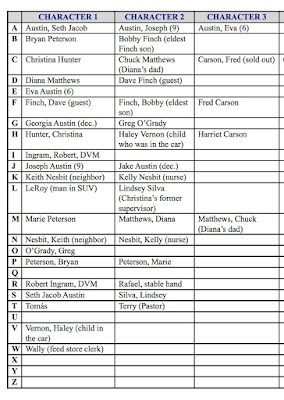
A character name chart. I write in Scrivener, so I’ve created a table-based template in which I enter each significant character’s name alphabetically twice—by first name, last name; then by last name, first name—if necessary, adding a word or two describing roles and/or relationships. As I start the next book in the series, I copy the chart into that Scrivener project and add names as new characters appear. Before moving to Scrivener, I used an Excel spreadsheet for this purpose, or you can create a similar table in Word. Here’s a segment from my Hill Country name chart. (You should be able to click on any of the images to see them in a larger window.)


A map of the community. If you’re handy with the drawing tools in Word or another program, you can create a map on your computer. I prefer having an editable computer drawing that I can link to my book files, but if you’re more comfortable using pencil and paper, that’s fine, too. The example below shows Juniper Bluff, Texas, the setting of Her Hill Country Cowboy and the next book in the series, Hill Country Reunion (coming February 2018). As various businesses crop up in each story, I decide where they’ll be located and add them to the map.


A running list of random characters and details. If a character is just a walk-on and not central to the story, I don’t clutter up my character name chart with that  information. Instead, I use a separate text file in my Scrivener characters folder, grouping names according to their role: various businesses and their owners or employees, names of pets, etc. In my Hill Country series, for example, the Serenity Hills Guest Ranch horses are listed along with photos found online to match the horses’ descriptions.

A story calendar. I use an Excel spreadsheet to create my story calendars, referring to TimeandDate.com for any holidays that fall within the story timeframe. For a historical series, obviously, my calendar will be set up according to the exact timeframe in which my story takes place. For contemporary novels, I rarely refer to actual dates, but my calendar is usually based on the year in which (I hope) my story will be published. The TimeandDate.com website is also a great source if you need to know phases of the moon (such as when your romantic couple is gazing up at the evening sky, or they’re running through a dark forest at night to escape the bad guys).

As my story unfolds, I jot brief notes in the calendar squares about what’s happening on any given day. This keeps me honest when I need to use transitions such as “two weeks later” or “the following Thursday.” For each consecutive book in the series, I typically just add on to the original calendar so that it’s easy to refer back if mention is made of something that happened in the past. Or if the plot calls for an event yet to come, it gets noted on the calendar so I can plan and pace the events leading up to it. By the way, an accurate story calendar is handy to have as a backup when the copyeditor questions your book’s timeline.

Here’s a screenshot of a portion of my calendar from Her Hill Country Cowboy, with details blurred out to prevent any spoilers!


If you’d like to create your own character name chart or story calendar, those templates are included along with other writing helps as part of my Novel Planning Excel Workbook, available for download at my website. Be sure to follow the instructions for preserving the original templates for future use.

How about you? Writers, any other tips you’d recommend for keeping track of story details, especially for a series? Readers, what are some of your favorite organizational tools and tricks? Join the conversation today and let me know if you’d like to be entered in the drawing for WINNER’S CHOICE of any of my books in print, including my September release, Her Hill Country Cowboy.


About Myra: Award-winning author Myra Johnson writes emotionally gripping stories about love, life, and faith. Myra is a two-time finalist for the prestigious ACFW Carol Awards, winner of Christian Retailing’s Best for historical fiction, and winner in the Inspirational category of the National Excellence in Romance Fiction Awards. Originally from Texas but now residing in the beautiful Carolinas, Myra and her husband love the climate and scenery, but they miss Texas bluebonnets in the spring and may never get used to the pulled pork Carolinians call “barbecue”! The Johnsons share their home with two very pampered doggies who don’t always understand the meaning of “Mom’s trying to write.” They have also inherited the “cat with a ’tude” their daughter and family had to leave behind when they recently moved overseas.
Sign up to receive Myra’s regular e-news updates here!

Tuesday, August 8, 2017

10 Traits of Successful Writers


Pondering what to blog about today got me thinking about the attributes of successful writers, so I came up with a Top 10 list. Maybe you’ll find some of these descriptions as motivational (and, in some cases, as convicting) as I do.

Trait #1. Writers write. You get a story idea, but you haven’t settled on the best way to begin, so . . . you don’t. Sure, you may be uncertain where to start, but if you don’t start somewhere, the book will never get written. You can always go back and fix things during revisions. The important thing is not to get hung up on getting it right the first time, because that’s paralyzing. Just write!

Trait #2. Writers finish what they start. I know, I know. It’s way too easy to get sidetracked by glittery new ideas you’re eager to pursue, or finding yourself bogged down in the middle of the story without enough energy (or interest?) to push through to the end. Make some notes for future reference and then ignore those other ideas for the time being. Because, especially for unpublished writers, it’s next to impossible to sell an unfinished manuscript.

Trait #3. Writers don’t wait to feel inspired or until they’re “in the mood” to write. If you’re waiting for the perfect state of mind or that elusive burst of inspiration, you could be waiting a long, long time. If you want to make money as a published author, you have to approach writing in a businesslike manner. Schedule writing time, and when that time rolls around, make sure you’re in your chair with fingers on the computer keys. This is your job, so treat it that way.


Trait #4. Writers identify their target audience and focus on them. When I first started out writing for magazines, I sent off for scads and scads of sample copies and writers guidelines. This was back in the day when snail mail ruled, so I racked up some hefty postage bills. But studying those sample issues gave me insight into whom the magazines were targeting, what kinds of topics the editors looked for, average article word count, and so much more. Even the advertisements offered clues about the reading audience and their interests. Novelists should be prepared to do an equal amount of market study. Visit publishers’ websites. Pick a similar book to your own and scan Amazon’s “also bought” feature. Read reviews. Check out book blogs to see who’s commenting and what those comments say about the readers.

Trait #5. Writers master basic grammar. Okay, do I have to get Grammar Queen on your case? Because I will, you know! If you don’t trust your own skills to catch grammar errors, enlist the aid of a proofreader whose knowledge you trust. Words, sentences, punctuation—those are the tools of our trade. You don’t want glaring grammar mistakes blowing your chances of an acceptance.

Trait #6. Writers continually study their craft. If you need to brush up on topics like single point of view, characterization, story structure, etc., just check the labels over on the right. You’ll always find plenty of helpful instruction right here in Seekerville. Attend conferences and workshops. Invest in some good craft books, check them out at the library, or borrow from your writer friends. (Have you seen my office bookshelves???)


Trait #7. Writers trust the vision. Having a critique partner or two or three can be helpful, provided you respect them both as individuals and as writers. But bear in mind that everyone has an opinion, and the more opinions you solicit, the more varied those responses are going to be. Take it from someone who’s been there—too many opinions can confuse you so much that you lose your grip on your own vision and voice. Limit yourself to feedback from the people you trust the most, and even then, weigh their comments against your own best judgment.

Trait #8. Writers take the long view. Especially when you’re first starting out, it can be all too tempting to jump at the first offer of a publishing contract or agent representation. (Can you hear Sally Field’s Oscars speech in your head right now? “You like me! You really, really like me!”) But be patient. Don’t get locked in with a bad deal—an unfairly slanted contract or an agent who turns out not to be the right fit. Building a successful writing career takes time. Plan wisely.

Trait #9. Writers take responsibility for their own marketing. Whether traditionally or independently published, we can’t escape this crucial part of the business. A professionally designed website is not a frivolous investment. Make sure it showcases who you are and is easy to navigate. If you blog, make sure you’re offering useful information for the readers you want to attract. Use social media for developing relationships and not just to sell books. Get to know your local booksellers and librarians, because you want them on your side!

Trait #10. Writers don’t quit. So it’s taking a lot longer than you thought it would and the long-awaited book contract hasn’t materialized. Or you’ve published several books but the sales numbers are unimpressive if not downright dismal. It’s hard to watch your writer friends’ careers going gangbusters while yours seems to be creeping along at a snail’s pace. But quitting? When you have no idea what could be waiting just around the bend? Take it from someone who, after 25 years of collecting book rejections, was this close to walking away before I got “the call.” That was nine years ago this month, and in just a couple of weeks, my twentieth published book officially releases! If you can quit, then . . . okay. But if you’re hardwired to be a writer, then stay true to the work God called you to. Be patient, keep writing, and wait for His perfect plan to unfold.

Writers, which of these traits causes you the most struggle? Which comes easier? If you need to make some changes, what steps can you take?

Readers, are there aspects of these traits that could apply to your daily life? Please share!

Any other traits you’d add to my list?

Join the conversation in the comments and mention your interest if you’d like to be entered in a drawing for either or both of today’s two giveaways: my very first published novel, One Imperfect Christmas, or my twentieth book in print, Her Hill Country Cowboy


About Myra: Award-winning author Myra Johnson writes emotionally gripping stories about love, life, and faith. Myra is a two-time finalist for the prestigious ACFW Carol Awards, winner of Christian Retailing’s Best for historical fiction, and winner in the Inspirational category of the National Excellence in Romance Fiction Awards. Originally from Texas but now residing in the beautiful Carolinas, Myra and her husband love the climate and scenery, but they may never get used to the pulled pork Carolinians call “barbecue”! The Johnsons share their home with two very pampered doggies who don’t always understand the meaning of “Mom’s trying to write.” They have also inherited the cute little cat (complete with attitude) their daughter and family had to leave behind.
Twitter: @MyraJohnson and @TheGrammarQueen 
Sign up to receive Myra’s quarterly e-news updates here!

Friday, August 4, 2017

Best of the Archives: Saddle Up for Writers!

This post by Myra Johnson first appeared in Seekerville on 
August 15, 2015. Comments are closed today so we can catch up 
with our reading and writing!

Her Hill Country Cowboy, my next Love Inspired romance, officially releases September 1, and I'm delighted the art department used actual Western tack on my cowboy's horse! True, non-horse people might not notice the difference, but for me, it was an important detail not to get wrong!

So . . . if there’s a horse in your story, 

here’s some stuff you might need to know!

Thanks for stopping in today as I reprise 

one of my earlier posts on horses and tack.


~~~~~~~

Whether you’re writing a historical romance about cowboys and the American West, a contemporary novel about a dressage competitor, or any story in which a horse may turn up at some point, you’d better know a hock from a forelock and a cinch from a bridle.

It's been quite a while since I've been on a horse, but as with many subjects, I know just enough about horses and riding to be dangerous. However, I do know it stops me cold when I read a novel where a heroine who’s never ridden before climbs onto a stallion for a leisurely trail ride. Or when the hero leads his horse to the pasture, then turns him out without removing the halter (unless it’s a breakaway type!). Or when a book cover depicts a supposedly "real" cowboy riding in English tack.

So, for what my limited experience as a wannabe equestrian is worth, here is a basic primer on horses and tack.

(FYI, in order to read the labels more clearly in the photos below, you may need to click the image to open in another window. And yes, that IS me!) 

My first and only dressage schooling show, April 2005.

Horse parts—what do you call them? 

Some terms you might need to know:
  • muzzle: the front part of the nose including nostrils
  • poll: the spot between and just behind the ears
  • throatlatch: kind of what it sounds like, the neck area running from behind the jaw to behind the ears, where you’d buckle a bridle strap
  • withers: the tallest point on the horse’s back, located at the base of the neck
  • chest: the front of the horse (below the neck and in front of the forelegs)
  • barrel: the round part of the horse’s body behind the forelegs and where you find the horse’s ribs
  • elbow: joint at the top of the foreleg; points toward the rear of the horse
  • knee: the front-facing joint on the foreleg
  • cannon bone: the long bone between the fetlock and the knee or hock
  • fetlock: the ankle on both front and back legs
  • pastern: the joint between the ankle and hoof on both front and back legs
  • loin: the rearmost part of the horse’s back; the area behind where the saddle would sit 
  • croup: the hindquarters area between the loin and the tail
  • flank: where the hind legs join the body
  • stifle: the large rear leg joint, similar to the human knee; a common injury location for horses
  • hock: the rear-facing joint halfway between the stifle and the ankle

Check out these websites for more detailed information: 


Western, English—what’s the difference?

Now that you can refer to the main parts of a horse by their correct names, you need to know what kind of tack your characters will need. A saddle is just a saddle . . . right?

WRONG!

Okay, maybe you’ve figured out there’s a basic difference between English and Western tack. But to complicate things even more, there are important tack differences for each riding discipline within those two broad categories!

English Tack


Let’s start with English tack, which is what I’m using in these photos. This is a dressage saddle, with long, straight flaps and a deep seat. It enables the rider to sit erect, and the longer stirrup length (actually tucked up in this photo so it doesn't bang the horse’s sides) offers freedom of leg movement for the subtle cues the dressage rider uses to influence the horse’s gait, direction, and body position. 

For a complete explanation of the sport, visit this site.
Check out this Wikipedia article as well. 

The other type of English saddle is the hunt seat, which places the rider more forward in the saddle for jumping over obstacles, either cross-country or in an arena. The stirrup length is shorter, giving more bend in the knee. Since I have ZERO experience with hunter/jumper riding, let me refer you to an informative article on the discipline. 

This Wikipedia article may also be helpful. 

Giving one of the grandsons a ride at my lesson arena, also around 2005.

Here is what a basic English bridle looks like. There are variations related to type of bit (usually a snaffle, meaning two sections connecting at a center joint), single or double reins, martingale attached, etc., but those are topics best left to someone with a LOT more experience! This article from Dover Saddlery offers further explanation.

Western Tack

This horse was ready for her Special Olympics rider.

There are several variations on the Western saddle, so you need to know what kind of work your cowboy will be doing. As with English saddles, some seats are deeper or flatter, some allow closer leg contact, and some are made especially for comfort over long trail rides. Here’s an overview. 

Fort Worth Stockyards, cowboy herding longhorns in the parade.

The Western bridle is slightly different from the English bridle. Most do not have nosepieces. Instead of a full browband, some bridles are one-ear or two-ear headstalls. The curb bit (straight shank) is typical.

Reins may be closed or split, depending on the type of riding.


Do you know your horse colors?
  • Chestnut or sorrel: Both refer to a reddish-brown horse. For some reason, English riders tend to use “chestnut,” while Western riders use “sorrell.” Radar, the horse I’m riding in these photos, is a chestnut.
  • Bay: A brown or reddish-brown horse with black points (muzzle, legs, mane, tail, tips of ears).
  • Gray: Commonly mistaken for white; if the horse’s skin is black, it’s a gray. The variations include dapple grays, flea-bitten grays (speckled with black or brown), and steel grays.
  • White: A true white horse (Dominant White) has pink skin, hazel or brown eyes, and white hair. 
  • Black: Pure black with no brown or other colors (other than white markings).
  • Dun: Sandy yellow or light reddish-brown, usually with darker legs, and always with a dark stripe down the middle of the back.
  • Buckskin: Similar to the dun but without the dark stripe; all black points.
  • Palomino: Gold coat with white or cream-colored mane and tail.
  • Roan: Solid color with single white hairs mixed in.

For more complete descriptions of horse colors along with photos (and including the grulla as described in Mary Connealy’s Now & Forever), see this site.


About Her Hill Country CowboySingle father Seth Austin will do anything for his children. So when he discovers the new housekeeper his grandmother hired for their guest ranch is a former social worker, he plans to keep his family far away from Christina Hunter. Seth once almost lost custody of his beloved kids because of an overzealous social worker. Problem is his children adore Christina and her sweet service dog—and he's starting to fall for her, too. Recuperating from an accident, Christina is determined to slowly ease back into her old life. But the more time she spends with them, the more she realizes that her future might be with the cowboy and his family.

About Myra: Award-winning author Myra Johnson writes emotionally gripping stories about love, life, and faith. Myra is a two-time finalist for the prestigious ACFW Carol Awards, winner of Christian Retailing’s Best for historical fiction, and winner in the Inspirational category of the National Excellence in Romance Fiction Award. Originally from Texas but now residing in the beautiful Carolinas, Myra and her husband love the climate and scenery, but they may never get used to the pulled pork Carolinians call “barbecue”! The Johnsons share their home with two very pampered doggies who don’t always understand the meaning of “Mom’s trying to write.” They also recently inherited their daughter's (occasionally) lovable cat when the family moved overseas for their next missionary calling. 


Sign up to receive Myra’s quarterly e-news updates here!

And now, for your viewing pleasure . . .
a trip down memory lane and a visit to 
the Fort Worth Stockyards
with Seekers Mary Connealy & Janet Dean.


Mary Connealy

Janet Dean
Myra Johnson

Tuesday, July 11, 2017

8 Writerly Things to Do When Writing Isn’t Working for You


It happens to each of us at one time or another. Life gets a little crazy, the interruptions won’t quit, and we just can’t find the time and/or mental focus to settle down for some serious writing. When the work-in-progress isn’t going well AND if you aren’t faced with a pressing deadline, sometimes the best thing to do is take a mental health day (or week or month) and do something else.

That’s kind of where I am this month. As many of you know, our daughter and family (2 adults, 4 kids—ages 15, 12, 6, and 3) have been living with us since Thanksgiving as they transition to their next overseas missionary assignment. Well, their time here is finally drawing to a close, and we’re all going a little bonkers as they work through checklist after checklist and suitcases and packing boxes pile up in our garage.

So I thought I’d take today to share a few of the ways I’ve found that help me make at least a little progress in my writing life while avoiding the guilt of total procrastination. The next time you’re faced with unavoidable interruptions or distractions, these suggestions may give you the break you need and the assurance that you haven’t abandoned writing entirely.

1. Read a craft book or watch an instructional video. My personal recommendations: Michael Hauge, Stanley D. Williams, Lisa Cron, or Dwight Swain. Investing 10 minutes, 30 minutes, or whatever time you have available can replenish your writing brain cells and ready you for writing again once things settle down.


2. Do you just need to get away from everything for a while? Take a walk. The exercise will give you both a physical and mental boost. Even better if you can brainstorm an idea or listen to a writing-related or motivational podcast as you walk. Have you discovered Write from the Deep? Great for inspiration, encouragement, and motivation!

3. Pull out an old manuscript and see if it’s worth reviving. Revising and editing take some brain power but not nearly as much as writing an entire novel from scratch.

4. Try writing a short story.
Learning to “write tight” is great practice! 

5. Clean up your writing area. Sort. File. Toss. And maybe dust and vacuum while you’re at it.


6. Are your bookshelves sagging with craft books or novels you’ve had forever but don’t need anymore? Gather a few to give away at your next writers group meeting. Or donate to your library. Or trade them in for credits at the used bookstore.

7. Learn a new techno-skill. Is there some writing-related software you’ve been meaning to master? Maybe it’s time to tackle Scrivener. Or are you a closet graphics artist? Experiment with Canva, PicMonkey, or one of the other online design sites. If you’re really brave, try your hand with Photoshop and book cover design.

8. Catch up with social media. Think of it as “networking.” Or dust off that blog you started years ago and haven’t posted on in forever. Let your faithful reader(s) know you’re still alive.

What are some of the ways you’ve found to keep moving forward in the writing life even through life’s interruptions? Join the conversation and you could win an early copy of my September 2017 release from Love Inspired, Her Hill Country Cowboy. There will be three lucky winners today, so be sure to mention in your comment if you’d like to be entered in the drawing!
About the book: Single father Seth Austin will do anything for his children. So when he discovers the new housekeeper his grandmother hired for their guest ranch is a former social worker, he plans to keep his family far away from Christina Hunter. Seth once almost lost custody of his beloved kids because of an overzealous social worker. Problem is his children adore Christina and her sweet service dog—and he's starting to fall for her, too. Recuperating from an accident, Christina is determined to slowly ease back into her old life. But the more time she spends with them, the more she realizes that her future might be with the cowboy and his family.

About Myra: Award-winning author Myra Johnson writes emotionally gripping stories about love, life, and faith. Myra is a two-time finalist for the prestigious ACFW Carol Awards and winner of Christian Retailing’s Best for historical fiction. Originally from Texas but now residing in the beautiful Carolinas, Myra and her husband love the climate and scenery, but they may never get used to the pulled pork Carolinians call “barbecue”! The Johnsons share their home with two very pampered doggies who don’t always understand the meaning of “Mom’s trying to write.” They’re also currently harboring their younger daughter and family (six in all plus a kitty!) as they transition toward their next missionary calling. With grandkids underfoot ranging in age from 14 down to 3, there’s never a dull moment! 


Sign up to receive Myra’s quarterly e-news updates here!

Tuesday, June 13, 2017

Yes, You Can Be a Story Genius!


If you’ve been a Seekerville regular for a while, you may remember a post from a few years ago by Seekervillager Mary Curry entitled, “Story: Your Brain on Drugs.” Mary based her post on Wired for Story: The Writer's Guide to Using Brain Science to Hook Readers from the Very First Sentence, by Lisa Cron. If you haven’t read Mary’s blog, be sure to check it out later, because it contains some fascinating insights into why we love stories so much—and why they matter.
Lisa Cron has since published another book, Story Genius: How to Use Brain Science to Go Beyond Outlining and Write a Riveting Novel (Before You Waste Three Years Writing 327 Pages That Go Nowhere). After coming across this book recently, I devoured it, highlighting dozens of passages that not only reinforced points from Cron’s previous book but also (re)opened my eyes to several vital aspects of storytelling.
It starts with “what if . . . ?”
Maybe you’ve played the “what if” game and come up with a general premise for your story. What if a girl is swept up in a tornado and lands in a magical place threatened by a wicked witch? What if a small, furry-footed creature is called upon to destroy a powerful ring before an evil lord uses it to take over the world?
Intriguing ideas, to be sure. But are they stories yet? Not until we know something about the central characters and have been given a reason to care.
That’s why I agree completely when Lisa Cron states: 
“Ultimately, all stories are character driven—yes, all stories.” 
Why? Because a story really isn’t about what happens. It’s about how the central character makes sense of what happens. And if the author hasn’t made the reader care about why any of this matters to the protagonist, there goes another book slammed shut and tossed aside.
What every story must have, according to Cron, is “the third rail”— kind of like the powered rail that drives a cable car or subway train. Cron explains the “third rail” in terms of the protagonist’s internal struggle to achieve a goal or strong desire while at the same time remaining true to the fear that is keeping her from fulfilling that desire. 

In other words, it’s the emotional power source that keeps driving the story forward. So, if you want your reader to stay connected to the story, then every action, description, and plot point must somehow connect with that “third rail.”
We care about Dorothy in The Wizard of Oz because we can relate to her frustration and discouragement when everyone seems too busy to pay her any attention. We care about Frodo in The Lord of the Rings because on some level we know what it’s like to feel small and insignificant, to be compelled to accept a task seemingly beyond our abilities or our courage.
Does your story make a point?
But again, story isn’t about what happens. The things that happen in your story should ultimately make a point—the overarching theme, or, as we’ve discussed here in Seekerville before, the Moral Premise. “The point,” Cron writes, “is what is borne out in the protagonist’s inner struggle.”
One of the first things you need to know about your story, then, is what your protagonist wants. Keep digging to discover the answers to the following questions:
  • Why does your character want this? In other words, what will getting it mean to her?
  • What is the misbelief that is keeping her from getting what she wants?
A misbelief is a belief that feels right to your character because of something that happened in her past. The belief may even be considered a universally accepted truth, until carried to extreme. Whatever the belief, it has skewed the lens through which your character views her world, and not in a positive way. 
How the character overcomes her misbeliefs is what your story is all about.
So the real story actually begins long before page one of your novel. As you dig deeper, Cron recommends actually writing out the scene where your character first forms her misbeliefs. While the scene may not appear in your novel except in brief references or flashbacks, the insights gained will flesh out your character’s background and help to ensure her actions and decisions are consistent with who she is.
Cron’s book walks you through the full process of discovering your story—far too much to cover in a single blog post—but here are a few of the important steps:
  • Identify three key turning points in the story that will help you develop the escalating arc.
  • Figure out the one thing that will catapult your protagonist into action at the beginning of the story.
  • Make a list of obstacles that could keep your protagonist from reaching her goals.
  • Sketch out the scope of your story—the time frame covered, the external plot and internal struggles. Beneath each “what,” always be asking yourself “why?”
Being a “story genius” takes time.

To thoroughly work through each step presented in Cron’s book will take a significant amount of time and brain power. I confess, I haven’t gone through the entire process yet, but reading Story Genius with my own wip in mind definitely gave me some new insights. When I’m ready to start my next book, I’m planning to implement even more of Cron’s techniques.

Lest anyone think this is going to transform me from pantser to plotter, though, don’t count on it! No matter how much preplanning I may convince myself to do, when it comes to actually writing the story, I’ll always leave room to be surprised by my characters!

Question: Writers, think about the story you’re working on right now. Readers, think about the book you’re currently reading. Can you identify what the protagonist wants most (dig deep here!) AND the misbeliefs keeping her/him from achieving it?  


Today’s giveaways: Writers, would you like your own copy of Lisa Cron’s book? I’m giving away one copy today! Also giving away a copy of my historical romance Castles in the Clouds (Flowers of Eden, book 2), recently named a finalist in the 2017 Selah Awards and the 2017 National Excellence in Romance Fiction Awards. Just mention your interest in the comments to be entered in either or both drawings.


About Myra: Award-winning author Myra Johnson writes emotionally gripping stories about love, life, and faith. Myra is a two-time finalist for the prestigious ACFW Carol Awards and winner of Christian Retailing’s Best for historical fiction. Originally from Texas but now residing in the beautiful Carolinas, Myra and her husband love the climate and scenery, but they may never get used to the pulled pork Carolinians call “barbecue”! The Johnsons share their home with two very pampered doggies who don’t always understand the meaning of “Mom’s trying to write.” They’re also currently harboring their younger daughter and family (six in all plus a kitty!) as they transition toward their next missionary calling. With grandkids underfoot ranging in age from 14 down to 3, there’s never a dull moment! 

Twitter: @MyraJohnson and @TheGrammarQueen 

Sign up to receive Myra’s quarterly e-news updates here!

Friday, April 14, 2017

Best of the Archives: Four Fixes for Faulty Dialogue


Good morning, Seekervillagers! Myra here. Now that Speedbo is over, it's time to whip those manuscripts into shape. One area you'll want to look at is dialogue, so here's a post from the archives you may find helpful.


~~~~~


In real life, conversation is usually the quickest and most effective tool we have for getting to know another human being. This is true in our stories as well. Nothing draws a reader into a scene more quickly than a lively exchange of spoken words between two motivated characters. 

In a novel or short story, this is called dialogue.


Writing effective dialogue for your story characters, however, isn’t as simple as replicating real-life conversations word for word. Fiction writers must be skilled in choosing which parts of a conversation best move the story forward while also providing subtle insights into the personalities, backgrounds, goals, and/or motivations of the speakers. 

Here are a few pointers to keep in mind as you craft dialogue in your stories:

1. First and foremost, remember that story dialogue should be only an approximation of real-life speech, a condensed version that maintains the flavor of real speech but hits just the high points, the elements of character interaction that best serve the plot. You can quickly spruce up and tighten your characters’ speech by nixing most of the small talk, greetings, ums, ers, and wells we typically hear in everyday conversations. 


Exception: Sometimes small talk contains subtext, which can clue the reader in on the speaker’s frame of mind or personal take on the situation. Here’s a short example from my brand new Love Inspired romance, Rancher for the Holidays. In this scene, the hero, Ben Fisher is helping unload painting supplies for a church outreach committee and secretly hoping to impress Marley Sanders, the heroine. However, he’s already running afoul of Ernie, Marley’s friend and self-appointed protector. Note the implied sarcasm in Ernie’s tone, and also in Ben’s terse reply. Clearly, neither of these guys means quite what he’s saying!
Before he [Ben] could lower himself to the ground to move the bucket into the wagon, Ernie returned and grabbed the handle. “Careful, there. Wouldn’t want you to hurt yourself.”

“Thanks.” Ben stifled a twinge of envy as Ernie effortlessly shifted the paint can into the wagon. Note to self: find new gym.


2. Know how to correctly use dialogue tags and beats. A dialogue tag identifies the speaker with “said” or some other speech-related verb that indicates how the dialogue is delivered. Important: Make sure your dialogue tag is something a human being can actually do with the voice. Verbs like these are fine:
  • said
  • stated
  • whispered
  • cried
  • shouted
  • murmured
  • croaked
  • rasped
  • mumbled
Verbs like these are physical actions and are not “said” words, so don’t use them as such: 
  • shrugged
  • nodded
  • winked
  • blinked
  • cringed
  • huffed
  • harrumphed
  • hissed (unless the dialogue has a lot of S’s)

3. Characters should converse, not speechify. Short, snappy paragraphs of dialogue help keep up the pace of your story, plus the white space is more inviting to readers. If one of your characters has a lot that must be said, break up the speech with bits of action, judicious (and relevant) use of description, or interjections from another character. 

4. Punctuate dialogue correctly. When there is no attached dialogue tag, all punctuation goes inside the quotation marks, as in the following examples:
  • “Aren’t the autumn leaves beautiful this year?”
  • “You’re driving me crazy!”
  • “Meet me at the mall at four.”
When a tag follows the line of dialogue, exclamation points and question marks remain; however a period will be replaced by a comma.
  • “Aren’t the autumn leaves beautiful this year?” Ruthy asked.
  • “You’re driving me crazy!” Mary exploded.
  • “Meet me at the mall at four,” Debby said. 
When the tag precedes the dialogue, a comma follows the tag, like this:
  • Pam said, “Let’s stop for ice cream on our way home.”
  • Looking toward the mountains, Glynna murmured, “Aren’t they beautiful?”
When the tag interrupts the speech, it looks like this (notice comma placement):
  • “If you ask me,” Sandra stated, “we have a good chance of winning the pickleball match.”
  • “I’d like to watch,” Julie said with a sigh, “but I won’t be in town that weekend.”
A beat is a bit of physical action that can be used in addition to or (preferably) in place of the dialogue tag. Keep in mind that a beat is not a “said” word (see note above concerning shrugged, nodded, etc.). The beat not only identifies the speaker but can show the character in action much more vividly than one more boring “she said.” Here are some examples of dialogue with beats.
  • Audra snapped her fingers. “Rats! I forgot my billfold.”
  • “Do you like my new haircut?” Smiling, Cara patted her curls.
Notice that the beat is a separate sentence from the line of dialogue. DO NOT combine the dialogue and an action beat with a comma! 

INCORRECT: “It’s late. I’m going home,” Janet put on her coat.
FIX: “It’s late. I’m going home.” Janet put on her coat. [replace comma with period]

INCORRECT: “Would you mind,” Pam raised a brow, “if we postponed until tomorrow?”
FIX: “Would you mind,” Pam asked, raising a brow, “if we postponed until tomorrow?” [added a “said” word and comma; changed raised to raising]
ALTERNATE FIX: “Would you mind”—Pam raised a brow—“if we postponed until tomorrow?” [the dashes set off the action beat; exact placement of quotation marks and dashes may vary among publishers’ style sheets, but this format seems the most common]

~~~~~~~~

Myra Johnson
On your own: Select a snippet of dialogue from your work-in-progress or a novel you’re reading. What does the conversation reveal about plot and/or character? Are the characters saying what they mean, or do their words contradict what they’re really thinking or feeling?

Comments are closed today so we can spend more time writing and reading! Join us tomorrow for another news-packed Weekend Edition!

                                                       ~~~~~

And . . . look for my newest release, A Rose So Fair, Flowers of Eden book 3, available now in both ebook and paperback! 

Plucky Rose Linwood grew up on her grandfather’s Arkansas tenant farm, a life her two older sisters never cared much for. Working alongside her grandpa, though, Rose learned to love the land as much as he did. Now her sisters have married and moved on, Grandpa has gone to his eternal reward, and Rose is determined to make a go of the farm on her own. But crops have been slow to recover since the drought of 1930-31, and the whole country struggles in the grip of the Great Depression. Drifters looking for work or handouts roam the countryside, some of them up to no good, so Rose keeps her trusty Winchester rifle at the ready.

Caleb Wieland, Rose’s best friend, isn’t the farmer his late father was, and he’s about to lose his cotton crop to boll weevils. He’d let the farm go and search for work he’s more suited to, except he can’t desert his widowed mother. Besides, he’s been quietly falling in love with Rose since they were in grammar school, and the thought of leaving her behind is too much to bear. He’d give anything to win her heart, but Rose’s stubborn independence is proving as thorny as the flower for which she’s named.

About Myra: Award-winning author Myra Johnson writes emotionally gripping stories about love, life, and faith. Myra is a two-time finalist for the prestigious ACFW Carol Awards and winner of Christian Retailing’s Best for historical fiction. Originally from Texas but now residing in the beautiful Carolinas, Myra and her husband love the climate and scenery, but they may never get used to the pulled pork Carolinians call “barbecue”! The Johnsons share their home with two very pampered doggies who don’t always understand the meaning of “Mom’s trying to write.” They’re also currently harboring their younger daughter and family (six in all plus a kitty!) as they transition toward their next missionary calling. With grandkids underfoot ranging in age from 14 down to 3, there’s never a dull moment! 


Sign up to receive Myra’s quarterly e-news updates here!