Showing posts with label the end. Show all posts

Friday, July 21, 2017

Best of the Archives: The End!

This post by Cara Lynn James first appeared
 in Seekerville on August 25, 2011.
 Comments are closed today so we can catch up 
with our reading and writing!

The End--two of the most satisfying words an author can write. My fourth manuscript for Thomas Nelson is due a week from today and I’m rushing toward the end with less than 1,000 words to go and one more scene to write. Then I can celebrate and breathe easy for a few weeks!

I like to write the ending of a manuscript not just because it signals the culmination of a long project, but also because I actually enjoy the process as opposed to developing middles. By the time I arrive at the last act I know my characters and plot so well it’s easy to write. Relatively. Unlike the beginning, there are only so many ways to conclude a story. And unlike ‘sagging middles,’ the ending is relatively short. It’s the resolution of conflicts that many of us don’t like writing because we like our characters to get along and be happy.

The forces that you’ve developed during the middle of the book will collide at the climax. Something has to give—things can’t keep going the way they were. Peaceful Endings are anti-climactic and disappointing to the reader. Can anyone think of a satisfying resolution that didn’t involve some kind of confrontation between the forces in opposition?

You must use the same characters, tensions, and conflicts etc. that are developing through the story at the conclusion. No fair bringing in the cavalry to bail out your characters!

The ending has to fulfill the promise you made to your reader throughout the story. Did you promise love? Or justice? Or terror? Don’t promise love and then deliver only heart-stopping terror. If it’s romantic suspense, you’ll want the plot to resolve, but you also want the love between the hero and heroine to come together, too.

It’s a good idea to list the forces you’ve set into conflict earlier so you’ll remember to deal with each and every one of them. No loose ends or your reader will feel dissatisfied and cheated!

Most story endings have two parts: the climax and the denouement.

The climax is the clash of the forces at the big, important story event that brings it all together. It often shows how the protagonist has changed. It’s the payoff.

The climax should do four things:

1. It must satisfy the view of life implied in your story.

2. It must deliver emotion—especially important in a romance.

3. It must deliver the appropriate level of emotion.

4. It must be logical to the plot and believable for the characters.

The ending grows out of who the characters are. The climax usually takes at least a chapter, sometimes several chapters.

The denouement comes after the climax. Its function is to wrap up the story. It shows the reader the consequences of the plot and the fate of any characters that are not accounted for in the climax. To be successful it has three characteristics: closure, brevity, and dramatization.

Once you satisfy all these things you can write The End and smile at your accomplishment-- unless you have an Epilogue, but that’s a topic for another post.


Do you have a favorite section to write? Any reason why?


Cara Lynn James currently lives with her family in northwest Florida. She's lived in Vermont, Virginia, California, Texas, Rhode Island, Massachusetts, and Connecticut. Her historical romances in the Ladies of Summerhill series all take place in Newport, Rhode Island during the Gilded Age. You can find her on Facebook, or Twitter.

Wednesday, March 20, 2013

The End!

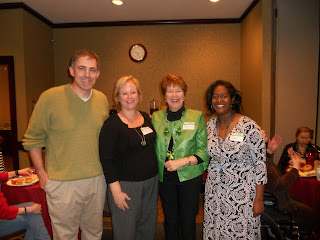
Walt Mussell, Missy Tippens, Debby Giusti
and Piper Huguley at the Georgia Romance
Writers meeting, March 16, 2013

Debby Giusti here!
I’m welcoming the first day of spring with photos of flowers I snapped in my local area. The beginning of spring signals the end of winter, and that’s what I’m blogging about today.

Not the change of seasons, but The End of our stories.

Lots of articles focus on creating compelling openings; few discuss how to end the story, yet  The End is important. Why? 

Because the beginning of a story sells the current book, but the ending sells the next book.


First, let’s define The End. I’m not talking about the climax. In a suspense, that’s the highly charged portion of the story where the hero and heroine are in imminent danger from an outside source, such as a villain or force of nature. Often one character saves the other in an emotionally charged scene that, hopefully, keeps the reader on the edge of her seat.

In a sweet romance, the climax pits the hero against the heroine, involves the black moment and revolves around two opposing goals that keep the lovers from coming together. Those barriers must be overcome to have the happily ever after, which is the portion of the story we’re talking about today.
         
For a suspense writer, that happily ever after can provide a significant change of pace. After struggling to stay alive, the hero and heroine are given an opportunity to express their love and luxuriate in each other’s arms. The dark clouds and stormy weather changes to blue skies and sunshine or moonlight and a star-filled sky. Everything that was not good just pages earlier is now perfect and peaceful and full of promise for a future together.


What do readers want?

The WOW Factor.
The ending should bring a smile to the reader’s lips but also a deep sigh of satisfaction. If she loved the story, she’ll want to read more of your work. 

The WOW factor works with agents and editors as well. They long for a satisfying ending and the promise of the next story being equally as well written. Pack an emotional punch into your conclusion. Don’t skimp at the end. Knock their socks off, and they’ll be dialing your number and offering you a contract.

A Secret Surprise.
Save a secret to be revealed in the ending. After the breakneck pace of the climax, the end is the perfect place to share something from the past, especially if the revelation leads to healing and/or redemption.

The Love Vibe.
The hero and heroine should declare their love in the final pages of the story. The promise of a future marriage proposal works if they haven’t known each other long, but even more satisfying is to write the proposal into the story. Allow the reader to become that heroine wrapped in the arms of her bigger-than-life hero. Let her feel the strength of his embrace as he pulls her close. She wants to gaze into his adoring eyes and experience the sense of connection that comes when two people—who your reader believes were destined to be together since the beginning of time—are able to overcome the obstacles that have threatened their relationship.

Tie Up Any Loose Threads.
The story needs to be wrapped up neatly with a bow that pulls all the loose ends together. The main plot as well as the significant secondary plot lines should be resolved. (Note: A less important aspect of the story can be left dangling, if the hero or heroine alludes to how it will eventually tie into the plot.)

Since I can’t use the villain’s point of view in Love Inspired Suspense, the ending often provides an opportunity to reveal the villain’s GMC and establish the motivation that has driven him or her throughout the story. If two villains work in tandem, the ending allows me to show that devious alliance between the antagonistic forces and even unveil more sinister threats that would have loomed if the hero and heroine had not intervened.


Declaration of Faith.
While the characters often turn to God during the climax, that acceptance of the Lord in their lives is solidified in the closing. Their newfound or renewed faith will be the bedrock upon which the hero and heroine will build their relationship and their marriage. The reader should be convinced that these characters will never again waiver in their commitment to or their love for the Lord. As devoted Christians, they will walk boldly into the future with Christ at their side.

To Epilogue or Not?
An epilogue is a glimpse into the future or a scene that plays out after a period of time. Everyone loves a wedding, and the epilogue is the perfect place to have the hero and heroine exchange their wedding vows, kiss and then leave the church arm-in-arm as they start their new life together.

Skip ahead even farther to show a pregnancy or the birth of a baby. The reader will love knowing about the blessings that have come to this heroic couple and their sweet family.

The Takeaway.
Offer hope to your reader. She too may have struggles and needs to overcome obstacles that hold her back from living life fully in the present. When your fictional heroine conquers her greatest fears, the reader realizes she too can tackle the problems in her own life. She may also realize she can trust the Lord and that He is a God of forgiveness and mercy who loves her unconditionally.

Milk the Emotion.
Give the reader time to enjoy the ending. In my upcoming September release, The Soldier’s Sister, I have a scene where the hero and heroine declare their love. I added an epilogue to bring the secondary characters together. The scene takes place three months after the story, set in August, ends. I chose Veteran’s Day in November—a perfect holiday for my military characters--to showcase the progress everyone has made with the physical and emotional issues that play into the story.


What do you like to see in the ending of the stories you read? Which endings have stayed with you as special memories you will always treasure? What points do you work into the conclusions of your stories and why do you think they are important to include?

I’m at The End of this blog, although the discussion will continue throughout the day. Take a short break from Speedbo and post a comment to be included in the drawing for one of my Love Inspired Suspense stories, winner’s choice.


Happy writing! Happy reading!

Wishing you abundant blessings,
Debby Giusti

Join me at the Barbara Vey Reader Appreciation Lunch on April 27th in Milwaukee, Wisconsin. Mix and mingle with 37 of your favorite writers, including New York Times best selling author James Rollins. Each person attending will receive a tote bag filled with books and goodies as well as the opportunity to win one of the numerous author-donated baskets and book donations. Enjoy a delicious luncheon with each table hosted by an author, and take part in a private book signing following the festivities! Sign up at http://www.BarbaraVeyReaders.com
(Due to a glitch in the website, anyone wishing to sit at my table—which I  would love—needs to email that request to Barbara barbaraveyreaders@gmail.com.) Hope to see you there!

THE GENERAL'S SECRETARY

By Debby Giusti

Trusting the Wrong Person Can Be Deadly...
Lillie Beaumont's dark past has just turned up on her porch--fatally wounded. The dying words of the man imprisoned for killing Lillie's mother suggest hidden secrets. Criminal Investigations Division special agent Dawson Timmons agrees. He has his own motive for seeking the truth, and it gives Lillie every reason to doubt him. But even as they reluctantly begin to face painful secrets together, Dawson fears that a murderer is waiting to strike again. And this time, Lillie is right in the line of fire...

Thursday, August 25, 2011

The End!


The End--two of the most satisfying words an author can write. My fourth manuscript for Thomas Nelson is due a week from today and I’m rushing toward the end with less than 1,000 words to go and one more scene to write. Then I can celebrate and breathe easy for a few weeks!

I like to write the ending of a manuscript not just because it signals the culmination of a long project, but also because I actually enjoy the process as opposed to developing middles. By the time I arrive at the last act I know my characters and plot so well it’s easy to write. Relatively. Unlike the beginning, there are only so many ways to conclude a story. And unlike ‘sagging middles,’ the ending is relatively short. It’s the resolution of conflicts that many of us don’t like writing because we like our characters to get along and be happy.

The forces that you’ve developed during the middle of the book will collide at the climax. Something has to give—things can’t keep going the way they were. Peaceful endings are anti-climactic and disappointing to the reader. Can anyone think of a satisfying resolution that didn’t involve some kind of confrontation between the forces in opposition?

You must use the same characters, tensions, and conflicts etc. that are developing through the story at the conclusion. No fair bringing in the cavalry to bail out your characters!

The ending has to fulfill the promise you made to your reader throughout the story. Did you promise love? Or justice? Or terror? Don’t promise love and then deliver only heart stopping terror. If it’s romantic suspense, you’ll want the plot to resolve, but you also want the love between the hero and heroine to come together, too.

It’s a good idea to list the forces you’ve set into conflict earlier so you’ll remember to deal with each and every one of them. No loose ends or your reader will feel dissatisfied and cheated!

Most story endings have two parts: the climax and the denouement.

The climax is the clash of the forces at the big, important story event that brings it all together. It often shows how the protagonist has changed. It’s the payoff.

The climax should do four things:
1. It must satisfy the view of life implied in your story.

2. It must deliver emotion—especially important in a romance.

3. It must deliver the appropriate level of emotion.

4. It must be logical to the plot and believable for the characters.

The ending grows out of who the characters are. The climax usually takes at least a chapter, sometimes several chapters.

The denouement comes after the climax. Its function is to wrap up the story. It shows the reader the consequences of the plot and the fate of any characters that are not accounted for in the climax. To be successful it has three characteristics: closure, brevity and dramatization.

Once you satisfy all these things you can write The End and smile at your accomplishment-- unless you have an Epilogue, but that’s a topic for another post.

Do you have a favorite section to write? Any reason why?

I’m giving away a copy of Love by the Book, the newest historical romance in the Ladies of Summerhill series. Please leave your e-mail address if you’d like to be in the drawing.


Tuesday, March 2, 2010

Putting Your Baby To Bed

Eventually all of us come to the glorious moment in our WIP when we get to type...


(If you never reach the end please email me privately and we will discuss an intervention.)


You've polished and edited and after 23 sets of revisions are ready to close the book.

Here's my process for putting my baby to bed and starting a new project.


First I collect the following from where ever they are hiding on my pc and stick them in the same folder:

1. time line spread sheets
2. notes-to include deleted scenes
3. synopsis short and long
4. the complete manuscript
5. research links
6. photos of characters and scenes


Then I save everything on

1. CD

2. hard drive

3. flash drive

4. external hard drive

5. Mail it to myself


On a real world level, I sort and organize all papers and photos and charts and put them into a three ring binder. All my WIPs are in similar binders. I learned the binder trick from Superromance author Rogenna Brewer.


Next is the most traumatic part of the entire process.

I clean my office.


Many of you have read my post that discusses my office issues. The point is we may never agree on levels of organization and clean. The above photo is my office...neat and tidy (in your world you may suspect a tornado has hit Denver and my neighborhood specifically). But, before I start a new writing venture, I bring my office back to the level of neat that works for me.


I am now ready to start my next WIP!!


I love office supplies. My favorites include: yellow legal pads, Foray highlighters, mechanical pencils, gel pens, multi-colored stickies, binder clips and neon paper clips.


A trip to either Staples or Office Depot or if I am flush...Target, is the next step.


1. A binder is chosen for the next project and the working title of the manuscript goes into the clear cover.

Next I begin printing out the various forms I use as story preparation.

2. An Excell spreadsheet for scenes. On the spread sheet I color each scene with pink or blue to show the hero and heroine's POV. I also use symbols to indicate eating scenes and romance scenes. I happen to be heavy on eating and too light on romance. I know, this shocks me too, but apparently it comes as no surprise to my husband.


The grid helps me keep track of the story time line as well as page count and POV.


3. Years ago I bought Caroline Green's Plot Doctor's Prescription for Plotting notebook.It includes every chart you could ever think of and I print a new copy for each new manuscript.

The Prescription for Plotting workbook includes worksheets which help with:

  1. Capturing the idea when it's still just a tiny spark.
  2. Characterization (none of those "what's his favorite ice cream" questions)
  3. Conflict, motivation, and goals
  4. Figuring out what should happen in the story, and when
  5. Writing the synopsis
  6. Making sure your scenes don't snooze
  7. Keeping track of your story's timeline
  8. Ending your story with a satisfying conclusion and character growth
  9. Keeping track of your daily writing productivity
  10. Making sure all your characters' names don't sound the same
  11. Tracking your submissions
  12. Coming up with alternative title possibilities
  13. Remembering people you may want to acknowledge in your dedication
  14. Taking advantage of publicity opportunities when your book is published
  15. And writing tools no writer should be without.


4. I pull out my copy of The Hero's Two Journeys by Michael Hauge and Christopher Vogler and I create a chart for the new story after watching the DVDs again and getting my head into the new story.

The process includes:

Act 1:

Stage 1 Set Up
Turning Point #1 Opportunity

Stage 2 New Situation
Turning Point #2 Change of Plans
Stage 3 Progress


Act 2:

Turning Point #3 Point of No Return
Stage 4 Complications and Higher Stakes
Turning Point #4 Major Setback

Act 3:

Stage 5 Final Push
Turning Point #5 Climax
Stage 6 Aftermath


4. I prepare the Plotting Board for a quick visual help with the scenes. I use only pink and blue on mine. I use the board to easily move my scenes around. Then when I am satisfied I type it into the Excel spreadsheet.


4. I also keep Debra Dixon's GMC (Goal, Motivation and Conflict) on hand to begin plotting. I'm a pantser but even a pantser has to have some structure. Besides, no matter what I do I will always be a plotless wonder.


5. I also refer to several Seeker posts that assist me in the process.

Myra's WIP Management Tips


Conflict In Every Line

Some Deep POV Tips

Strong Emotional Reactions Part One and Part Two

Also Seeker guest Vince, did an excellent post that I use often: What Mega-Selling Authors Know That You Could Use To Boost Your Sales.


That's my process..what's yours?

Today I will draw the name of two Seekerville posting guests for a package of office supplies.
Winners announced in the Weekend Edition.

Now back to cleaning my office.