Showing posts with label theme. Show all posts

Friday, November 25, 2016

Best of the Archives: True Lies: Writing Stories that Resonate

It's another Friday in Seekerville, which means we're spending the day writing and reading! Comments are closed today, but we hope you'll enjoy revisiting this June 2014 post from Myra Johnson.


Writing fiction is easy, right? We just make stuff up!

Wrong!

For anyone writing either historical or contemporary fiction, I don’t expect any arguments about the necessity of research. We gather information about places, customs, fashions, careers, historical events, and much more, all because we want our stories to reflect the truth about the setting and era we’re writing about.

Even fantasy, sci-fi, and speculative writers can’t entirely escape a certain amount of research. At the very least, they must plan carefully so that the “facts” of their imagined worlds remain consistent and believable.

But today I’m not talking about research or fact-finding. I’m talking about a different kind of truth, the kind that will resonate with your readers long after the story ends.

We’ve talked in Seekerville before about theme and Moral Premise (see links below to a few of those posts). These are the “big truths” your story portrays. As Dr. Stanley Williams states in his book The Moral Premise: Harnessing Virtue and Vice for Box Office Success,
“Good stories tell us something that rings true about our experience as human beings.”
This truth is what readers are hungry for, even if they don’t consciously realize it. It’s the truth that gets them in the heart, revealing aspects about themselves, their relationships, or their worldview, possibly in ways they may never have considered.

How do we, as fiction writers, incorporate the kind of truth that resonates?

Three-dimensional characters. By making our characters fully human, not just stereotypical cardboard cutouts, we give our readers someone “real” to connect with. Think about your character’s fears, dreams, mannerisms, or likes and dislikes. For example, Sandra Leesmith’s Skye Larsen in Love’s Refuge dreads the changes coming to her peaceful island in Puget Sound. Resistance to change in something many readers can relate to.

Universal emotions. Lisa Wingate’s novel The Prayer Box resonates on several emotional levels: a mother’s constant worry about her children’s wellbeing; fear of one’s past catching up; yearning for real love; searching for God. Even something as simple as describing a rainy day or the smell of new school supplies can strike a chord of emotional truth in your reader.

Shared experience. In Ruth Logan Herne’s Running on Empty, Anne Kellwyn carries a painful secret that destroyed her marriage. Readers who have experienced anything similar to what Anne went through can easily empathize with her anger, shame, and determination to create a better future.

Challenging beliefs and perspectives. Tamera Alexander’s historical romance To Whisper Her Name explores attitudes in the South following the Civil War, particularly the convictions of one man who was branded a traitor when he chose to fight for the Union. The growth he and the other characters experience can shed light on how each of us responds to cultural pressure.

Difficult choices. In my novel When the Clouds Roll By, Samuel must choose between remaining loyal to a friend or pursuing the woman he’s falling in love with. When there are no simple answers, such as when either choice could hurt someone the character cares about, what core truths will the character draw upon to make important decisions?

Wise mentors. Tina Radcliffe covered this topic in depth. If you missed it, check it out! Mentor characters can illuminate truth by pointing out our central characters’ bad choices or skewed values. Mentors are often the “accountability police” for our stories, guiding the hero or heroine toward the right path.

What other ways do stories reveal truth, whether through the “big picture” or in smaller, more immediate ways? Look for examples in your own writing or from a favorite book or movie.

Read related discussions in the following Seekerville blog posts:

Melanie Dickerson: Theme: How can I use it for a more powerful reading experience?
Theme: How can I use it for a more powerful reading experience? - See more at: http://seekerville.blogspot.com/2014/03/theme-how-can-i-use-it-for-more.html#sthash.AUhEi2D7.dpuf

Stan Williams: Seekerville welcomes Dr. Stanley Williams, "The Moral Premise Guy"

Mona Hodgson: The Truth in Fiction

Missy Tippens: Charting Your Way to a Story--The Moral Premise

~~~~~~~~

If you haven't read Myra's Christmas novella, Designs on Love, you can order it now for Kindle from Amazon or in paperback from most online bookstores.

Ranch foreman Jacob Collins has had designs on Vera Mae Beasley since he first realized the differences between boys and girls. Then Vera left to study fashion design in Philadelphia, and Jacob had all but given up hope of sharing a future with her. Now she's back in Texas, mourning the loss of her family to yellow fever and closing out the family business. Helping Vera heal offers Jacob a second chance at winning her heart, and he's not about to let it slip away.

Note to readers: This story was originally published for Kindle in 2014 as part of the Seekers' Hope for the Holidays historical collection.

About Myra: Award-winning author Myra Johnson writes emotionally gripping stories about love, life, and faith. Myra is a two-time finalist for the prestigious ACFW Carol Awards and winner of Christian Retailing’s Best for historical fiction. Originally from Texas but now residing in the beautiful Carolinas, Myra and her husband love the climate and scenery, but they may never get used to the pulled pork Carolinians call “barbecue”! The Johnsons share their home with two very pampered doggies who don’t always understand the meaning of “Mom’s trying to write.”

Subscribe to Myra's e-news updates! 

Tuesday, June 10, 2014

True Lies: Writing Stories that Resonate

Myra & friend at a recent book signing
Writing fiction is easy, right? We just make stuff up!

Wrong!

For anyone writing either historical or contemporary fiction, I don’t expect any arguments about the necessity of research. We gather information about places, customs, fashions, careers, historical events, and much more, all because we want our stories to reflect the truth about the setting and era we’re writing about.

Even fantasy, sci-fi, and speculative writers can’t entirely escape a certain amount of research. At the very least, they must plan carefully so that the “facts” of their imagined worlds remain consistent and believable.

But today I’m not talking about research or fact-finding. I’m talking about a different kind of truth, the kind that will resonate with your readers long after the story ends.

We’ve talked in Seekerville before about theme and Moral Premise (see links below to a few of those posts). These are the “big truths” your story portrays. As Dr. Stanley Williams states in his book The Moral Premise: Harnessing Virtue and Vice for Box Office Success,
“Good stories tell us something that rings true about our experience as human beings.”
This truth is what readers are hungry for, even if they don’t consciously realize it. It’s the truth that gets them in the heart, revealing aspects about themselves, their relationships, or their worldview, possibly in ways they may never have considered.

How do we, as fiction writers, incorporate the kind of truth that resonates?

Three-dimensional characters. By making our characters fully human, not just stereotypical cardboard cutouts, we give our readers someone “real” to connect with. Think about your character’s fears, dreams, mannerisms, or likes and dislikes. For example, Sandra Leesmith’s Skye Larsen in Love’s Refuge dreads the changes coming to her peaceful island in Puget Sound. Resistance to change in something many readers can relate to.

Universal emotions. Lisa Wingate’s novel The Prayer Box resonates on several emotional levels: a mother’s constant worry about her children’s wellbeing; fear of one’s past catching up; yearning for real love; searching for God. Even something as simple as describing a rainy day or the smell of new school supplies can strike a chord of emotional truth in your reader.

Shared experience. In Ruth Logan Herne’s Running on Empty, Anne Kellwyn carries a painful secret that destroyed her marriage. Readers who have experienced anything similar to what Anne went through can easily empathize with her anger, shame, and determination to create a better future.

Challenging beliefs and perspectives. Tamera Alexander’s historical romance To Whisper Her Name explores attitudes in the South following the Civil War, particularly the convictions of one man who was branded a traitor when he chose to fight for the Union. The growth he and the other characters experience can shed light on how each of us responds to cultural pressure.

Difficult choices. In my novel When the Clouds Roll By, Samuel must choose between remaining loyal to a friend or pursuing the woman he’s falling in love with. When there are no simple answers, such as when either choice could hurt someone the character cares about, what core truths will the character draw upon to make important decisions?

Wise mentors. Tina Radcliffe covered this topic in depth last week. If you missed it, check it out! Mentor characters can illuminate truth by pointing out our central characters’ bad choices or skewed values. Mentors are often the “accountability police” for our stories, guiding the hero or heroine toward the right path.

Can you think of other examples of how stories reveal truth, whether through the “big picture” or in smaller, more immediate ways? Share from your own writing or from a favorite book or movie.

Read related discussions in the following Seekerville blog posts:

Melanie Dickerson: Theme: How can I use it for a more powerful reading experience?
Theme: How can I use it for a more powerful reading experience? - See more at: http://seekerville.blogspot.com/2014/03/theme-how-can-i-use-it-for-more.html#sthash.AUhEi2D7.dpuf

Stan Williams: Seekerville welcomes Dr. Stanley Williams, "The Moral Premise Guy"

Mona Hodgson: The Truth in Fiction

Missy Tippens: Charting Your Way to a Story--The Moral Premise

~~~~~~~~

Mention your interest in a comment to be entered in a drawing for an autographed copy of Myra’s latest release, Whisper Goodbye (Till We Meet Again, book 2), from Abingdon Press.

Crippled both physically and emotionally by his war injuries, First Lt. Gilbert Ballard struggles to find himself again in civilian life. After breaking his engagement to Annemarie Kendall, he has found solace in the arms of Mary McClarney, a spunky Irish immigrant nurse he met at the Army and Navy Hospital in Hot Springs, Arkansas. Yet Mary’s love for Gilbert goes unreturned.

If it’s not Gilbert’s insane jealousy over his former fiancĂ©e’s new marriage, it’s his addiction to pain killers and gambling that thwarts Gil’s own happiness. Worse, Gilbert’s mother, Evelyn, continually reminds him of what he lost when he pushed Annemarie away. Under Evelyn’s critical eye, Mary fights to believe in her worth, wondering if she will ever be enough.

 As Mary longs for the day when Gilbert will finally let go of the past and learn to love her as she loves him, she realizes that the only way to open Gilbert’s heart is to whisper her goodbyes . . . and pray God will bring them back together.

Thursday, March 6, 2014

Theme: How can I use it for a more powerful reading experience?


With Guest Melanie Dickerson. 

Theme has always been one of those ethereal aspects of story that I wasn’t too sure I even understood, let alone something I could plan and/or harness to make my story more powerful. Lately I’ve been realizing that theme is something I should be paying a lot more attention to. But what is theme?

Here is the definition I like best from Merriam-Webster: Theme is an idea, ideal, or orienting principle that is dominant or persistent.

In other words, theme is a dominant principle that shows up persistently in a story. The more stories I write, the more I want each one to stand out and to make a powerful impression on my readers. And I’ve been wondering if I might be able to intentionally weave theme throughout my story.

But how? 
 

Now, I’m still figuring this out. In fact, the reason I volunteered to write my blog post on theme was because I wanted to learn more about it and figure out how to do a better job of incorporating theme into my stories.

I’ve been reading a book called Writing Subtext: How to craft subtext that develops characters, boosts suspense, and reinforces theme by Elizabeth Lyon. I realize that most of the things she talks about I am already doing, but not intentionally.
To be honest, I was never very good at figuring out the theme and underlying meaning behind poetry or classic novels. I guess I tend to think in literal terms. And it makes me upset when “experts” interpret a poem or story to mean something I don’t think the author ever intended—or when reviewers read something into my own novels that I never intended. So how can we make sure our readers don’t miss the theme of our novels, experience it in a deep and meaningful way, and yet, avoid beating them over the head with it?

James Scott Bell and Donald Maass, both a lot smarter and more experienced than I am, have talked about the fact that, if you do the work of developing your characters and your plot, theme will naturally emerge. But what can you do to reinforce it? And should you even try?

In my Beauty and the Beast story,The Merchant’s Daughter, one of the themes that naturally emerged was the theme of inner beauty and that it was possible to love someone in spite of their outward appearance. The main characters and plot epitomize this theme, as the hero was disfigured in an accident when he was younger and didn’t believe any woman, especially a beautiful woman, could ever love him. 


But I also had a secondary character who reinforced it. Stephen was the heroine’s good friend from childhood, and she loved him. Her friendship type of love was not hampered in the least by Stephen’s cerebral palsy, which caused him to walk in a way that was noticeably different from everyone else. But if I had wanted to be even more intentional about reinforcing the theme, I might have spent a little more time exploring Stephen and his experiences and interactions with other characters. I also could have had one of the characters mention the theme in dialogue.

I came up with three ways theme might be reinforced:


1. Subplots

2. An object that symbolizes the theme


3. Metaphors


3. Dialogue

However, I also got to thinking that this sort of reinforcement of theme could easily become overdone and seem heavy-handed. My conclusion is that, as the author, I need to be aware of the theme of my book, whether it’s while I’m writing the first draft, before I even start writing, or after I’m done, when I’m revising. During the revision process, I need to reinforce theme, but I should be careful not to overdo it. Let the story itself convey the theme, let the characters come to grips with the theme, but don’t preach the theme to the reader.


Two principles of good writing: 1. Trust the reader to “get it,” and 2. Resist the Urge to Explain (RUE).

Another theme I have used in my novels is that we allow social status to affect our identity and feelings of self-worth, but our self-worth should be based on how God sees us. Looking back on some of my books, I think I could have focused in on this theme and made it more impactful if I had been more aware of it. I might have highlighted this theme through the use of subplots and secondary characters struggling with this issue. I might have had a character make a statement in dialogue that would have encapsulated the theme so succinctly that it would have been an “Ah-ha!” moment for both the POV (point of view) character and the reader.


I’m still figuring out how to reinforce my themes, but I do think, from now on, I will definitely try to identify my theme as early in the process as possible. In fact, I recently identified the theme of my three-book series that I’m still plotting. I haven’t even started the first draft of the first book, but already I’m excited about the ways I’ll be able to highlight this theme, and the variations of the theme that will emerge with each of the three books.

Discussion time! Have you identified the theme of your current writing project? What are some ways you might reinforce this theme to create a powerful “ah-ha” moment for your characters and your reader? How can we avoid “preachy-ness” and still enhance theme?


 Bio:
Melanie Dickerson is the author of Young Adult fairy tale retellings set in Medieval Europe: The Healer’s Apprentice, The Merchant’s Daughter, The Fairest Beauty, and The Captive Maiden. Her fifth novel, The Princess Spy, releases in November. Published with Harper Collins Christian Publishing, she is a two-time Christy Award finalist and winner of the Carol Award in the Young Adult category and the National Readers Choice Award for Best First Book. She earned a bachelor’s degree in Special Education from The University of Alabama and lives in north Alabama with her husband, two book-loving daughters, and two cute-but-incontinent R.O.U.S.s, also known as guinea pigs, named Cecily and Rue.


 You can connect with Melanie through facebook, https://www.facebook.com/MelanieDickersonBooks, twitter, https://twitter.com/melanieauthor, and her website, www.MelanieDickerson.com.


Today Melanie is generously giving away a copy of The Captive Maiden to one Seekerville commenter. Winner announced in the Weekend Edition.  And here's a special treat..CHECK OUT THIS VIDEO OF MELANIE reading from The Captive Maiden.

 The Captive Maiden by Melanie Dickerson.

Happily Ever After …Or Happily Nevermore? 

Gisela’s childhood was filled with laughter and visits from nobles such as the duke and his young son. But since her father’s death, each day has been filled with nothing but servitude to her stepmother. So when Gisela learns the duke’s son, Valten---the boy she has daydreamed about for years---is throwing a ball in hopes of finding a wife, she vows to find a way to attend, even if it’s only for a taste of a life she’ll never have. To her surprise, she catches Valten’s eye. Though he is rough around the edges, Gisela finds Valten has completely captured her heart. But other forces are bent on keeping the two from falling further in love, putting Gisela in more danger than she ever imagined.


It's not too late to Speedbo...


Friday, October 15, 2010

Seekerville welcomes Dr. Stanley Williams, "The Moral Premise Guy"


It's my distinct pleasure to welcome independent television and film writer-producer and author Stanley D. Williams, PhD, to Seekerville today! I was first introduced to Stan's excellent book, The Moral Premise: Harnessing Virtue and Vice for Box Office Success, by my agent, Natasha Kern, and found his theories and instruction immensely enlightening. Stan and I have been corresponding via e-mail for several months now, so I asked him to be our guest today to explain more about The Moral Premise and how we can use it to give our stories more depth, meaning, and lasting impact. Please join me in giving Stan a warm Seekerville welcome!

~~~~~~~~~~~~~~~~~~~

Since Myra Johnson invited me to post and write something that might be useful to all of you, I've had the immense pleasure of enjoying five Seeker novels, and exchanging e-mails with some of you about your writing and your perception of the moral premise. The result of that research suggests that I use this space to explain a bit more about what the moral premise is, and how it can help you write focused, engaging stories. Although, based on what I've read, you need little advice from me. Every book brought tears to my eyes.

ANYHOW . . . THROUGH TEARS OF JOY . . .

The moral premise, or more specifically, the Moral Premise Statement (MPS), is a fairly simple concept that when properly understood will help focus your writing and help what you write connect more fully with your readers.

Although my expertise is principally feature films, the theory behind the moral premise applies to all storytelling—films, novels, short shorts, news stories, and even weather forecasts. (Yes, those are stories too, with a moral purpose ("Don't go out in the rain.").

THE FORM OF THE MPS

Stories will be more powerful and connect with audiences and readers on a profound level when all of your characters' decisions, actions, and resulting consequences (psychological and physical ) focus on one set of values. By "set of values" I mean two naturally opposing motivations or moral constructs—virtue and a vice—e.g. selflessness vs. selfishness.

Or, take the conflict constructed by bitterness vs. forgiveness, two psychological values that generate physical consequences and thus drama. Characters with goals start off harboring bitterness and striving with each other over the attainment of said goals. As the conflict escalates, hopefully, someone will discover the opposite to bitterness and try forgiveness. Then redeeming consequences result. But understanding that bitterness is in conflict with forgiveness is the moral core of your story.

Of course, it's all much more complicated than that, as all stories are. But now you can create a statement that summarizes what everything in your story is really about. For instance, your story can be about how...

Bitterness leads to destruction; but
Forgiveness leads to life.

That's a good MPS. Study its form for a moment. Notice that it has four parts:

(1) A psychological vice leads to a (2) physical curse; but
(3) A psychological virtue leads to a (4) physical blessing.

Or, even more simply:

Vice leads to bad;
Virtue leads to good.

Simple, right? It's like brain-dead stuff. But it is actually very deep and compelling when integrated into your story. To unpeel the onion, it's important to see that each line follows this generic formula:

Mental decisions lead to physical consequences.

And then recognize that you cannot have a character take some physical action without it being motivated by a value in the mind. Let me say it again, all physical CONSEQUENCES that your characters experience is based on a mental decision based on some combination of psychological VALUES.

For example you are reading this blog post, but what did you do before you began to read it? You decided to read. That's no small matter. You used a psychological VALUE (a thirst for knowledge) to motivate your ACTION (read), and the CONSEQUENCE that naturally results (better writing).

WORKING TOGETHER

So, let's go back and examine the MPS:

Bitterness leads to destruction; but
Forgiveness leads to life.

To make this work so your story RESONATES with TRUTH at every TURN of the plot, it is REQUIRED that EVERY CHARACTER struggle with some version of the same MPS. That is, every character struggles with bitterness, and if they let it fester, that bitterness will lead them to some form of dread. If the character is supposed to be redeemed by the end of the story, the bitterness (which has resulted in some dreadful circumstances befalling the character) will morph into forgiveness (with the resulting redemptive physical blessings).

Now, on the surface that sounds pretty boring, because as wordsmiths you're thinking, "Does that mean I have to use the term bitterness and forgiveness every time I go about explaining what character A, then B, and then Z, went through?" No. That's why there are Synonym Finders. Actually you have two choices.

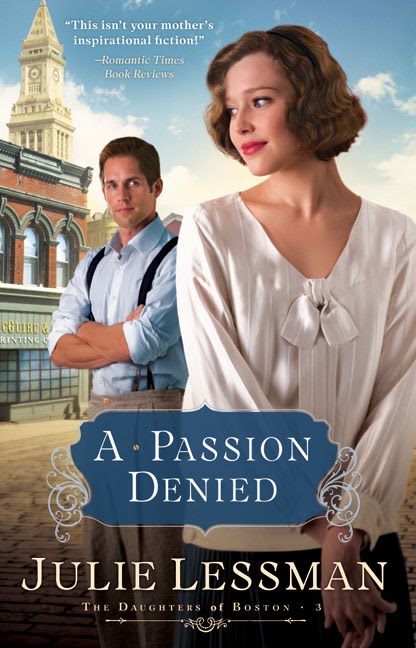
A PASSION DENIED

Let's look Julie Lessman's A PASSION DENIED, the story about a young lady who's convinced that the slightly older John Brady is her future husband; but John cannot allow his love for Lizzie to be expressed for fear of losing control of his passions because of his questionable past.


If you've read this, the third book in The Daughters of Boston series, you'll recognize that some of Julie's characters deal with bitterness. Patrick, the father of the O'Conner clan, becomes bitter when he discovers that his wife of 25 years did not love him on their wedding day. It's a good example of TSTL (Too Stupid to Live)... but he does. But while he's dealing with his bitterness toward Marcy he's headed for destruction in many ways, some of which Julie articulates, and some of which she might have added. What's evident in the story is Patrick's health fades (he spends over a month sleeping on a couch at his work rather than in his bed with Marcy). His family also begins to disintegrate as the love and honesty that has kept the family together is severely drained by Patrick's dishonesty about not sleeping at home. What Julie doesn't describe, but would be evident if this MPS were applied to all aspects of Patrick's life, would be that his business and the relationships with customers and employees similarly suffers the consequences of his bitterness.

Thus, in this particular subplot, we'd see how the natural law of sowing bitterness and forgiveness reaps opposite consequences. Now, Julie does not have to use the term "bitterness" or even "forgiveness" in describing Patrick's application of the two values. She has two options. First, she can simply describe what he does and what happens. Cause and effect. It's the simple formula that popular movies use. If you show the consequences of decisions and actions thoroughly, very little didactic explanation is necessary; and audiences like figuring things out on their own.

Second, when there is need to make clear what the story is about, Julie can open her synonym finder and for "forgiveness" come up with words like "absolve," "pardon," "exonerate," "mercy," "grace," ...etc.

Likewise, each of the other characters must also deal with bitterness, but on different levels and in different situations. John is bitter toward his stepmother for her immoral behavior, Michael is bitter with John for refusing to sign estate papers, Marcy is bitter with Patrick for not being home more, and Lizzie is bitter with John for not expressing his passion for her. When Julie goes to express this malaise of bitterness, she's likely to use various synonyms for the various characters and their different situations. John holds onto a resentment for Lucille, Michael is angry toward John, Marcy is short-tempered, and Lizzie is... is... well, all a-tizzy.

ALTERNATE MORAL PREMISE STATEMENTS

Now, Julie's novel is explicitly about passion, and so she also has the option of coming up with an alternate MPS that says the same thing as the former, but with different terms. One thing that Patrick was doing, in his bitterness, was denying Marcy his sexual passion. But he was also denying his commonplace passion for all the other things in his family's life that he loves. Thus, we might construct a different version of the MPS that works more universally:

Denying God's gifts of passion in our lives leads to separation and dread; but
Embracing God's gifts of passion in our live leads to community and vitality.

Now, I do not advocate creating different MPS for each character, because different terms do have subtle differences in meaning. What you'll discover, however, is that as you write you'll find different ways to express the same conflict of values and their consequences. As soon as you discover one expression that seems universal to all the characters in your story, latch on to it, and toss the other ones away.

PASSING IT AROUND

Using this last MPS we see that it should apply to each of the other characters, not just to Patrick. John Brady denies God's gift of passion (e.g. Lizzie) and his life is one isolated affair, Michael Brady denies God's gift of passion (for God) and is left with separation from Lizzie, John, and Helena. Lizzie doesn't directly deny God's passion for her life (John) but she does deny God's passion for patience and obedience, and that deals her so many twists and turns that I was surprised there wasn't an epilogue explaining why, at story's end, Lizzie wasn’t in a mental ward for emotionally whiplashed heroines.

On the opposite side of the moral premise we have a virtue that leads to redemption, wholeness, happiness, and life. We see Marcy and Patrick forgive the mistakes of each other, embrace each other (God's gifts of passion) and embrace, again, their role as role models for their friends and family. Lizzie finally gets the hang of pursing God's passion, even going to a seminary where she "seduces" John Brady, and there John repents of his pride (a version of denying God's passion for humility) and they finally end up together.

Given more time, we could take each of the other characters and explore how they do and don't reflect the positive and negative sides of the moral premise statement, to give the reader a satisfying and true experience. In your writing, where you can't figure out how the main moral decisions that define the turning points in your story fit together, it's time to change your story so they do.

THE GOOD OF SUFFERING

Now, some of you may be sharp enough to ask, how do you wrangle a MPS when the story is about the importance of suffering? My answer is that your characters need to reflect the reality of life if they are to connect with readers, and suffering often occurs to real people even when they make morally good decisions all the time. Yet, when bad things happen to good people it may seem to negate the Moral Premise concept. But the moral premise is not karma. For example, a karma understanding of Jesus' life and death would suggest that Jesus, to be murdered like he was, did something really bad. But a correct understanding of reality tells us that his passion and death resulted in an ultimate good, for all people, in all time, and all places. So, his goodness, had an eternally good outcome. In like manner, any of your characters suffer something bad, which brings ultimate good. A MPS form that works for such situations is:

Doing what is right, though it leads to immediate death, brings ultimate freedom; but
Doing what is wrong, though it leads to immediate life, brings ultimate slavery.

Another example: The MPS for the movie BRAVEHEART, where William Wallace's courage and sacrificial leadership led to his death, can be stated like this:

Compromise of liberty leads to tyranny; but
Dying for liberty leads to freedom.

The one thing you can never do with the MPS (and have it work for you) is to have it say something that is not, in reality, true. Only TRUE moral premise statements lead to success.

THEMES vs. PREMISES

One of the things many writers do (and several of you have told me this) is to focus on a theme of what you're writing, by printing it on an index card and taping it over your computer screen. But a theme is only going to solve 25% of your problems. What you need is the 100% solution.

Let me explain by looking at Cheryl Wyatt's A SOLDIER'S PROMISE. Here we have the story of Amber, a private school teacher, her young student Bradley who is dying from leukemia, and a U.S. Air Force pararescue jumper, Joel, who literally drops into their lives. Because of what appears to be different value systems, the relationship Amber and Joel both seek is in doubt (at least for 200 pages, although this IS a romance, and there's not a chance they won't end up together).


The THEME of A SOLDIER'S PROMISE could be expressed in any one of these four ways.

a. Timidity Meets Stubbornness
b. The Isolation of Love
c. Sacrifice of Self
d. The Demands of Relationship

But tacking one of those onto the edge of your computer screen may ultimately result in writer's block. Why? Because a theme alone does not answer the basic story structure questions. For instance, using just ONE of those themes does not answer:

a. What happens when timidity meets stubbornness?
b. Under what circumstances does love isolate?
c. What good does it do to sacrifice oneself for any cause?
d. What are the demands of a relationship?

But look what happens when we take those themes and put them into a cohesive moral premise statement? Here are two versions of the same story:

Commitment without compromise leads to isolation; but

Commitment with compromise leads to relationship.

And...

Timidity or stubbornness leads to isolation; but
Sacrifice and love leads to relationship.

Or, you might combine them:

Commitment without compromise (due to timidity or stubbornness) leads to isolation; but
Commitment with compromise (because of sacrifice and love) leads to relationship.

Now, you have answers to those writer’s-block type of questions and you know what inner struggles of values your characters are struggling with, and what the results are going to be when they give into to one value or the other:

a. What happens when timidity meets stubbornness? The characters experience some form of isolation or separation.

b. Under what circumstances does love isolate? When the characters refuse to compromise on their goals for the sake of the other.

c. What good does it do to sacrifice oneself for any cause? It leads to relationships with like-minded individuals.

d. What are the demands of relationships? That the people involved compromise as part of the commitment process. It's what true love does.

With those answers you are ready to plot out the conflict and the sort of decisions that will result in bringing this couple to the altar.

OTHER EXAMPLES

In Mary Connealy's western romantic comedy PETTICOAT RANCH, it's 1867 in Mosqueros, Texas, and Sophie and her daughters are hiding out in an old cabin in the brush from the outlaws that killed her husband, Cliff, and took their ranch. One rainy night they rescue a man who runs his horse into the ravine. The man is Cliff's unknown (good) twin brother, Clay, who has come to rescue Sophie and the girls. But of course, this is a romance, so before we "let" the man rescue the girls (or pretend to), the girls have to first rescue the man (or we're led to believe they did). (Yep, this here is a man writing?)


A good moral premise for PETTICOAT RANCH, which applies to even the minor characters is:

Seeking revenge leads to destitution; but

Seeking justice leads to satisfaction

Revenge is seeking to control others for our personal twisted understanding of satisfaction. If you're familiar with this story, you'll notice that this moral premise theme is applied to each character. Cliff sought revenge on Sophie for not birthing him a boy...even though we now know it was HIS gene's fault. Clay is hounded and hoodwinked by the womenfolk when he seeks to silence them for what he mistakenly thinks will give him peace. Adam battles the revenge he feels towards Judd and the gang, but by suppressing it he's able to help bring about justice. Sophie's thoughts of revenge probably led her into the bush and using foul-smelling disguises, a form of destitution. But with Clay's help she argues herself back to the justice theme. And Judd, the epitome of revenge, leads himself and his gang to destitution, at least to the degree allowed by Christian romance. I wanted a bit more justice, frankly, my dear.

MOMENTS OF GRACE

In The Moral Premise, I write about the importance of MOMENTS OF GRACE (MOG), the midpoint in a character's arc where they change their motivations from that of the vice side of the MPS to the virtuous side. The moment is brought about by the trials pushed upon the character by their nemesis. (c.f. James 1 about how trails make us stronger.) For the protagonist the Moment of Grace is usually in the middle of the story. For other characters, it can appear anywhere, even in the story's climax.

Revisiting PETTICOAT RANCH for a moment, Sophie and her new husband, Clay, are at each other's throats. Clay wants to take care of Sophie and the girls (Mandy, Beth, Sally and Laura) but Sophie has done just fine (almost) without Clay's help and it's a little hard for Sophie to give up her independence. She's still feeling revenge for the past years, and she's really not ready to give in to a man, fully. Until, that is, Judd's gang tries to kill her and Clay by taking potshots at them while they work on their ranch. At that moment Sophie starts to change.

In Ruth Logan Herne's WINTER'S END Kayla Doherty, R.N., is a hospice nurse who braves the cold, harsh winter of upper New York State to care for Pete DeHollander, a dying man in his old, drab, but well-kept farmhouse. Years before WINTER'S END begins, Mrs. DeHollander, tired of farm life and marriage, left the family for the big city, leaving Pete to raise Marc and kid sister, Jess, an active 4H'er. During Kayla's visits to the homestead, Marc becomes Kayla's bittersweet love interest. He knows how to run the farm and the feed store and guide Jess in her animal husbandry projects, but one of the things that separate him from Kayla is Marc's lack of Christian faith.


The story's MPS can be stated like this:

Bitterness toward those that hurt us leads to confusion and separation; but


Forgiveness of those that hurt us leads to purpose and attachment.

In the center of the story Jess' horse, "Grace," gives birth to a filly, that Jess names "Glory." It's an emotional moment as Marc leads Jess to the barn to see the foal for the first time. Marc thinks Jess will name the foal "Sweetheart," but Jess says, "Not now that I've seen her." (Jess) eyed Grace for a moment, then turned Marc's way. "She'll be Glory...the beginnings of my breeding program. Grace and Glory." Ruth then writes:
The names stopped Marc's progress. His throat tightened at the look on Jess' face, her belief in all things holy.

Her strength tweaked a memory of a boy who believed in God, in heaven and hell. Gifts of the Spirit. For a moment he couldn't say anything, then he took a step back, approving. "Nice combination, Jess."

A smile lit her face, her eyes on the mother-foal duo. "Yes. It is."
Now, I like very much how this is written. The layered meaning of the new birth of the foal and the words spoken between Marc and Jess, parallel the rekindling of new birth in Marc's heart, and the budding of "true" romance between Marc and Kayla. This is the moment of grace for Marc, and it's not accidental that the horse's name is Grace, or that accepting grace can usher one into glory, in this life and the next. And that is the turning point for Marc, and thus a major turning point for the whole story. Nice job, Ruth.

So, writers, please understand the critical importance of a Moment of Grace in all your characters. At moralpremise.blogspot.com I explain many other MOG's, both for the good guys and the villains.

LEFT BRAIN VS RIGHT

This whole approach to writing, using the moral premise as the cornerstone of your story's structure, sounds a little left-brained. And it is. Unfortunately. I think most creative people are right-brained. And if you try to write using your left brain (as I often do) you may end up with something that is technically flawless, but doesn't resonate with vitality. That is a problem with using the moral premise too literally and following it legalistically.

In Myra Johnson's AUTUMN RAINS, Valerie Bishop is the widow of Tom, a man who, while walking across a street to mail a letter to an incarcerated friend, Gus, is hit by a car driven by criminals who are evading police. The "accident" puts the criminals on the run and one of them grabs a pregnant Valerie as hostage and then pushes her away into an obstruction that causes a miscarriage. Valerie, suffering psychologically with the wound of her double loss, imprisons herself in her brother's home, caring for the house and her brother's family. Until Healy Furgeson, an ex-con, shows up to live above the garage.


The moral premise for AUTUMN RAINS can be stated like this:

Trusting in your own wisdom and knowledge leads to a dreadful imprisonment; but

Trusting in God's wisdom and knowledge leads to a pleasant freedom.

When I wrote to Myra and told her what I thought the MPS was for the book and what Valerie's Moment of Grace was, Myra disclaimed any awareness of either. But the book solidly contains both. Myra wrote:
...not to say I don't put a lot of thought into scenes, characters, and plots, but honestly, I don't know the details of what's going to happen until I'm immersed in the writing. Later I will look back at a completed ms. and wonder where in the world some of that stuff came from! For me, it's the most fun part of being a writer--the journey of discovery!
Myra is very typical of good writers. In chapter 4 of The Moral Premise I describe the "natural processes" of how stories come to Hollywood writers—Trial and Revision, Instinct & Osmosis, Naturally, Talent, and Perseverance & Perspiration.

As Myra suggested in another part of the email, good writing isn't so much about following formulas, but about allowing the Holy Spirit to inspire us and to keep before us the Truth about which the story is really about.

~~~~~~~~~~~~~~~

Stanley D. Williams, Ph.D. is an independent television and film writer-producer and author of The Moral Premise: Harnessing Virtue and Vice for Box Office Success. He is also a story consultant to Hollywood, workshop leader, and speaker. He can be contacted through his book's website, moralpremise.com or his movie blog moralpremise.blogspot.com

~~~~~~~~~~~~~~~

Stan has offered to stop in as time permits and answer any questions you may have about The Moral Premise, so let's get the discussion flowing! Also, leave your e-mail address to be entered in a drawing for a copy of Stan's book. Once you've grasped this amazing concept, your fiction will never be the same!


Wednesday, April 28, 2010

GUEST MONA HODGSON: THE TRUTH IN FICTION


Many of my closest friends are liars. But they might prefer the title storyteller extraordinaire. Tale-weavers. And whether the literary yarn they spin is set in an actual place or based upon real life events and historical characters, they are authors of fiction. I am too. And as novelists, we have chosen to write fiction, not fact. But even so, is the story we weave truly and completely made up?
.
Not the best stories. All compelling fiction resonates with readers. Why? Because the best stories are rich in truth.
.
Why has Gone with the Wind by Margaret Mitchell camped on bestsellers’ lists? Why has it inspired movies and spin-offs? Why is Gone with the Wind a classic? Because the story told the truth. Even though Scarlet’s tale wasn’t necessarily formed in actual reality, the setting and characters, action and themes offer a tapestry of honesty that can make a work of fiction feel more real, at times, than life itself.
.
You and I can tell the truth in our novels too. Using those four central threads of fiction, you and I can create an honest story world and premise that will provide a platform for truth. I say we take a longer look at how we might best use them to deepen the realness of our fiction.
.
SETTING
.
As the backdrop for the action, the setting anchors your story in time and place. How can setting add truth to your fiction? You and I are affected by the location in which we find ourselves. We react to our setting on physical, emotional, mental, and perhaps even a spiritual level. Sometimes we’re aware of our reactions, other times they take place in our subconscious. .
Where is your story set? At a plantation in Georgia? Tell me more. Actually, it’s Tara, a cotton plantation Scarlet’s father named after the hill of Tara, once the capital of the High King of ancient Ireland. When? Through the Civil War and into the reconstruction period. That’s more like it.
.
The time period in which your story unfolds has everything to do with the setting. And that’s true whether it plays out in a historical time and place or whether it’s contemporary. Setting isn’t limited to a pin on a map, but also provides a cultural, social, and political context in which the characters act, interact, and react. Consider the West Coast of America in contrast to the South. Ireland in the1600s and the USA in that same time period. What about settings where women are finally able to vote? And post 9/11? These events will be considered and remembered differently, depending upon the setting and situation in which the characters experience them.
.
So think about it . . . what is your main character’s surface and gut-level reaction to the details and fullness of their setting? If you and I are being true to the time and place, a clearly defined setting will impact our characters, and, consequently our readers because they will recognize honesty in the setting.
.
CHARACTERS
.
Scarlet O’Hara was fake only when she chose to be to serve her purposes. Otherwise, she was one of the most “real” characters we’ll find in literature. An individual through and through, Scarlet was bathed in the truth of human nature—replete with strengths and weaknesses, self-centered pursuits and dogged determination in the company of tragedy.
.
In his book, Writing the Breakout Novel, Donald Maass says, “Inner conflict is what makes a character truly memorable.” I would add that a character’s inner conflict is what invokes honesty.
.
Margaret Mitchell imbued Scarlett, a multi-dimensional character, with a clearly defined goal—to win Ashley’s heart, and then to save Tara and win Rhett Butler back. We watched Scarlett’s desires unfold and change and deepen, along with the setting in which she found herself.
.
How do you draw truth out of your character? We saw it with Scarlet. It’s through the fascination and friction inherent in human relationships (fictional ones included) that reveals true character. And that’s true whether those secondary characters are love interests, antagonists, sidekicks, or mentors. They provide a means for the reader to see the main character’s vulnerabilities and strengths.
.
So what does your character want? What must he or she achieve or overcome? Why? Where lies their motivation? What is at risk if he or she doesn’t meet their goal? What will happen if their objective changes?
.
If you “flesh out” the character and her journey and outcome, you’ll be writing truth in
fiction.
.
ACTION
.
The story plot consists of a series of actions inspired by a character’s goal and motivation, driven by the interactions with others, and deepened by the roadblocks they face, which may in part be inherent to the setting they find themselves in.
.
For instance, Two Brides Too Many, Book One in my Sinclair Sisters of Cripple Creek Series, is set in a mining camp in Colorado in the late 1890s. There are many truths intrinsic to the time, place, and culture of the Wild West mining camps. Ore fever, most definitely. Prostitutes, certainly. In that time period, most of those towns were still made of wood. Those that were went up in flames at least once and, most of them, many times before the town’s people chose to rebuild using brick and stone. Kat Sinclair encounters one of those fires in Cripple Creek, which serves as a key plot point in her journey, fueling action on her part and on the secondary characters with whom she interacts.
.
Here’s what Donald Maass had to say about plot, “What is plot if not an account of the many complications thrown in the way of your hero? Complication can be inner, psychological, and private, or they can be external, unprovoked, and public.”
.
Basically, plotting is the action your character takes to overcome the obstacles and work through the conflict that stands in the way of him or her reaching their goal. Gone with the Wind is resplendent with such action.
.
Have you used setting honestly in plotting your story? Is there truth in the reactions and actions of your character?
.
THEME
.
The theme provides the walk-away value in the story. What central truth do you want your readers to recognize in the setting, the characters, and the action and take with them when they close your book?
.
In Plot & Structure: Techniques and Exercises for Crafting a Plot That Grips Readers from Start to Finish, James Scott Bell writes, “Develop your characters fully and set them in the story world where their values will conflict with each other. Allow your characters to struggle naturally and passionately. Theme will emerge without effort.”
.
Margaret Mitchell didn’t break into the story to tell us the themes of Gone with the Wind. Through setting, characters, and action, she showed us triumph over tragedy and there is strength in love. In Two Brides Too Many, I showed God making a way through the wilderness for those who placed their trust in Him.
.
The message or moral of your story will only ring true when your characters carry the theme with them on their journey from goal through conflict to resolution. In his book, Writing the Breakout Novel, Donald Maass adds, “If authentic, theme is not something apart from story, but something intrinsic to it. It is not embedded, but rather emerges.”
.
What truth about themselves, the world, God, and others will your reader take with them after reading your story?
.
Where is the truth in fiction? Yes, it is in the details. But it is birthed deep within you—the writer. I’m trying to dig deep to create stories rich in authentic settings, characters, action, and themes. Join me?
.
1. Think about the books you’ve read. To what book do you attribute honesty, a certain truth in the storytelling?
.
2. What aspect—setting, character, action, or theme do you feel contributed most to the story’s honesty? How?
.
Leave comment today (and your email address) and be eligible to be entered in a drawing for a copy of Two Brides Too Many!
____________
.
MONA HODGSON is the author of Two Brides Too Many (May 2010) and Too Rich for a Bride (October 2010, available exclusively at Walmart), the first two books in the Sinclair Sisters of Cripple Creek Series (WaterBrook Multnomah). Her writing credits also include 28 children’s books, Real Girls of the Bible: A Devotional, Bedtime in the Southwest, and four Princess Twins books. You can follow Mona here at Twitter and become a Facebook fan at the Mona Hodgson Fan Page. To read the first chapter of Two Brides Too Many, go to http://www.monahodgson.com/, click on Mona’s Novels then on Sneak Peek.

Thursday, March 25, 2010

Story Ideas


After returning from my RWA chapter conference (Gulf Coast Chapter) on Sunday afternoon, I thought over what I'd learned and enjoyed the most. It was an exhilarating and exhausting weekend at Pensacola Beach, Florida. The conference, appropriately named Silken Sands, had all the ingredients necessary for a great experience--editors and agents, wonderful workshops given by knowledgeable speakers, good food, meeting old and new friends and a touch of magic--sugar-white sand and turquoise Gulf waters.


One of my favorite workshops was presented by Lenora Worth, a talented Steeple Hill writer. In "How to Write a Good Book based on the Good Book" she discussed how we can base our inspirational stories on the 10 Commandments or the fascinating stories in the Bible. They're all about flawed people and their relationships with God and with each other.


Like us, the 'characters' are real--not sugar coated--and damaged by their sins. They're all caught in the human condition just as we are--we're born, we live, we know our ultimate fate is death and then we face death itself. And then what? We have to ponder this reality, accept it and decide how to deal with it and how it effects our life. Of course with faith in God it's not as grim as it sounds. In fact, we have great hope. But still we're dealing with an unknown we have to grapple with and can't avoid.


How our characters respond to the human condition and their particular situation in life can be explored in depth in our stories. Our story people can be flawed by one of the 7 Deadly Sins: pride, envy, gluttony, lust, anger, greed and sloth. Or they might have one or more of the 7 Heavenly Virtues: prudence, temperance, courage (fortitude), justice, love, hope and faith. Think of all the tales you could develop from just these attributes.


Stories can also revolve around the 7 Corporate Virtues: feeding the hungry, giving a drink to the thirsty, giving shelter to strangers, clothing the naked, visiting the sick, ministering to prisoners, burying the dead.


Trust, forgiveness and redemption are common themes in Christian stories. Other themes might include respect, integrity, honor and dishonor, good versus evil, corruption versus justice, doing the right thing in the face of difficulty and cherishing relationships over material things.


So our story ideas can come from the Bible, not just from newspapers and fairy tales. Can you adapt a Bible story to your own writing? Francine Rivers certainly can!