Showing posts with label Asked & Answered. Show all posts

Thursday, January 12, 2017

Asked & Answered, Part 3: Proposals and Query Letters


Good morning, Seekerville! You asked and we answered with a four-part series covering some very important aspects of writing... My assignment? To talk query letters and proposals this week. These are important matters. You know this. That's why you asked. But you also know that the first and most ginormous part of getting published is Write a Great Book... and you can do this! So get that part done. Nobody buys a blank page. No one buys an idea.... Put the proof in the pudding, write the book(s) and polish them... and have fun doing it! I want you to love this job, this career, these amazing opportunities surrounding us today! And then let's write that query and polish that proposal...


Yes, you read that right. Seventy-nine pages. More about that later!

There's a lot to talk about here. And I mean A LOT. There are multiple reasons for this. It used to be a fairly cut-and-dried process. No more. The publishing landscape has changed radically in the last decade. Heck, it's changed that much again in the last few years. How do you keep up? How do you sort it out?

Easy.

It's all mathematical. 


If you are aiming at building a strictly indie audience, you won't need to use query letters, proposals, synopses or cover letters. That's a ginormous difference in time out-put. Don't minimize that from a professional standpoint. Time is money in every business. Including yours!

If you go the indie-route you will write your book(s), arrange for a cover and formatting (or do it yourself), hire an editor (or trade editing with another writer and possibly ruin a friendship or the story), revise as needed and publish, taking your chances on an excited readership. So if you pick CHOICE ONE: Indie publishing, you don't need this blog post, but keep it in your writing folder because a lot of authors cross over the lines... and it's good to have info on hand.

Let's talk query letters first.

Basically a query letter is a one-page sales pitch. It's not the chance to talk about your hopes and dreams or kids and hardships, although relatable glimpses can help agents and editors "see" you better. It's a chance to attract the editor or agent to read more. Now if they read two paragraphs of your work and set it aside with a stamped rejection, a great query won't save you. Think Chip and Joanna and "Fixer Upper" (I love Fixer Upper)... when people know it's a match, they'll plunk down their money right quick. So write the best book you can... and think of the query as the frosting on the cake.

My post from 2011, "Nail That Query", the same advice I'd give today because it worked well. I'll be watching my 20th Love Inspired hit the stands next November... so catching Melissa Endlich's eye with that letter (and a story she loved!) was clutch to launching my career.

Myra's post from 2015 "Crafting a Catchy Query Letter", great advice, point by point. Myra gives you a step-by-step approach and explanation based on her years of experience. And like anything else, practice makes us better. Write... then re-write the letter, parsing words and phrases to make yourself sound (perhaps!) a little better than you are... but still honest. :)

Courtesy of Tina Radcliffe, Seekerville.blogspot.com
And now on to proposals...

Do not let this scare you. A basic proposal is generally this format for submitting to agents and our Love Inspired editors:


  • Cover letter (I use the same thing I would do in a query letter)
  • Synopsis (I suggest 4-5 pages long, be concise and chronological. Think technical writing, not creative writing)
  • First three chapters
  • Author Bio (here's where you can either sound very professional or funny. I like to match my bio with my personality, so my bios are humorous and poignant.)


A basic proposal is primarily your chapters, synopsis, bio and cover letters. So about 50-55 pages.

So why was mine 79 pages long, you ask?

Well because once you have a track record, you have to note it. So if a book bombs (and they do, for multiple reasons) it's right there in black and white for the entire publication committee to see. (SERIOUS QUAKING GOING ON).

There is no hiding numbers. 


But if there are lots of good numbers, and a few shakier ones, savvy publishers realize that writers can only do so much. Some things are out of our control.

I also have to include comparables in my project, books in the Christian or ABA market that my books would stack up against. I include reviews from Amazon and Goodreads. I present my online profile, what I do on facebook, twitter, website, blog and here in Seekerville (thank you, my friends!) and Yankee Belle Cafe. My job is to show the editors and publishers and the SALES TEAM that I'll do whatever it takes to help present my work to the public.

The sales team needs to see you and your work as marketable. You are impressing them as much as you are anyone else, and they are an unseen entity. When I was offered my contract with Waterbrook for the Double S Ranch series....


I found out they'd been watching me for a while. My online presence. My work ethic. How I interacted with people on my blog, my website, facebook, Seekerville and Twitter. I had no idea they were tuning in... Because honestly, once you're online, your life is pretty much an open book.

It wasn't that I impressed them with my skills. (grinning!) But I never stop trying, and they noticed.

Once you are published, the record-keeping of those sales numbers becomes part of your job. It can be a humbling effect.... but also a great motivator. Writers learn to enrich their "discoverability" in whatever way works.

Things are different than they were that decade back. From Publisher's Weekly 9/14/16Meanwhile, Dave Lewis, executive v-p of sales and marketing at Baker Publishing Group, said changes in the Christian market reflect struggles in the general trade. “Christian bookstores went away dramatically in the last decade; what’s happening there is what’s happening to everybody,” he said, citing losses due to the recession, digital sales, and Amazon. “Consolidation is happening across the board.”

As authors it's our job to be savvy to the market. Not to jump on bandwagons... that wheel still goes round, and that fly on the top will make his way to the bottom. We are more than authors. We are businessmen and women.

Your proposal should be crisp and clean. A straightforward cover page. Your very best opening chapters, no mistakes. No grammar, formatting, spelling errors allowed... that means slice and dice as needed.

Laurie Tomlinson did a great blog on synopses last week. LINK IS HERE

Courtesy of Just Commonly.blogspot.com
I would advise you to not send things out before you're ready, but WE ALL DID IT! And we survived! Went on to flourish! I wish I could go back and snatch all those half-baked ideas off folks' desks, but oops.... and in the end, I/we learned a lot from those early mistakes and mis-steps.

Contests are a huge way of cleaning up your work. Getting feedback that isn't from a critique partner or group is good for us. It can be eye-opening.... possibly gut-wrenching.... but it's a teaching tool for a very reasonable price.

Mostly, you need to write. Make writing a habit. A good habit! And don't let fear or discouragement dog your days.

Our theme for 2017 is "Look How Far We've Come!" and that's the positive attitude I want you to take into your daily routine.

One day at a time... a solid work ethic... with blinders on. Don't assess yourself by someone else's win/loss ratio. Be your own person. Plan the work and work the plan.

And wow, this was a whole lot of serious going on here today.... So to lighten things up, I've got a book and chocolate combo pack coming someone's way. You get your choice of any Ruthy book I have in stock.... and chocolate. :) Because Ruthy and chocolate go hand-in-hand! And for you authors out there, I'll do a cover or query letter critique.... but let me know in the comments that you'd like it, that you're ready for  it...  Let's go into this new year with light and encouragement brightening our paths.

Multi-published, award-winning author Ruth Logan Herne has sold nearly two million books and still pinches herself when she wakes up each morning to make sure it's all real... It is and she's delighted! She loves to connect with readers and writers on facebook (Ruth Logan Herne), through her website ruthloganherne.com and @twitter as @ruthloganherne.

You can also stop by her personal blog ruthysplace.com, a fun place to stay up to date on contests, thoughts, books... or visit her today at the Yankee Belle Cafe where she'll share the most delicious apple cake she's ever made.... Print it off and try it, see what you think!

Come on inside... coffee's on... and tell me what scares you most about the business side of writing.... and I'll talk you off the ledge, darlings!


Tuesday, January 10, 2017

Asked & Answered, Part 2: Social Media and Other Techy Stuff

Myra here. For some unfathomable reason, I have earned a reputation among the Seekers as one of the more techy/social media types. Maybe it’s because somewhere along the way I figured out how to Tweet and create memes.

Or maybe because Tina looked at me and saw G-U-L-L-I-B-L-E tattooed across my forehead.
Anyway, I have been assigned the dubious privilege of presenting this portion of our Asked & Answered series. So, without further ado, let’s get right to some of the questions and concerns our Seekervillagers have submitted.

“Twitter hashtags confuse me.” Well, guess what. They often confuse me, too, especially the really random ones. Basically, the purpose of a hashtag is to label your Tweet according to a popular or trending search topic. That’s why many of our Seekerville Tweets include hashtags like #amwriting, #writetips, and #pubtips. Anyone interested in following Tweets about the business of writing can search for any of those hashtags and find a whole stream of Tweets from Seekerville and others who post on writing-related topics.

Other hashtags writers and readers regularly follow: #giveaway #Kindle #motivation #inspiration #quotes #ChristFic (short for Christian fiction) #amreading #sweetromance #FHLAuthor (promoting members of the Faith, Hope & Love chapter of Romance Writers of America) #MSWL (manuscript wish list, often used by agents and editors!)

The key to using hashtags effectively is to avoid getting too creative with your own. Instead, if you want your Tweet to reach the most people, do a search of the terms you’re considering and see which ones generate the most results. Regular Twitter users have favorite hashtags they follow, so you want to make sure your Tweet shows up in the appropriate lists.

“I still don’t understand how to post a pic on Twitter. It never works for me.” This is really pretty simple. If you have your Twitter window open on your computer, you’ll see a little window near the top with “What’s happening?” in faded type. That, of course, is where you enter your Tweet. Now look just beneath the white box. You should see a camera icon. When you click on it, you should be able to choose an image from your computer and add it to your Tweet. Easy-peasy!

Of course, there are optimal image sizes for various social media outlets. For Twitter, the ideal in-stream image should measure 440 px wide by 220 px tall (minimum) up to 1024 x 512. Here’s a handy reference with recommended graphics sizes for several popular social media sites: The Ultimate Cheat Sheet of Photo & Image Sizes on Facebook, Twitter, LinkedIn & Other Social Networks

If you access your social media accounts from a smartphone or tablet, the easiest way to post an image is to select a picture you have saved on your phone, then bring up the menu that lets you choose one of the share icons. That should allow you to post directly to Facebook, Twitter, or one of your other supported profiles.


While we’re on the subject of social media images …

“What are the best apps for creating and editing social media graphics?” A popular and easy-to-use online tool is Canva. Canva gives you a wide variety of image sizes to fit just about any social media need. They offer many free layouts, backgrounds, text fonts, and images, plus even more you can purchase for $1 each. (Be sure to read the disclosures about how and where you can use any images you purchase.) The site also has a tutorial to walk you through the steps of creating your own designs.

Picmonkey is another image editor worth trying. You can choose from one of their templates or start from scratch.

A new online graphics program I’ve recently started using is Stencil. It has both free and paid versions and works a lot like Canva, although it lacks some of the image editing/resizing tools. While they have a huge collection of images to choose from, you can only use them as backgrounds for your own uploaded images or with their limited selection of icons. Then you can add text to create unique and attractive social media graphics. You can also easily convert a rectangular Twitter graphic, for example, to a square Facebook or blog graphic, without having to start from scratch.

I also highly recommend Unsplash, a FREE source of hundreds of amazing and gorgeous photographic images! Their website says it simply: “Free (do whatever you want) high-resolution photos.”

And here’s one more free resource Seekerville just came across: The Ultimate Guide to Designing Epic Social Media Images.

“Social media: time, content, which ones to post on?” It’s true, social media can be a HUGE time suck! There’s no one-size-fits-all answer for which one(s) you should focus on. Basically, it comes down to a combination of where you’re personally most comfortable AND where the audience you hope to connect with usually hangs out.

Here’s a side-by-side comparison of Facebook and Twitter that you may find helpful: Difference Between Facebook and Twitter. Or check out this article, The Difference Between Facebook, Twitter, Linkedin, Google+, YouTube, & Pinterest, for a rundown on all the major social media outlets.

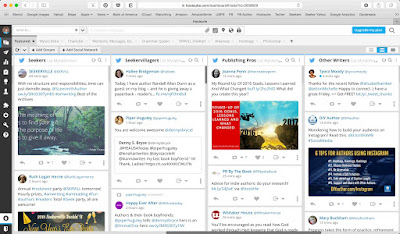
One simple tip for making Twitter or Facebook easier to navigate is to create lists. Group the people you’re most interested in following into category-specific lists. Here are a few of my personal Twitter groupings:

  • Seekers
  • Other Writers
  • Publishing Pros
  • Inspiration
  • For Fun
  • Movies & TV

This way, when I visit Facebook or Twitter, I don’t have to wade through the entire feed. Instead, I browse through my lists, where I’m seeing only the status updates I’m most likely to be interested in. For Twitter, you can create, manage, and view lists directly through the Twitter site, or you can use an application like Hootsuite (my personal favorite). Here’s a screenshot of a few of my list feeds:


As you can see, Hootsuite also lets me create tabs so I can group related lists on their own pages. With the free version, I can access Twitter from three different profiles. With the paid version you can add even more profiles, including many of your other social media accounts. Find out more at Hootsuite.com

“I’ve heard Instagram has changed recently. Should I have a business page there?” I’m definitely not an Instagram expert, but based on things I’ve read, I haven’t come across any real advantages to converting to a business account. I enjoy Instagram for the personal connection. I don’t use it to buy products, and I tend to skip right over any posts that even remotely smack of advertising. (Same for Facebook and Twitter, BTW.) Here’s an article you may find enlightening: Why Converting to Instagram Business Is Not a Winning Brand Strategy.

“Are platforms needed for unpublished authors?” “Platform” can be a confusing, even intimidating, concept. Nonfiction writers have it much simpler because typically they have particular knowledge about a subject and may already have a speaking platform. A fiction writer’s platform is not always so clear-cut. Jane Friedman offers her insights here: A Definition of Author Platform. In light of our discussion of social media, one of her key points is especially noteworthy: “being an extrovert on social media will not, by itself, lead you to a platform that interests publishers.”

“People say unpublished authors should have web sites and author Facebook pages. That seems kind of premature.” Again, I’m going to refer you to a Jane Friedman post, 3 Reasons to Have a Website If You’re Unpublished. I completely agree with her point about getting past the learning curve! As for whether an unpublished writer needs a Facebook author page, my opinion is no. An author page is mainly there to interact with readers and to share news about your current and upcoming releases. Instead, focus on an attractive, user-friendly website that editors and agents might refer to if they’d like to learn a little more about you.

For tips on how to use Facebook more effectively, read How to Engage on Facebook WITHOUT All the Stress & Strife on Edie Melson’s blog.

You can garner more detailed information on other aspects of social media from these posts that previously appeared in Seekerville:

Adventures in Social Media, Part 1, with Audra Harders
9 Ways to Boost Your Social Media Presence, with guest Edie Melson
Be a Successful DIY Author Techie, with guest Angela D. Meyer

Switching gears, let’s address one last techy-type question. A Seekervillager asked us to share some Scrivener tips and tricks. Obviously, Scrivener is WAY too extensive a topic to cover in a couple of brief paragraphs! For starters, check out this guest post from Scrivener expert Gwen Hernandez: Scrivener—Everything But The Muse. Learn even more by taking one of Gwen’s online Scrivener classes! You can also follow @ScrivenerCoach (Joseph Michael) on Twitter for daily tips and tricks.


Two giveaways today! Join the conversation for a chance to win a Kindle copy of Edie Melson’s social media guidebook, Connections, OR a paperback copy of my historical romance novel The Sweetest Rain (Flowers of Eden, book 1). Just mention in your comment if you’d like to be entered in either or both drawings. Winners announced in the next Weekend Edition.

About Myra: Award-winning author Myra Johnson writes emotionally gripping stories about love, life, and faith. Myra is a two-time finalist for the prestigious ACFW Carol Awards and winner of Christian Retailing’s Best for historical fiction. Originally from Texas but now residing in the beautiful Carolinas, Myra and her husband love the climate and scenery, but they may never get used to the pulled pork Carolinians call “barbecue”! The Johnsons share their home with with two very pampered rescue doggies who don’t always understand the meaning of “Mom’s trying to write.” Myra and her husband are also currently harboring their younger daughter and family (six in all plus a kitty!) as they transition toward their next missionary calling. With grandkids underfoot ranging in age from 14 down to nearly 3, there’s never a dull moment! 


Twitter: @MyraJohnson and @TheGrammarQueen 

Sign up to receive Myra’s quarterly e-news updates here!

Monday, January 9, 2017

Asked and Answered Part 1: Conflict and Character Arc


By Missy Tippens

Welcome to our first Asked and Answered post! Last year, we offered a survey to find out what topics our readers would like us to address in our posts. I’m kicking off the first of our four-part series today talking about two topics brought up by multiple respondents. I admit I chose the topic of conflict because it’s something I struggle with. So, writing this post has been a nice review!


First, briefly, conflict is what drives our plot. The character wants something (her goal) for a very good reason (motivation), but then something gets in her way, making it impossible to achieve that goal (creating conflict). So the character has to react to that “disaster”, make a decision about what to do next, and then act on that decision. These actions and reactions build our scenes/sequels, and thus our story.

The book that I have used most when studying internal and external conflict is the much-loved Goal, Motivation & Conflict: The Building Blocks of Good Fiction by Debra Dixon. I found several posts in our archives and thought I would share those with you today, as I don’t think I can cover the basics of the topic any better.

[Please note! I want to provide new links since some of the links in these older posts no longer work. I’ll leave them at the end of my post.]

Here is one of my previous posts where I share my GMC chart for His Forever Love. I show how I usually combine a standard GMC chart with the Magic Conflict Chart from Carolyn Greene’s Prescription for Plotting Notebook (updated info at the end).

Here’s is another of my posts on the topic of using your GMC chart to help you plot out your scenes. This is a great way to incorporate the characters’ internal and external conflicts into scenes that move your story forward. (Please note this post contains spoilers if you haven’t read The Doctor’s Second Chance yet.) In the post, I have copied and pasted sections of my brainstorming file to show how I came up with scenes used in the book.

This is a post by Tina Radcliffe where she talks about the beauty of using a GMC chart and shares an example from The Rancher’s Reunion.

Here's a good basic post about conflict (what it is and what it isn't) by Janet Dean. She shares her GMC chart from The Bounty Hunter's Redemption.
http://seekerville.blogspot.com/2016/10/conflict-roadblocks-to-your-characters.html

This is a post by Cara Lynn James where she shares how important motivation is while doing your GMC chart. She uses examples from Love On a Dime.

I hope that reading these posts will be a nice refresher on creating internal and external conflict for each of your characters.

In a blog post on her website (click here), author and writing mentor K.M. Weiland tells us that conflict by itself is not enough. We need for readers to have empathy, to care about one of the characters. The character must be relatable enough that the conflict matters.


I think that for us to care about a character, we need to see the character make a journey—to battle through conflict, to grow and change and earn the happy ending. So, for the rest of my post, I want to talk about character arcs. In researching the topic, I discovered K.M. Weiland’s new how-to book that I’m finding very helpful. It is Creating Character Arcs: The Masterful Author’s Guide to Uniting Story Structure, Plot, and Character Development.

Some things that I highlighted in this book:
-- Characters resist change.
Resistance --> Conflict --> Plot.
-- We need to figure out the misconception the character has about himself or his world, or look at what he’s lacking in his life. Once we the author knows what’s wrong, we can set him off on his journey of change.
-- There is conflict between what the character wants and what he needs.
-- The external plot is all about the character's inner journey.
-- I love one way Weiland described character arc (in chapter 21): “Character arc is always the final sum of your story’s ending minus your story’s beginning.” There are different types of character arcs, but for those of us who write romance novels, there is usually what Weiland calls a Positive Change Arc. The character goes on a journey from overcoming a lie he believes in the beginning of the story to making a positive change by the end so that he’s in a better place, a place of truth.


That’s all I’ll share for now. Weiland’s book Creating Character Arcs: The Masterful Author’s Guide to Uniting Story Structure, Plot, and Character Development is packed full of information!


To finish up, I wanted to share some other blog posts about character arcs that you might find helpful.

This is a post by Ruth Logan Herne where she shares examples of taking our heroes on a journey.

When I asked Ruthy for more on this topic, she said:

Missy, I don't use books or charts. I use emotion. How did a hero's childhood trauma mold him? Why does he stay on the outside, looking in? Why is he dogged, determined, dedicated to being the best all day, every day? When I answer the "whys" I have my backstory.


And I do the same for the heroine.... Why does the thought of riches and money and power repel her? Why doesn't she wear super cute clothes that hug her figure? Why is she caring for 3 little kids, none of which are hers? Is she a soft touch and gullible... or is there a reason behind her sacrificial nature?


Once I know all this, writing the book becomes science and art. The science is every bit as important as the art to me: Every action has an equal and opposite reaction... and if for some reason it DOESN'T... then the story just deepened.”

Missy again...To tie together my topics of conflict and character arc, I want to share these additional resources…


Another book that I’ve found invaluable while planning my characters is Alicia Rasley’s The Story Within Plot Guide. Here is the link to a post she did for us here on our blog that is fantastic:


And from Alicia’s blog:

I wanted to share one last article from Janet Dean that I thought would be helpful because she ties story arc to character goals and conflict:

If you made it this far, thanks so much for hanging with me today! I know you had to do a lot of clicking to other pages, but I hope you found information to answer your biggest questions. We’ll answer more survey questions in future posts, so be sure to check back!

If you’d like to be entered in my giveaway today (two winners!), please let me know in the comments section which book you’re interested in. I’ll be giving away a print copy of The Story Within Plot Guide (one U.S. winner). And a second winner will receive a Kindle copy of K.M. Weiland’s Creating Character Arcs.


And now for those updated links I promised:

Prescription for Plotting by Carolyn Greene is temporarily out of print while she revises and prepares for a new edition release this year in e-book format. Yay! So please send Carolyn an email to let her know you’re interested. She’ll send you an email to let you know when the new edition is available for purchase. Carolyn [at] carolyngreene.com (be sure to type in correct format)

The Story Within Plot Guide by Alicia Rasley

GMC: Goal, Motivation & Conflict by Debra Dixon (this page links to different booksellers for different formats)


Missy Tippens, a pastor’s wife and mom of three from near Atlanta, Georgia, made her first sale to Harlequin Love Inspired in 2007. Her books have since been nominated for the Booksellers Best, Holt Medallion, ACFW Carol Award, Gayle Wilson Award of Excellence, Maggie Award, Beacon Contest and a 2013 RT Reviewer’s Choice Award. A House Full of Hope was a Romance Writers of America 2013 RITA® Nominee. Her recent releases include titles from Love Inspired as well as Indie published boxed sets with fellow Seekerville bloggers. Visit Missy at www.missytippens.com, https://twitter.com/MissyTippens and http://www.facebook.com/missy.tippens.readers.